A cocktail of powerful antibodies identified in recovered patients locks the coronavirus infection machinery, inhibits SARS-CoV-2 attachment to host cells, and protects animals challenged with the pandemic coronavirus
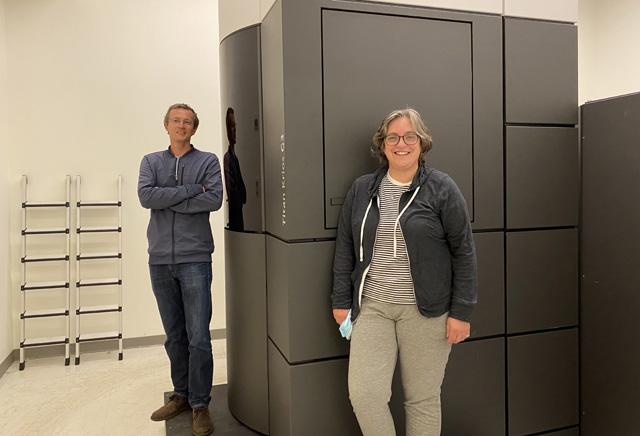
Credit: Matthew McCallum/Veesler Lab
A mix of ultrapotent antibodies from recovered COVID-19 patients has been shown to recognize and lock down the infection machinery of the pandemic coronavirus and keep it from entering cells. Each of the antibody types performs these overlapping tasks slightly differently.
Low doses of these antibodies, individually or as a cocktail, were also shown to protect hamsters from infection when exposed to the coronavirus by preventing it from replicating in their lungs.
An advantage of such cocktails is that they might also prevent the natural mutant forms of the virus that arose during this pandemic to escape treatment. As some variants in the infection machinery have already been discovered during the coronavirus pandemic, using a mix of antibodies allows for neutralization of a broad spectrum of such viral variants.
In addition to preventing virus entry into host cells, the presence of the antibodies also seems to set off the infection-fighting actions of other immune cells, which arrive to clear out the virus.
“We believe that leveraging multiple, distinct, complementary mechanisms of action could provide additional benefits for clinical applications,” the researchers noted.
The researchers determined how the antibodies worked on a molecular level through cryo-electron microscopy studies of the resulting changes in the configuration of the virus infection machinery. Besides directly preventing interactions with the host receptor, one of the two discovered antibodies locks the infection machinery in an inactive conformation, meaning it could not fuse with the host membrane on the surface of the cell. If unable to fuse, the coronavirus cannot break in and deliver its RNA to commandeer the cell.
The findings of this research are reported Sept. 24 in a rapid release paper in Science. Here is the paper.
The senior authors were Dr. Katja Fink of Vir Biotechnology and Dr. David Veesler, associate professor of biochemistry at the University of Washington School of Medicine. Veesler has studied the molecular structure and infection mechanisms of a variety of coronaviruses and other viruses.
The lead authors were M. Alejandra Tortorici of the UW Department of Biochemistry and the Institut Pasteur in Paris, and Martina Beltramello of Humab BioMed, a subsidiary of Vir Biotechnology in Switzerland. Researchers from Washington University in St Louis, Rega Institute in Belgium, the University of Milan, Italy, and the University of Texas in Dallas also collaborated on the research.
Efficient therapeutic options are needed to control the spread of SARS-CoV-2 that has caused more than 978,000 fatalities worldwide. While the world awaits approved vaccines, pharmaceuticals to prevent or treat infections from the pandemic coronavirus are being sought that might be quicker to develop and test. These might both address the gap until vaccines are widely distributed, and still be needed for use after vaccines are available.
“Our results pave the way to implement antibody cocktails for prophylaxis or therapy that might have the advantage of circumventing or limiting the emergence of viral escape mutants,” the researchers noted. The antibody cocktail in their study needs to undergo trials in humans to determine safety and effectiveness.
###
This study was supported by the National Institute of General Medical Sciences, the National Institute of Allergy and Infectious Diseases, a Pew Biomedical Scholars Award, an Investigators in the Pathogenesis of Infectious Disease Award from the Burroughs Wellcome Fund, Fast Grants, the University of Washington Arnold and Mabel Beckman cryoEM center, the Pasteur Institute, the KU Leuven/UZ Leuven COVID-19 Fund, the Flanders Fonds voor Wetenschappelijk Onderzoek, and the Bill and Melinda Gates Foundation.
Media Contact
Leila Gray
[email protected]
Related Journal Article
http://dx.