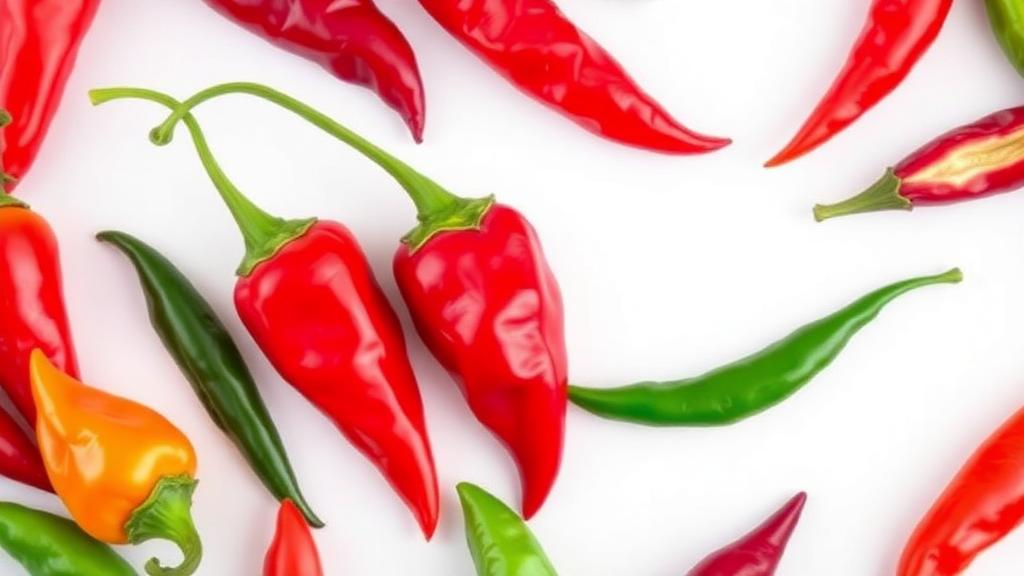
Chili peppers are one of the world’s most consumed spices, and their appeal rests on two chemical pillars: the burn of capsaicinoids and the bouquet of volatile organic compounds that give each variety its distinctive smell. A new study published in Food Chemistry: X has now tracked both pillars simultaneously across fruit development, revealing that the chemistry of pungency and the chemistry of aroma rise and fall together as peppers ripen. Working with eight cultivars of Capsicum annuum grown under identical conditions in Shandong Province, China, a research team led by Qianqian Jia and Dingding Su mapped volatile flavor compounds and capsaicinoid levels at three ripening stages: green, breaker, and full maturation.
The analytical centerpiece of the study was gas chromatography coupled to ion mobility spectrometry, or GC-IMS, a technique that separates volatile molecules in a gas phase and then distinguishes them by the speed at which they drift through an electric field. The method is particularly well suited to small, low-boiling-point compounds in the C2 to C10 range, which include many of the molecules that dominate fresh pepper aroma. In total, the team identified 57 volatile organic compounds across the eight cultivars, distributed among five chemical classes: 20 alcohols, 23 esters, 3 aldehydes, 6 ketones, and 5 miscellaneous volatiles. Esters emerged as the largest and arguably most important class, consistent with earlier work showing that these compounds impart the fruity notes prized in many pepper varieties.
Crucially, the researchers did not simply count molecules; they weighted each one by its sensory impact. Using the Relative Odor Average Value, or ROAV, method, they calculated how strongly each compound contributes to the overall aroma by combining its concentration with its odor threshold, the tiny concentration at which the human nose can detect it. Compounds with an ROAV of 1 or higher are considered key aroma contributors. Five compounds cleared that bar in every sample: 3-methylbutanal, which smells sweet and nutty; 2-methyl-1-butanol; and three ester species, including butanoic acid ethyl ester, the ethyl ester of butyric acid that carries a distinct fruity character.
The dynamics of these compounds during ripening tell a striking story. In most cultivars, the total relative content of volatiles actually declined as the fruit matured, reaching its lowest point at the maturation stage. Yet the aroma contribution of specific esters soared. In one cultivar, the ROAV of butanoic acid ethyl ester climbed from 6.80 at the green stage to 41.74 at maturity; in another, it rose from 7.27 to 47.50. In other words, even as the sheer quantity of volatiles fell, the molecules that remained became disproportionately important to what the nose perceives, because low-threshold esters were enriched relative to less potent compounds. Aldehydes, which lend green fruit its fresh, grassy character, declined in most varieties as ripening progressed, consistent with the biochemical conversion of aldehydes into esters through lipid metabolism pathways.
To untangle the cultivar differences, the team applied orthogonal partial least squares discriminant analysis, a supervised multivariate method that separates samples along axes that best explain group differences. The model performed well, explaining 45.8 percent of variance in the first two components, with a predictive Q-squared value of 0.699, and a 200-fold permutation test confirmed it was not overfitted. The analysis sorted the eight cultivars into four groups based on their volatile fingerprints, and 28 compounds with variable importance in projection scores above 1 were flagged as the main chemical signatures distinguishing one variety from another. Among these were (Z)-3-hexen-1-ol, (E,E)-alpha-farnesene, several pentanones and pentanols, and methyl 3-(methylthio)propanoate, a sulfur-containing ester.
On the pungency side, capsaicin and dihydrocapsaicin were quantified using ultra-high-performance liquid chromatography coupled to tandem mass spectrometry, following the Chinese national standard method for scoville-related analysis. The results revealed dramatic genotypic variation. At the green stage, capsaicin content ranged from 785.7 micrograms per gram in the lowest cultivar to 2587.6 micrograms per gram in the highest. By full maturity, the spread widened further: one cultivar reached a total capsaicinoid content of 3065.2 micrograms per gram, while another fell to just 462.3 micrograms per gram. Not all varieties followed the same trajectory either. Some accumulated capsaicin steadily through the breaker stage, while others showed a dip, possibly reflecting reduced biosynthesis or increased degradation as the fruit transitioned in color.
The study’s most consequential finding came when the two datasets were brought together. Pearson correlation analysis, with p-values corrected for multiple comparisons using the false discovery rate method, showed that both capsaicin and dihydrocapsaicin were significantly and positively correlated with ester compounds, with correlation coefficients of 0.518 and 0.579 respectively. Individual esters driving the association included 3-methylbutyl 2-methylbutanoate, 3-methylbutyl pentanoate, hexyl 2-methylpropanoate, and isoamyl butyrate. Certain alcohols, including 1-penten-3-ol and 2-methyl-1-butanol, also tracked with capsaicinoid levels. In plain terms, the peppers that got hotter as they ripened also tended to develop stronger fruity, ester-driven aromas.
Why should pungency and aroma be chemically entangled? The authors point to a plausible metabolic explanation rooted in shared biochemistry. Capsaicinoids are assembled from two building blocks: vanillylamine, derived from the phenylpropanoid pathway, and a branched-chain fatty acyl chain supplied by fatty acid metabolism. Volatile esters and aldehydes, meanwhile, are largely generated when fatty acids are oxidized and degraded through the lipoxygenase pathway, yielding alcohols and acyl-CoA substrates that are then esterified. When fruit ripening activates fatty acid metabolism, it simultaneously feeds both branches of the network, providing precursors for aroma volatiles and for the fatty acid side chains of capsaicinoids. The researchers are careful to stress that correlation alone cannot prove shared regulation; the hypothesis will need confirmation through transcriptomics, enzyme assays, or metabolic flux experiments before causal links can be established.
The practical implications are twofold. For breeders, the identification of 28 cultivar-discriminating volatiles and the capsaicinoid-ester correlation offers a chemical roadmap for selecting varieties that balance heat with desirable fruity notes, rather than optimizing pungency in isolation. For growers and food processors, the finding that ester aroma contributions peak at full maturity, even as total volatile content declines, suggests that harvest timing can be tuned to favor either fresh, grassy green notes or the sweeter, fruitier profile of ripe fruit. The authors caution that their conclusions rest on one growing season and one location, and that environmental factors such as temperature and light, which are known to modulate capsaicinoid accumulation, will need to be varied in future trials. Still, the study delivers a rare, integrated picture of how two of the chili pepper’s most celebrated chemical traits unfold together as the fruit ripens, turning a everyday kitchen observation, that red peppers smell and taste different from green ones, into a quantifiable map of co-varying metabolites.
Subject of Research: Dynamic changes in volatile flavor compounds and capsaicinoids during chili pepper fruit ripening
Article Title: Dynamic changes in volatile flavor compounds and capsaicinoids and their interrelationships in eight chili pepper cultivars across three ripening stages
Article References: Jia, Q., Bi, W., Yang, T., zhang, R., Han, J., Sha, H., wang, Y., Han, D., Zhu, Z., & Su, D. (2026). Dynamic changes in volatile flavor compounds and capsaicinoids and their interrelationships in eight chili pepper cultivars across three ripening stages. Food Chemistry: X, Article 104568. https://doi.org/10.1016/j.fochx.2026.104568
Image Credits: AI Generated
DOI: Not provided
Keywords: chili pepper, capsaicinoids, volatile organic compounds, GC-IMS, fruit ripening, ester aroma compounds, flavor chemistry, Capsicum annuum, ROAV analysis, fatty acid metabolism, food chemistry, pepper breeding
News Source: Bethany Barker. (October 5, 2026). Why Ripe Chili Peppers Smell Fruitier: Ripening Links Heat and Aroma. Scienmag.