• HOME
  • NEWS
  • EXPLORE
    • CAREER
      • Companies
      • Jobs
    • EVENTS
    • iGEM
      • News
      • Team
    • PHOTOS
    • VIDEO
    • WIKI
  • BLOG
  • COMMUNITY
    • FACEBOOK
    • INSTAGRAM
    • TWITTER
Tuesday, June 30, 2026
BIOENGINEER.ORG
No Result
View All Result
  • Login
  • HOME
  • NEWS
  • EXPLORE
    • CAREER
      • Companies
      • Jobs
        • Lecturer
        • PhD Studentship
        • Postdoc
        • Research Assistant
    • EVENTS
    • iGEM
      • News
      • Team
    • PHOTOS
    • VIDEO
    • WIKI
  • BLOG
  • COMMUNITY
    • FACEBOOK
    • INSTAGRAM
    • TWITTER
  • HOME
  • NEWS
  • EXPLORE
    • CAREER
      • Companies
      • Jobs
        • Lecturer
        • PhD Studentship
        • Postdoc
        • Research Assistant
    • EVENTS
    • iGEM
      • News
      • Team
    • PHOTOS
    • VIDEO
    • WIKI
  • BLOG
  • COMMUNITY
    • FACEBOOK
    • INSTAGRAM
    • TWITTER
No Result
View All Result
Bioengineer.org
No Result
View All Result
Home NEWS Science News Chemistry

Two chiral catalysts working hand in hand

Bioengineer by Bioengineer
December 3, 2019
in Chemistry
Reading Time: 3 mins read
0
IMAGE
Share on FacebookShare on TwitterShare on LinkedinShare on RedditShare on Telegram

Chemists develop a synthetic method providing access to different stereoisomers of a molecule: Study published in ‘Nature Catalysis’
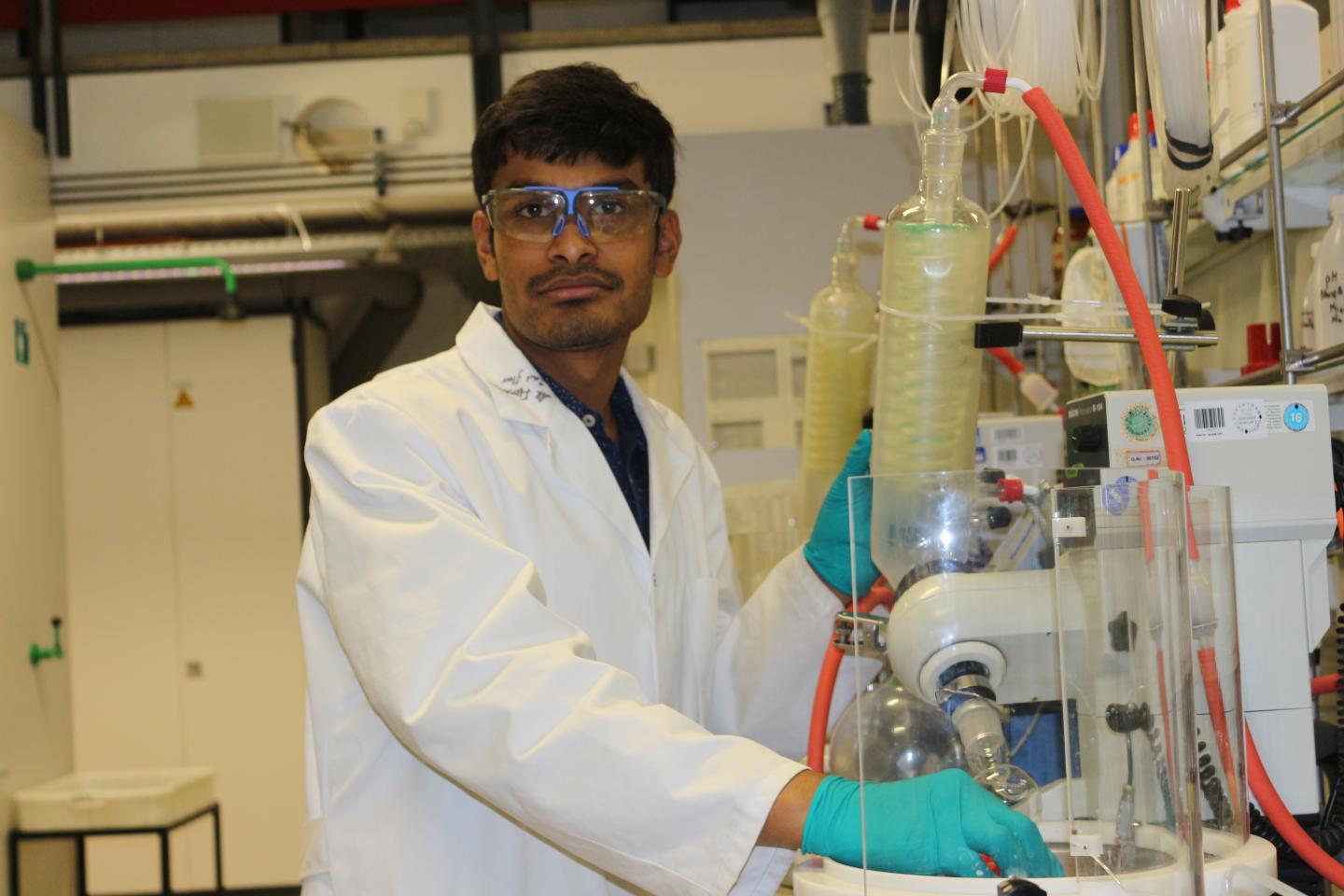
IMAGE

Credit: Barsu Nagaraju/MPI KoFo

Just as our left hand is not superposable to our right hand, the mirror image of certain molecules cannot be overlapped onto it, even when turned or twisted. These two mirror images are referred to by chemists as enantiomers and the molecule is said to be chiral. Chirality, which is a word derived from the ancient Greek word for hand, is important since it is present in our daily lives. For example, the stereoisomers of a molecule – i.e. compounds in which the binding pattern is the same but which differ in the spatial arrangement of the atoms – can produce different effects when interacting with a biological system.

The stereoisomers of a drug, for example, can have different or even opposite effects on the body making it crucial to produce certain stereoisomers of a pharmaceutical compound. A central task for chemists is to develop methods that are switchable and can selectively produce one or another stereoisomer, from simple and identical starting materials using tunable reaction conditions. A team of researchers led by Prof. Frank Glorius from the University of Münster (Germany) has developed a new synthetic method for the targeted synthesis of all four stereoisomers of so-called α,β-disubstituted γ-butyrolactones.

γ-Butyrolactones are widespread motifs in natural products that display a wide range of biological activities. One important example is pilocarpine, a drug used to treat glaucoma. The newly developed synthetic method is based on the combination of two chiral catalysts–an organocatalyst and a metal catalyst–which each independently activate one of the two reaction partners.

“I very much like the picture of these two catalysts working hand in hand together,” Frank Glorius states. The catalysts are not consumed or changed during the course of the reaction, and work in sync to efficiently produce the final product, which contains two stereocenters. As each stereocenter can have two potential orientations – up or down – four possible products could be generated in this case.

The chemists use the different combinations of the two chiral catalysts to control the formation of only one of the four possible products, but are able to access any of the products. This is a quite rare feature that only few chemical processes exhibit. “Our method streamlines the synthesis of chiral α,β-disubstituted γ-butyrolactones into a single step, starting from simple precursors and using two chiral catalysts. It is a system that basically lets you chose which stereoisomer you want to make,” says Dr. Santanu Singha, one of the lead authors.

“It is amazing, the enantioselectivity is perfect, better than 99 percent, in nearly all of the cases,” continues Dr. Eloisa Serrano, another lead author. Since the γ-butyrolactone products are in the core of multiple natural products with interesting biological activities, the authors expect their method to be of high relevance in drug discovery. The results of the researchers’ work have been published in the latest issue of the journal “Nature Catalysis“.

###

Original publication:
S. Singha & E. Serrano et al. (2019): Diastereodivergent synthesis of enantioenriched α,β-disubstituted γ-butyrolactones via cooperative N-heterocyclic carbene and Ir catalysis. Nature Catalysis; DOI: 10.1038/ s41929-019-0387-3

Media Contact
Prof. Frank Glorius
[email protected]
49-251-833-3248

Original Source

https://www.uni-muenster.de/news/view.php?cmdid=10682

Related Journal Article

http://dx.doi.org/10.1038/s41929-019-0387-3

Tags: Chemistry/Physics/Materials SciencesIndustrial Engineering/Chemistry
Share12Tweet8Share2ShareShareShare2

Related Posts

Biochar-Based Materials Offer Promising Solution for Sustainable Uranium Recovery in Nuclear Energy — Chemistry

Biochar-Based Materials Offer Promising Solution for Sustainable Uranium Recovery in Nuclear Energy

June 30, 2026
From Cells to Boundaries: Unveiling the Origins of Biological Order — Chemistry

From Cells to Boundaries: Unveiling the Origins of Biological Order

June 30, 2026

AI and Physics Collaborate to Design Advanced Hydrogen Storage Materials

June 25, 2026

International Team Including Dresden Scientists Develops Novel Designer Proteins for Advanced Study of Living Tissue

June 25, 2026
Please login to join discussion

POPULAR NEWS

  • Saying Goodbye to PGY-6: Pediatric Fellowship Realities

    103 shares
    Share 41 Tweet 26
  • Detection of EDCs in Breast Milk and Infant Urine Up to Six Months Highlights Early Exposure Risks

    77 shares
    Share 31 Tweet 19
  • New Drug Candidate Developed at McMaster Shows Potential for Treating Brain Cancer

    58 shares
    Share 23 Tweet 15
  • KTU Researchers Explore Ultrasound’s Role in Enhancing Blood Flow Beyond Diagnostics

    53 shares
    Share 21 Tweet 13

About

We bring you the latest biotechnology news from best research centers and universities around the world. Check our website.

Follow us

Recent News

New Study Reveals Why Your Dominant Hand Excels at Everyday Tasks

UMaine Researchers Discover Woodcocks Charge Deer to Protect Their Nests

Indiana University Biologists Discover Molecular Mechanism Driving Spread of Antibiotic Resistance Genes in Bacteria

Subscribe to Blog via Email

Enter your email address to subscribe to this blog and receive notifications of new posts by email.

Join 82 other subscribers
  • Contact Us

Bioengineer.org © Copyright 2023 All Rights Reserved.

Welcome Back!

Login to your account below

Forgotten Password?

Retrieve your password

Please enter your username or email address to reset your password.

Log In
No Result
View All Result
  • Homepages
    • Home Page 1
    • Home Page 2
  • News
  • National
  • Business
  • Health
  • Lifestyle
  • Science

Bioengineer.org © Copyright 2023 All Rights Reserved.