Laser pulses enable faster creation of skyrmions in magnets
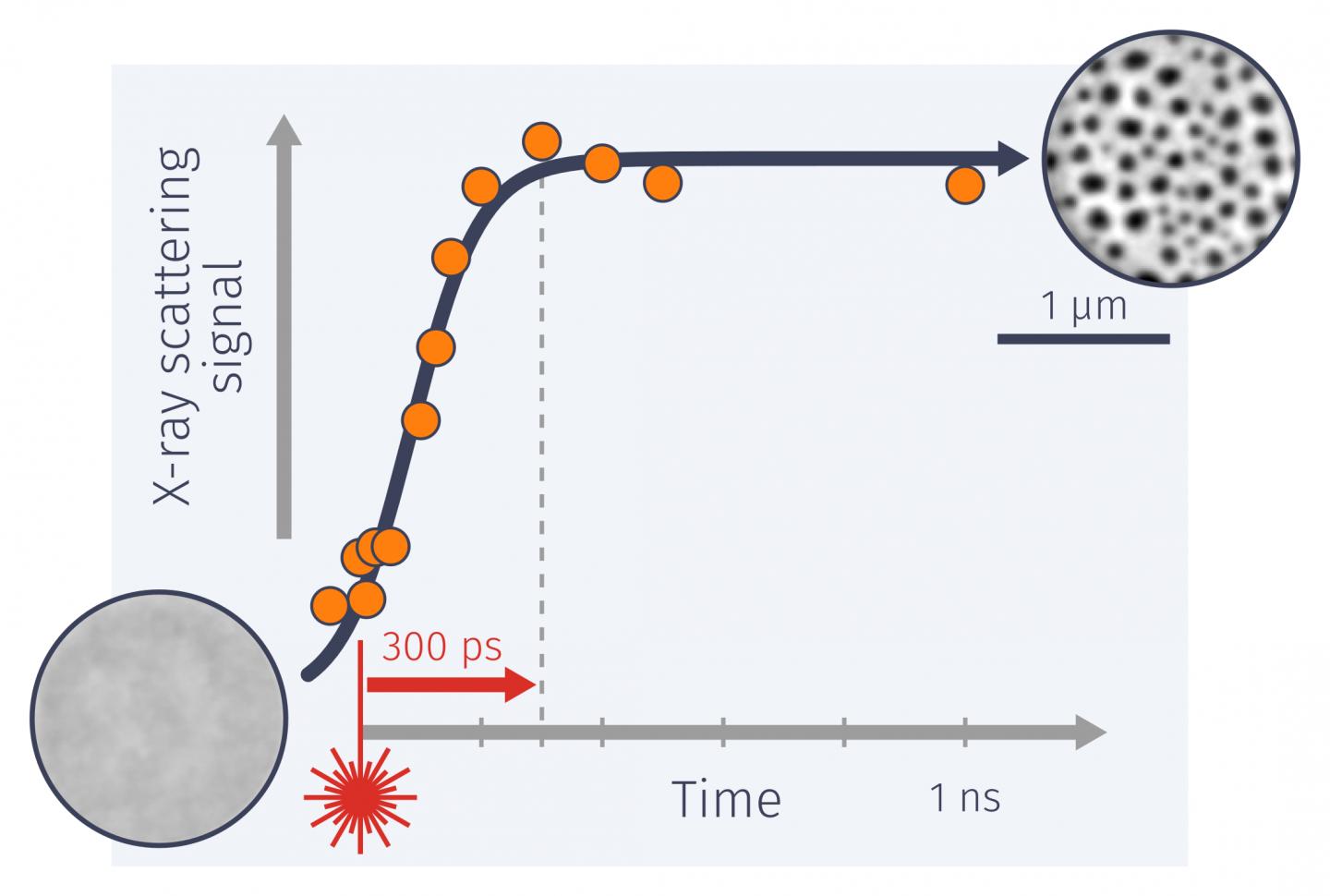
Credit: MBI
A team of scientists led by the Max Born Institute (MBI), Berlin, Germany, and the Massachusetts Institute of Technology (MIT), Cambridge, USA, has demonstrated how tiny magnetization patterns known as skyrmions can be written into a ferromagnetic material faster than previously thought possible. The researchers have clarified how the topology of the magnetic system changes in this process. As reported in the journal Nature Materials, the findings are relevant for topological phase transitions in general, and may inspire new routes how to use magnetic skyrmions in information technology.
Magnetic skyrmions are tiny swirls in the magnetization of thin magnetic films, where the direction of magnetization points in different directions as shown schematically in the first Figure. It turns out that the particular magnetization pattern can be characterized according to its so-called topology – a mathematical concept to describe the shape or geometry of a body, a set or – as in this case – a physical field (see infobox on topology). Importantly, the topology of skyrmions is different from the simple uniform state where the magnetization points in the same direction everywhere. To change between the two spin patterns, also the topology of the system must be changed. This contributes substantially to the stability of the skyrmions but also makes their fast creation very difficult.
In their work, which employs imaging of nanometer-sized skyrmions with x-rays and electrons, the researchers were first able to show that a single laser pulse of sufficient intensity allows to create skyrmions with a particular topology – that is, the magnetization pattern swirls in a particular fashion only.
Next, they set out to understand how such a change of topology is mediated by the laser pulse by investigating how this transition from a uniform pattern to skyrmions proceeds in time. Towards that end, they performed x-ray scattering experiments at the x-ray free-electron laser European XFEL in Hamburg, Germany, where the deflection of the x-ray beam by the skyrmions is detected. Hitting the ferromagnetic thin film in its uniform state first with an optical laser pulse followed by an x-ray laser pulse, they could map out how size and spacing of the skyrmions evolve over time. The first surprising result was that the topological change was finished after 300 picoseconds, which is significantly faster than observed for skyrmions in any other ferromagnetic system before. Comparing the experimental data with theoretical simulations, the team could infer how the topological transition comes about. The laser pulse promotes the system in a high-temperature state where the magnetization breaks up in small independently fluctuating regions, rapidly changing their magnetization direction. In this topological fluctuation state, the energy barrier for the nucleation of skyrmions is very much reduced, and they appear and disappear continuously. As the system cools down after laser excitation, some of the small skyrmion nuclei freeze out and subsequently grow to form the larger skyrmions, which have been observed in the initial imaging experiments.
Given that skyrmions can have a size in the range of ten nanometers and yet be very stable at room temperature, these findings may have interesting implications for future concepts of magnetic data processing and storage. Already today, the formation of “ordinary” bits on a magnetic hard drive is limited by the ability to switch very small yet stable bits with a magnetic field. Local heating by a laser is announced to be the next technology step in providing higher storage density, and the topological switching of skyrmions via laser pulses may add a new twist to that.
###
Media Contact
Dr. Bastian Pfau
[email protected]
Original Source
https:/
Related Journal Article
http://dx.