For roughly 25 years, an ecological model called MORPH has been quietly shaping how conservationists predict the fate of birds and fish facing habitat loss, human disturbance, climate change, aquaculture and shellfishing. In a new paper in Individual-based Ecology, the model’s developer distils the lessons learnt since MORPH was first built to answer a single, deceptively simple question: will an environmental change at a protected site reduce the number of birds able to survive the non-breeding season in good enough condition to migrate and reproduce? The answer required a modelling approach built on processes expected to hold even under conditions the model had never seen, which is precisely why individual-based simulation became the tool of choice.
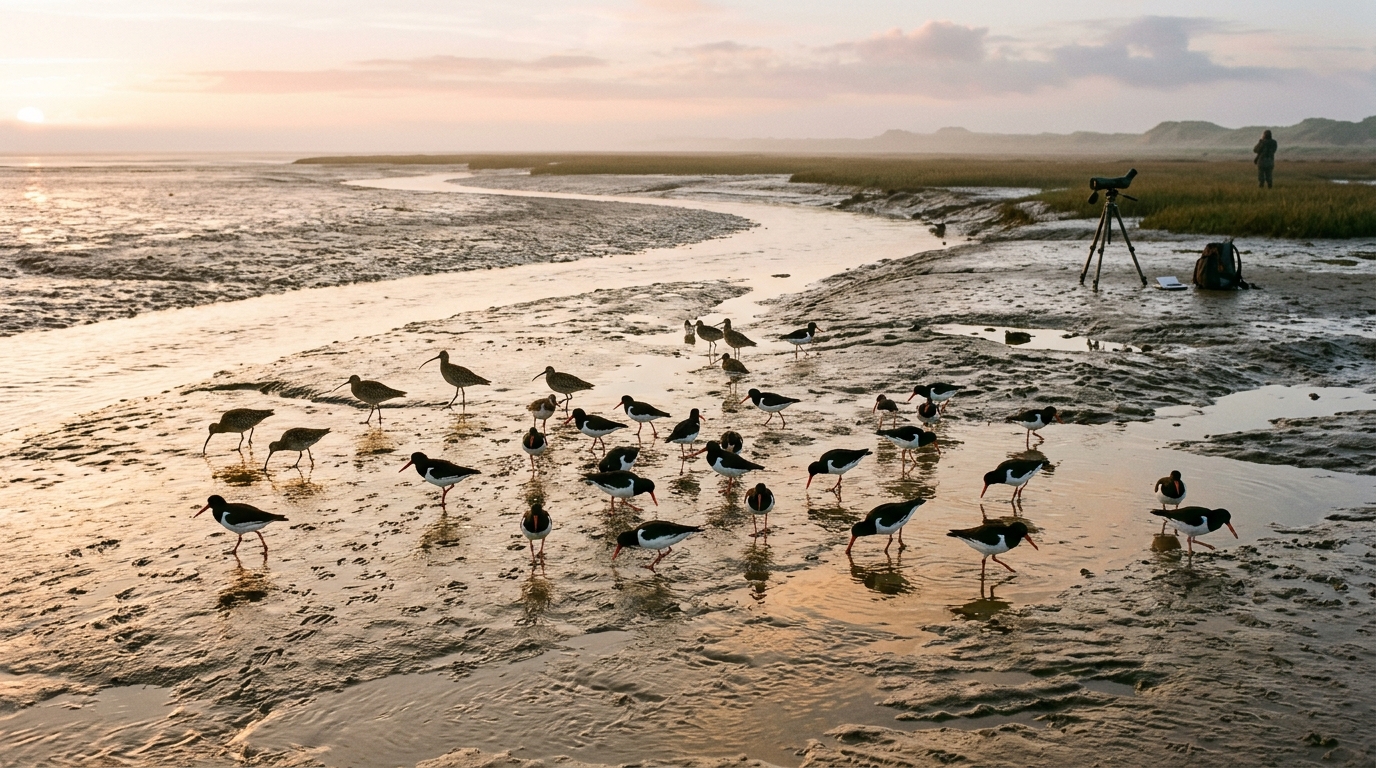
MORPH was originally developed for one bird species, the oystercatcher, feeding on mussels over the non-breeding season on the Exe Estuary in the United Kingdom. Yet its code has remained largely unchanged while the model has been applied to 30 bird species, including 18 shorebirds, 10 wildfowl, the glossy ibis and the greater flamingo, across 55 sites, and to three fish species: roach, Atlantic salmon and brown trout. The model’s overall purpose is to predict how the survival, condition and behaviour of animal populations are influenced by the food resources available and other environmental factors. That breadth of application, achieved without rewriting the core software, is the central story of the new review.
The model’s architecture is deliberately abstract. Time is divided into equal-length time steps, and space into one or more patches of varying area. Each patch contains food resources, which may represent different prey species, size classes or prey types, and each resource contains components such as energy or nutrients. Animals are represented as foragers of one or more forager types, for example different species or different kinds of individuals within a species. During every time step, each individual forager decides which patch to occupy and which diet, meaning a collection of resources, to consume, including the option of not feeding at all.
That decision is made by calculating a value the author calls the fitness measure for every possible combination of patch and diet, then moving to the patch and eating the diet that maximises this value, or choosing randomly among ties. Foragers assimilate a proportion of each component they consume, which tends to enlarge a component store in the body, while metabolism drains that store. If the store represents energy, foragers can be assumed to die of starvation when it falls to zero. Crucially, the code itself contains no details of what patches, resources, components and foragers actually represent; those details are read from a parameter file that converts the generic code into a specific system.
This abstraction is the first major lesson: think beyond the system being modelled. The model’s predecessor, built for oystercatchers on the Exe Estuary, hard-coded the tide as a continuous rise and fall in water level, with patches available when exposed. That worked on the Exe, the Burry Inlet and the Wash, but broke down at Poole Harbour, where atypical water levels produce two consecutive high tides followed by a low tide. In MORPH, the model has no concept of tides or water level built in at all; water level is treated simply as an environmental factor that may change whether a patch is available to foragers at any moment. Keeping system-specific detail out of the code and shifting it into parameter files has meant the code and structure of the parameter files have remained virtually unchanged since 2008.
A second lesson concerns individual variation. If all model animals are identical, such models tend to predict that either all survive or all die, because every individual is affected equally by conditions, and such extremes rarely occur in real systems. To predict realistic proportional survival between zero and one, MORPH allocates foragers variables that vary between individuals and affect their behaviour or physiology, most often foraging efficiency, the rate at which an individual consumes resources without competitors, and dominance, the ability to maintain consumption rates as competitor density rises. Foragers make fitness-maximising decisions, typically maximising the rate at which energy can be assimilated from each diet on each patch, and because individuals differ, their choices diverge under identical conditions. The author notes this approach makes the model more likely to predict accurately outside the range of conditions for which it was parameterised.
Parameterisation carries its own lessons. MORPH has typically been applied to a single site over a single non-breeding season rather than to multi-year, multi-site models with feedback between breeding and survival, which greatly reduces complexity while still informing the conservation of species protected site by site through mechanisms such as Special Protection Areas. General relationships from statistical models, such as those predicting energy requirements from body mass, simplified parameterisation of energy demand. Where no general relationships existed for how consumption rates depend on food abundance and competitor density, the author derived them through a statistical meta-analysis of shorebird body mass and prey mass, and through a fine-scale individual-based model of competitor effects. These approaches allowed MORPH to be parameterised for a wider range of shorebird species without collecting new behavioural data at each study site.
Another simplification was to minimise the number of parameters with unknown values, ideally to zero, because every unknown parameter may require calibration, and data used for calibration cannot then be used to test the model. Shorebird and wildfowl systems are relatively data-rich and readily observable, with birds feeding on stationary prey in open habitats, so parameter values were more likely to be available than in more complex or less easily observed systems. Sensitivity analyses of early and subsequent model versions revealed that predictions are most sensitive to parameters expressing the gross flow of energy from prey to birds: the rate at which prey can be consumed, the energy per gram of prey flesh, the proportion of that energy the birds can assimilate, and the birds’ rate of energy expenditure. Later models therefore represent foraging behaviour with fewer parameters while emphasising accurate estimation of these energy-flow values.
Testing has been extensive but constrained. The key conservation output, the proportion of birds predicted to survive the non-breeding season, requires individually marked birds and multi-year resighting data, so field survival data exist for only a few sites, including oystercatchers on the Exe Estuary and the Wash and redshank in Cardiff Bay. Instead, predictions underpinning mortality have been tested: the time birds need to spend feeding each day, the prey types consumed, the locations where they feed, and their body mass at season’s end. Rather than claiming a single accurate model version, the author compared alternative versions differing in processes or parameter values, determining which produced the most accurate predictions. Interfaces built with Microsoft Excel and R, alongside the earlier bespoke WaderMORPH software, have simplified running and interpreting the model, allowing conservation organisations to use it with some training.
Perhaps the most striking general insight comes from comparing predictions across sites. Simulations consistently predict that more shellfish food must be reserved for oystercatchers after shellfishing than the birds will actually consume, sometimes substantially more, because birds cannot find all the food, some food is lost to other causes, and some birds exclude others from the supply. The general rule that has emerged is that between two and eight times the amount actually consumed, depending on site characteristics, needs to be reserved, a figure that can be estimated without running a model at all when a new site cannot be modelled. The author also reflects candidly on what would change today: MORPH was coded in Pascal within the Delphi environment, whereas modern platforms such as NetLogo would speed development, and a new version would likely include geographical information system integration, open-source code, version control through systems such as GitHub, and simplicity of use built in from the start. Early applications faced scepticism when individual-based models were rarer, but the long-term study of oystercatchers on the Exe Estuary and the time to iterate on ideas made the model possible, and its lessons now stand as guidance for the individual-based models of the future.
Subject of Research: Lessons from 25 years of developing and applying the individual-based ecological model MORPH
Article Title: MORPH – Lessons learnt from the development and application of an individual-based model
Article References: Stillman, R. A. (2026). MORPH – Lessons learnt from the development and application of an individual-based model. Individual-based Ecology, 2, Article e210756. https://doi.org/10.3897/ibe.2.210756
Image Credits: AI Generated
DOI: 10.3897/ibe.2.210756
Keywords: individual-based model, MORPH, ecological modelling, shorebirds, wildfowl, oystercatcher, habitat loss, climate change, shellfishing, model calibration, sensitivity analysis, conservation management
News Source: Gavin Prescott. (November 5, 2026). Twenty-five years of MORPH: how one flexible bird model reshaped ecology forecasting. Scienmag.