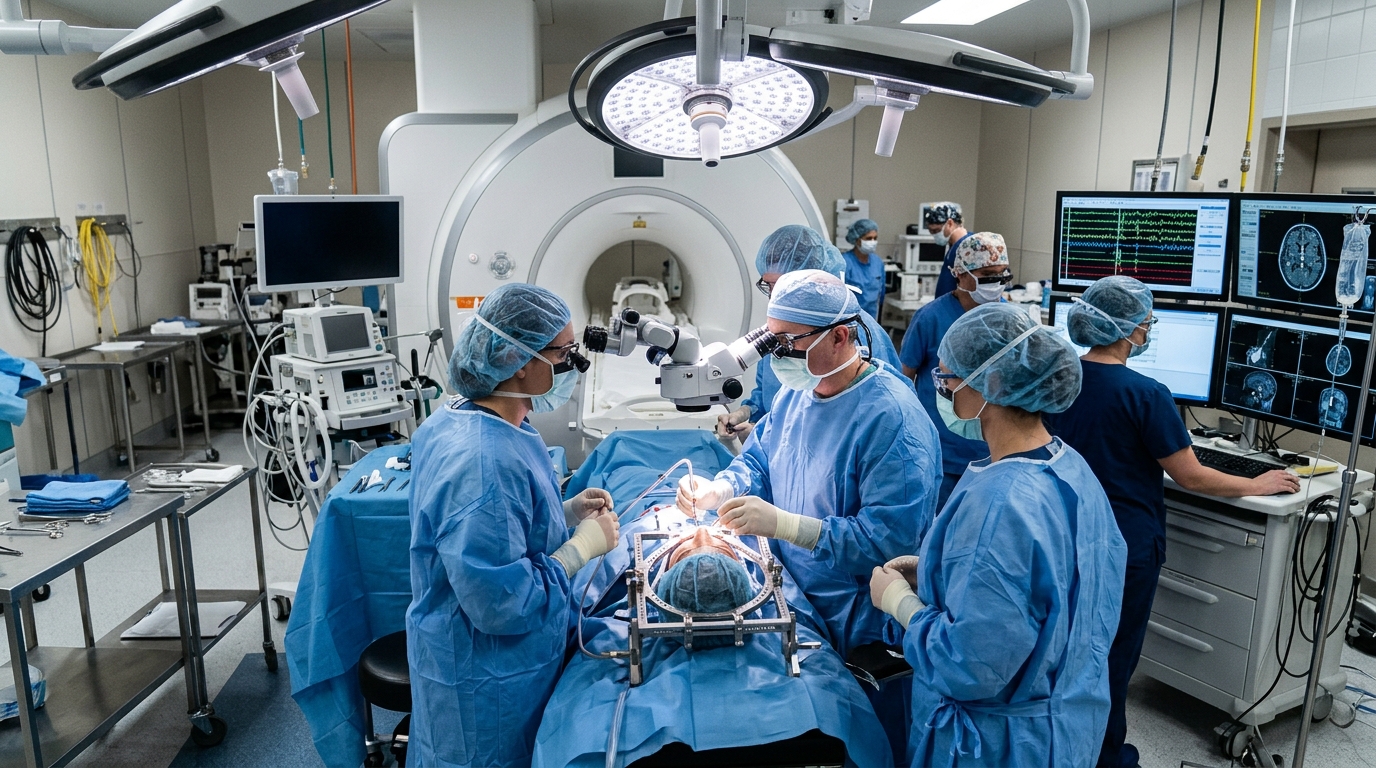
Surgeons who combined neuronavigation with intraoperative MRI and continuous neuromonitoring removed more of a rare and stubborn brain tumor than navigation alone, and their patients lived longer, according to a retrospective study of IDH-mutant low-grade gliomas that invade the corpus callosum. In the study, published in Chinese Neurosurgical Journal, 64 patients treated with the full multimodal setup achieved a median extent of resection of 100 percent, compared with 93.55 percent in 34 patients operated with neuronavigation only. Median progression-free survival stretched to 78.5 months with multimodal surgery against 48.1 months with the conventional approach, and median overall survival reached 106.1 months versus 66.9 months.
Low-grade gliomas account for roughly a quarter of all gliomas, and the 2021 WHO classification places grade 1 and 2 gliomas in this category, with IDH mutation a typical molecular feature of grade 2 astrocytomas and oligodendrogliomas. Previous work has shown that corpus callosum-involving low-grade gliomas carry a poorer prognosis than those without callosum involvement, and most prior resection studies of callosum gliomas focused on glioblastoma rather than the IDH-mutant low-grade form.
Researchers at a single Chinese neurosurgical department reviewed electronic medical records from January 2014 to December 2022, with follow-up ending in May 2025. Among 796 patients with supratentorial low-grade glioma, 109 had IDH-mutant tumors invading the corpus callosum, or 13.7 percent. Forty-six of those were butterfly lesions involving both hemispheres and 63 were non-butterfly lesions confined to one hemisphere. After excluding seven patients who underwent biopsy only, one with an isolated callosal lesion, and three lost to follow-up, 98 resected patients remained: 64 in the multimodal group, including 24 butterfly and 40 non-butterfly cases, and 34 in the conventional group, with 16 butterfly and 18 non-butterfly cases.
The multimodal workflow layered three technologies on top of standard navigation. All surgeries used neuronavigation, with guidance displayed both on a monitor and inside the microscope view. For tumors near eloquent brain regions, the team performed awake craniotomy with intraoperative neuromonitoring, using direct electrical stimulation through a monopolar probe to map functional cortex and fiber tracts while a neurophysiologist continuously watched evoked potentials. Once the surgeon judged resection complete, the intraoperative MRI magnet was moved into the operating room for scanning. If residual tumor appeared on T2 or FLAIR images, the scans were loaded into planning software to update navigation, and the surgeon returned to remove what remained. In ten multimodal patients, residual tumor was detected on the first intraoperative scan and further resection followed, lifting the final median extent of resection in that subgroup from 90.34 percent to 100 percent.
Safety metrics did not worsen with the heavier technological load. Median surgery time was nearly identical between groups at 7.17 versus 7.21 hours, and median hospital stay was 19 versus 18 days, neither difference statistically significant. Muscle strength, aphasia quotient, Montreal Cognitive Assessment scores, and Karnofsky Performance Status showed no significant differences between groups at any assessed time point. Residual tumors, when they occurred, clustered in eloquent areas such as the basal ganglia, internal capsule, and thalamus in 67.4 percent of cases, with the corpus callosum and distal contralateral lobes as other common sites.
Survival curves separated the two groups. Within the multimodal cohort, patients with astrocytoma had shorter progression-free and overall survival than those with oligodendroglioma, while in the conventional group no significant survival difference emerged between the two histologies.
Anatomy mattered as much as technology. Butterfly gliomas, which cross the midline into both hemispheres, yielded similar resection extents, gross total resection rates, and postoperative Karnofsky scores under the multimodal approach compared with non-butterfly tumors, yet their survival was worse: median progression-free survival of 44.3 versus 86.7 months and overall survival of 97.1 versus 108.6 months. Five-year survival was 66.7 percent for butterfly lesions against 95.0 percent for non-butterfly ones.
Multivariate analysis identified eight factors independently associated with longer progression-free survival: non-butterfly anatomy, smaller tumor volume, genu rather than splenium invasion of the corpus callosum, smaller volume of callosum invasion, higher extent of resection, more cycles of temozolomide chemotherapy, higher Karnofsky score at three months, and MGMT promoter methylation. Four factors predicted longer overall survival: invasion limited to the genu compared with combined genu and body invasion, higher extent of resection, longer temozolomide treatment, and MGMT methylation. Tumors invading the splenium, the body, or multiple callosal segments are harder to remove because they sit near functional areas, midline structures, and important draining veins.
The findings translate into a treatment philosophy. All high-risk patients in the study, defined as those aged 60 or older, not gross total resected, with tumors larger than 6 centimeters in diameter, or with preoperative neurological deficits, were advised to receive radiotherapy and adjuvant temozolomide.
The study carries important caveats. Its retrospective design introduces selection, recall, and attrition bias, although the authors note that baseline characteristics were balanced between groups and that enough candidate prognostic factors were included to keep selection bias within a reasonable range. The comparison pitted multimodal surgery against only one contemporary alternative, neuronavigation alone, so the advantage over other resection-focused techniques remains uncertain. Detailed molecular profiling was limited because few cases had next-generation sequencing. The authors call for prospective randomized studies with large samples to definitively establish the specific value of intraoperative MRI and neuromonitoring in this population.
Subject of Research: Retrospective comparison of multimodal surgical techniques versus neuronavigation alone for resecting IDH-mutant low-grade gliomas involving the corpus callosum
Article Title: Multimodal techniques for maximal safe resection of IDH-mutant low-grade glioma involving corpus callosum, a retrospective study and prognosis analysis
Article References: Cui, M., Zhang, M., Zhou, C., Sun, G., & Zhang, J. (2026). Multimodal techniques for maximal safe resection of IDH-mutant low-grade glioma involving corpus callosum, a retrospective study and prognosis analysis. Chinese Neurosurgical Journal, 12(1), Article 13. https://doi.org/10.1186/s41016-026-00432-y
Image Credits: AI Generated
DOI: 10.1186/s41016-026-00432-y
Keywords: low-grade glioma, IDH mutation, corpus callosum, intraoperative MRI, neuromonitoring, extent of resection, butterfly glioma, temozolomide, MGMT methylation, progression-free survival, neurosurgery, retrospective study
News Source: Ophelia Keating. (November 5, 2026). Intraoperative MRI and neuromonitoring extend survival in corpus callosum low-grade glioma surgery. Scienmag.