UConn and UNC startup, Nami Therapeutics, develops nanotechnologies for targeted cancer therapy
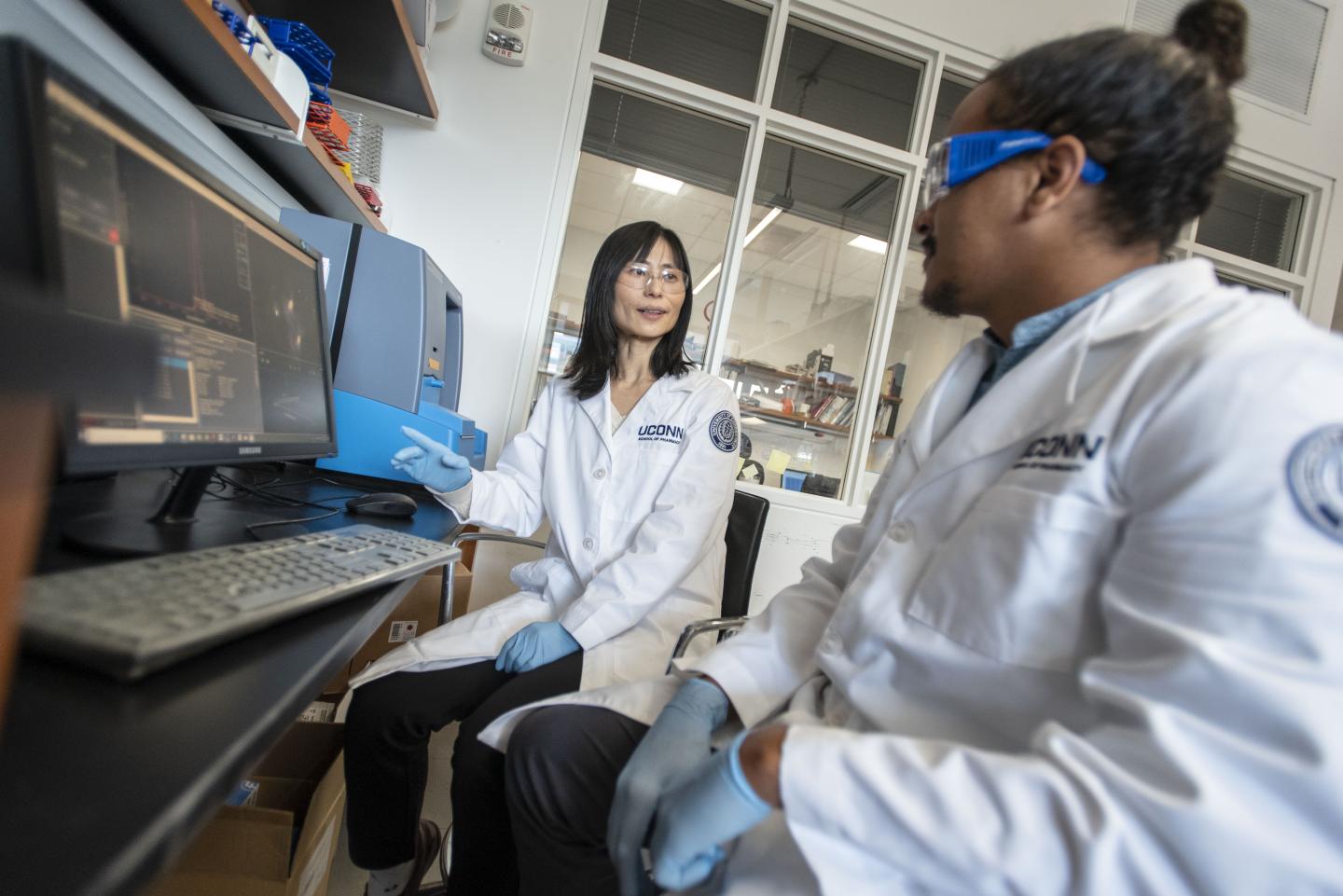
Credit: (Sean Flynn/UConn Photo)
Nami Therapeutics Corporation, which gets its name from the Mandarin word for “nano,” is committed to using nanotechnologies to make big advances in cancer therapy.
An early-stage startup led by researchers at the University of Connecticut and the University of North Carolina at Chapel Hill, Nami Therapeutics is developing specifically designed nanoparticles for targeted drug delivery.
“Our mission is to bring patients who have already exhausted many treatment options another chance to live a cancer-free life,” says Xiuling Lu, acting CEO of Nami and associate professor of pharmaceutics in UConn’s School of Pharmacy.
Incorporated in 2018, Nami Therapeutics is based on nanotechnologies developed by Lu and her collaborators at UConn, as well as a pioneering technology that Lu and co-founder Michael Jay invented nine years ago at the University of North Carolina at Chapel Hill.
The startup is now located at UConn’s Technology Incubation Program (TIP) where they are conducting R&D on their current product, a tumor-specific radioactive therapy designed to specifically target peritoneal metastasis of ovarian cancer. Animal studies have shown that the platform offers increased efficacy and reduced toxicity as compared to other treatment options.
Globally, 239,000 women are diagnosed with ovarian cancer each year. Five-year survival rates for advanced ovarian cancer are only 28%, leaving patients with inadequate and ineffective treatment options.
One of the biggest problems with current ovarian cancer therapies is that they can’t effectively target the tumor without also spreading throughout the rest of the body. Nami’s product – nanoparticles carrying the radioisotope Ho-166 – selectively targets cancer metastasis in the peritoneal cavity, while remaining only in the peritoneal space.
“That’s where we want the radioactivity to stay,” Lu says. “We don’t want it spreading throughout the body. It stays put in the region with the cancer cells.”
Another major advantage of Nami’s technology over existing treatments is the manufacturing process used to create the radioactive nanoparticles. Nami’s production process reduces the amount of time that technicians might need to handle the radioactive product.
“People know that making radioactive isotopes is hard. Nobody wants to handle that,” Lu says. “Ours is a safe, effective, and far more economical process because our manufacturing uses non-radioactive materials and then simply requires a one-step conversion to make it radioactive.”
The company has received entrepreneurial training and seed funding from UConn’s NSF I-Corps Site, Accelerate UConn, and the Connecticut Center for Entrepreneurship and Innovation. Lu credits these opportunities with helping her team better understand the business concepts they needed to get their company off the ground.
“These programs helped us shape our business plan, so we started to think like entrepreneurs and business people as well as scientists,” Lu says. “A lot of technologies are so fancy and look so nice, but you can’t move that technology as a product without understanding the business side of things.”
Through the startup, Lu and her collaborators recently won a grant from the NIH National Cancer Institute’s highly competitive Small Business Technology Transfer (STTR) program. In this funding round, only 13% of applicants received funding to commercialize promising technologies.
Nami Therapeutics is also working on a particle to deliver drugs to reduce the recurrence of leukemia by effectively targeting cancer stem cells with chemotherapy drugs. They are currently looking to continue their pre-clinical trial research with plans for full clinical trials in a few years.
“We’re still an early startup, but we have a big mission,” says Lu.
###
Media Contact
Jessica McBride
[email protected]
860-878-5058
Original Source
https:/