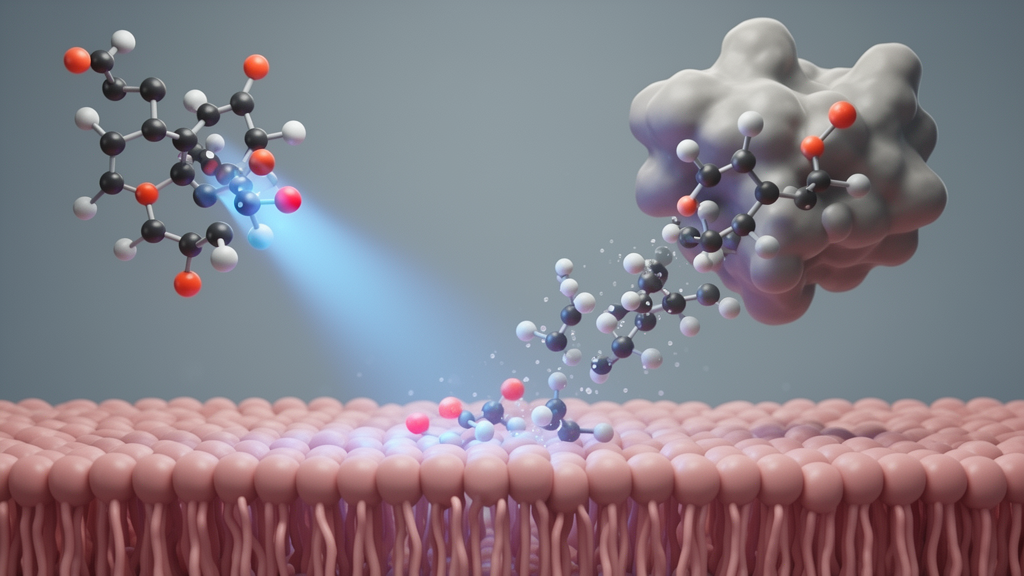
Researchers have developed a family of methylselenol (CH3SeH) donors that release the selenium-containing molecule only after a designated trigger is applied. The strategy combines a water-stable chemical scaffold with either ultraviolet light or the tumor-associated enzyme hNQO1, and preliminary tests showed intracellular delivery, protection from oxidative stress in HeLa cells and selective killing of hNQO1-high colorectal cancer cells. The results remain laboratory findings in cultured cells, not evidence of a clinical cancer treatment.
Selenium compounds have been investigated in clinical trials for several cancers, but their effects depend heavily on how the element is metabolized. The study distinguishes two major reactive pools: hydrogen selenide (H2Se), produced from compounds such as selenite, and CH3SeH, associated with methylseleninic acid, methylselenocysteine and other precursors. Although H2Se can exert antitumor effects, excessive amounts that exceed the threshold associated with selenoprotein biosynthesis can cause single-strand DNA cleavage, potentially narrowing the safety margin. CH3SeH is described as comparatively nongenotoxic and acts through several reported mechanisms, including regulation of NKG2D ligands, caspase-mediated apoptosis, modulation of oxidative stress and suppression of VEGF-mediated angiogenesis.
Natural methylselenocysteine can release CH3SeH through a pathway dependent on endogenous beta-lyase, while selenomethionine follows a different metabolic route and may not generate enough CH3SeH at low micromolar concentrations to produce antitumor effects. Existing donors based on methylselenocarbamates and methylselenoesters have also shown pharmacological activity, but their release can be difficult to control and may have low conversion efficiency. The central objective was therefore to build a donor that remains stable under physiological conditions yet converts rapidly to CH3SeH when a selected stimulus is present, allowing spatial and temporal control in living systems.
The first design attempt used classical quinone-methide self-immolative chemistry. An azide-bearing donor was reduced with tris-(2-carboxyethyl)phosphine in phosphate-buffered saline at pH 7.4 and 25 degrees Celsius. The initial reduction was rapid, with a bimolecular rate constant of 1.43 M-1s-1, but the intermediate then decomposed very slowly. Its self-immolative rate was 2.63 × 10⁻⁶ s-1, corresponding to a half-life of about 73 hours. This result showed why the chemistry required a different release mechanism for a drug designed to respond quickly to a biological or external signal.
To overcome that limitation, the researchers screened methylselenocarbamate structures for stability in water. Se-methyl N-phenylcarbamoselenoate decomposed rapidly in phosphate-buffered saline, with a half-life of 9.4 minutes, and produced aniline consistent with hydrolysis through an isocyanate intermediate. Adding a methyl group to the carbamate nitrogen produced Se-methyl N-phenyl-N-methylcarbamoselenoate, which was much more stable in buffer and in the presence of physiologically relevant thiols and amines. The modified scaffold therefore offered a more controllable foundation for constructing triggered donors.
The investigators then placed a Boc-protected amino group next to the stable methylselenocarbamate. At physiological pH, deprotonation of the amino group created a nucleophile that attacked the carbamate intramolecularly, causing rapid cyclization and release of CH3SeH. The resulting product, TD-MSe1, converted with an observed rate constant of 0.14 s-1 and a half-life of approximately 5 seconds at pH 7.4. Across the tested pH range, the reaction was faster at higher pH: its half-life fell from 2,654 seconds at pH 4.5 to 5 seconds at pH 7.4. Trapping experiments measured a CH3SeH release efficiency of up to 94.2 ± 2.7%.
Fluorescent detection with the selenol-responsive probe Sel-green supported intracellular delivery. HeLa cells pretreated with the probe showed little fluorescence on their own, whereas incubation with TD-MSe1 produced a concentration-dependent signal over 30 minutes. The unmodified methylselenocarbamate did not trigger the same response, indicating that activation of the caged amine was required. The findings demonstrated that the engineered platform could release CH3SeH inside living cells, although they did not establish behavior in animals or humans.
To make release dependent on an external signal, the researchers attached an o-nitrobenzyl group to the TD-MSe scaffold, creating the light-triggered donor TD-MSe2. The caged compound remained stable in phosphate-buffered saline at pH 7.4, including in the presence of physiologically relevant concentrations of thiols. Irradiation with 365-nanometre light induced decomposition, generating CH3SeH and the expected cyclization byproduct. High-performance liquid chromatography and mass spectrometry detected the predicted products, while a trapping reagent independently captured the released selenol. In alternating light-and-dark experiments, photolysis stopped when the light was switched off and resumed when it was switched on; product formation exceeded 80% after irradiation.
TD-MSe2 also showed a measurable biological effect in cultured HeLa cells. The donor alone, whether irradiated for 120 seconds or not, produced negligible cytotoxicity under the reported conditions. By contrast, exposing cells to 400 micromolar hydrogen peroxide for two hours reduced viability to approximately 22%. Pretreatment with 30 or 100 micromolar TD-MSe2 followed by 120 seconds of irradiation raised viability to approximately 42% and 67%, respectively, while the same donor without irradiation did not provide protection. Longer photoactivation produced greater protection, and a reactive-oxygen-sensitive probe showed lower intracellular fluorescence in irradiated donor-treated cells. The authors propose that released CH3SeH, including the diselenide dimethyldiselenide that can be reduced back to CH3SeH in glutathione-rich cells, may support a catalytic cycle for removing reactive oxygen species.
The platform was also adapted for biological activation. The researchers attached a trimethyl-locked quinone trigger that can be removed by hNQO1, an oxidoreductase reported to be overexpressed in some metastatic cells, producing TD-MSe3. The compound remained stable in phosphate-buffered saline for more than 70 hours but reacted rapidly when hNQO1 and NADH were present, with release of the trigger intermediate exceeding 90%. Dicoumarol, an hNQO1 inhibitor, reduced the reaction in a concentration-dependent manner. In cell imaging, hNQO1-high HT-29 colorectal adenocarcinoma cells produced a strong Sel-green response after treatment with TD-MSe3, while low-hNQO1 HeLa cells showed negligible fluorescence. Pretreatment with dicoumarol reduced the signal in HT-29 cells, supporting dependence on endogenous enzyme activity.
In the anticancer tests, TD-MSe3 reduced HT-29 cell viability after 72 hours with a reported half-maximal inhibitory concentration of 23.4 micromolar, whereas the non-triggered control compound did not show appreciable cytotoxicity up to 150 micromolar. The donor had much higher half-maximal inhibitory concentrations above 200 micromolar in hNQO1-low HeLa and HUVEC cells, indicating selectivity in this in vitro comparison. A separate colony-formation assay found that 2 micromolar TD-MSe3 reduced HT-29 colony formation by more than 35% relative to untreated cells, and 10 micromolar nearly abolished colony formation. These experiments demonstrate preferential activity in an hNQO1-high cell model, but the study did not test tumors, animals, dosing, long-term safety or therapeutic benefit in patients.
Subject of Research: Stimulus-responsive methylselenol donor chemistry for controlled intracellular selenium delivery
Article Title: Harnessing Methylselenol (CH3SeH): A Highly Effective Platform for Stimuli‐Responsive Delivery With Therapeutic Potential
Article References: Liang, W., Wang, L., Wang, X., Li, X., Xing, H., Sun, L., Xi, Z., & Yi, L. (2026). Harnessing Methylselenol (CH 3 SeH): A Highly Effective Platform for Stimuli‐Responsive Delivery With Therapeutic Potential. Advanced Science, Article e78356. https://doi.org/10.1002/advs.78356
Image Credits: AI Generated
DOI: 10.1002/advs.78356
Keywords: methylselenol, drug delivery, cancer research, hNQO1, photocaging, reactive oxygen species, selenium chemistry, HT-29 cells, intracellular delivery, Harnessing, CH3SeH, Highly
News Source: Denise Maddox. (October 20, 2026). Triggered Methylselenol Donors Enable Light- and Enzyme-Controlled Delivery. Scienmag.