A laboratory study of 56 adults found that a software-defined radio frequency sensing system could distinguish normal breathing, fast breathing and a simulated rapid, shallow, irregular pattern using denoised wireless channel state information. Across five-fold cross-validation, the deep neural network achieved a mean accuracy of 92.96 ± 1.18%, while the recurrent neural network achieved 92.92 ± 0.77%. The difference between the models was not statistically significant in a paired two-sided t-test, which gave t(4) = 0.12 and p = 0.912.
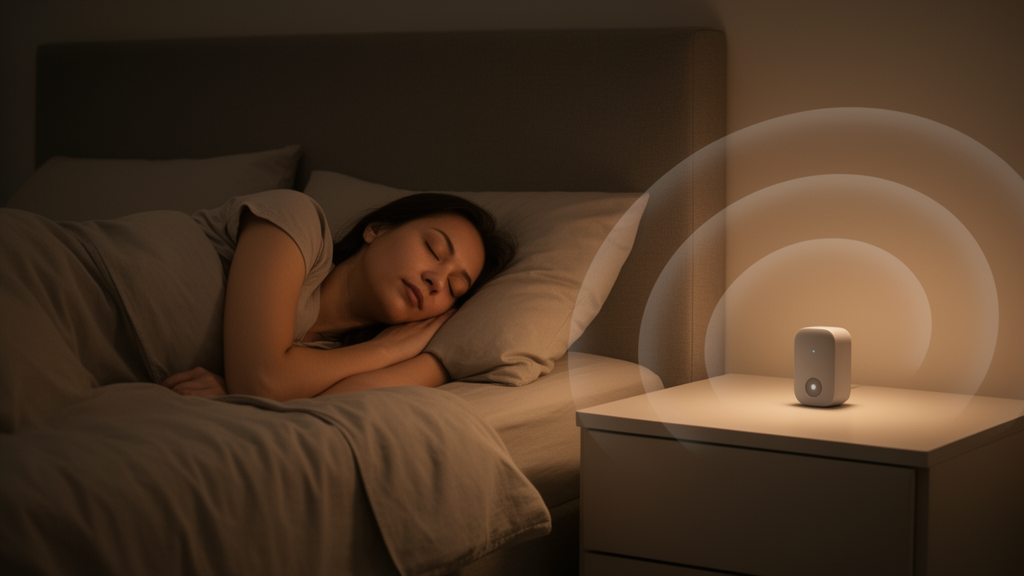
The experiment used two universal software-defined radio peripherals with directional antennas and two LabVIEW-controlled computing units, one serving as the transmitter and the other as the receiver. Participants remained stationary in the line-of-sight region between the antennas while chest and thoracic movement altered the wireless propagation channel. The configuration used 146 active orthogonal frequency division multiplexing subcarriers to acquire wireless channel state information, or WCSI.
Researchers collected 200 continuous 30-second recordings from participants aged 25 to 40 years, with a mean age of 29 years. The cohort included 30 men and 26 women; five participants reported being smokers and two reported having asthma. The three instructed patterns were normal breathing at approximately 14 breaths per minute, regular fast breathing at approximately 24 breaths per minute, and simulated rapid, shallow, intentionally irregular breathing at approximately 30 breaths per minute. The recordings comprised 67 normal-breathing, 66 fast-breathing and 67 simulated irregular-breathing cases.
The rapid, shallow, irregular condition was experimentally simulated and did not represent clinically confirmed dyspnoea. Recordings from the 200 experiments were converted into 35,037 labelled model instances: 11,661 normal-breathing instances, 11,654 fast-breathing instances and 11,722 simulated rapid, shallow, irregular instances. That is an average of approximately 175 usable instances per 30-second recording. Participants contributed approximately three to four recordings each.
Before classification, the researchers applied wavelet-based denoising, removed DC bias, excluded low-variance subcarriers and normalised the signals. Correlation matrices of the cleaned data had smoother patterns and more consistent relationships among subcarriers than the raw matrices, whose scattered correlations were attributed to environmental noise, DC drift, frequency-selective multipath fading and channel nulls. Power spectral density analysis also showed more concentrated respiratory spectral peaks after preprocessing, compared with the broad spectral spreading observed in the raw WCSI.
Feature extraction produced 28 candidates, comprising 14 time-domain and 14 frequency-domain measures. Root amplitude and minimum value received zero feature scores and were removed, leaving a 26-dimensional input vector. The DNN had five fully connected hidden layers provisionally configured with 256, 128, 64, 32 and 16 neurons, with ReLU activation, batch normalisation and dropout of 0.30. The conventional Elman RNN had three recurrent hidden layers of 256, 128 and 64 units, followed by a 32-neuron fully connected layer; its recurrent layers used Tanh activation and dropout of 0.25.
Both models were trained with the Adam optimiser, an initial learning rate of 0.001, mini-batches of 64 and categorical cross-entropy loss. Training was permitted for up to 100 epochs, with early stopping after validation loss failed to improve for 10 checks. The models produced accuracies above 98% in the fixed-split and fitted-model evaluations, and the DNN had marginally higher precision, recall and F1-score, each within 0.90 to 0.98. A confusion matrix from a final DNN evaluation reported 11,659 correctly classified normal-breathing instances, 11,652 fast-breathing instances and 11,720 simulated irregular-breathing instances, with six misclassifications in total and approximately 99.9% accuracy.
These higher fitted-model and confusion-matrix results are not directly equivalent to the cross-validation estimates. The five-fold protocol was stratified and performed at the model-instance level, with approximately 28,030 instances used for training and 7,007 for validation in each iteration. Because observations from the same participant could occur in both training and validation sets, subject independence was not preserved. The approximately 93% mean cross-validation accuracy is therefore the study’s principal estimate of classification performance within the investigated cohort, rather than evidence of generalisation to unseen participants. Normalisation parameters were calculated only from each training fold and then applied to its validation fold.
The study also used Simple Additive Weighting within a multi-attribute decision-making analysis to compare cleaned and raw DNN and RNN configurations across accuracy, stability, robustness and error-related criteria. The cleaned DNN ranked highest under equal weighting of 0.25 for each criterion, while the raw DNN ranked lowest. The experiment was conducted under controlled laboratory conditions, included only three instructed patterns and did not compare the DNN and Elman RNN with convolutional, long short-term memory, gated recurrent unit, temporal convolutional or Transformer models. The results support contactless RF classification of these experimental breathing patterns, but they do not establish clinical diagnostic performance, participant-independent generalisation or utility for detecting naturally occurring respiratory disorders.
Subject of Research: Deep learning classification of three breathing patterns from software-defined radio frequency sensing data
Article Title: A novel deep learning approach for denoising and classification of SDRF sensing data for breathing patterns
Article References: ul-Ain, Q., Zhao, N., Asif, R., Khan, M. B., Mustafa, A., & Yang, X. (2026). A novel deep learning approach for denoising and classification of SDRF sensing data for breathing patterns. Discover Artificial Intelligence, 6(1), Article 1244. https://doi.org/10.1007/s44163-026-02281-1
Image Credits: AI Generated
DOI: 10.1007/s44163-026-02281-1
Keywords: software-defined radio sensing, wireless channel state information, respiratory pattern classification, deep neural network, recurrent neural network, signal denoising, contactless monitoring, cross-validation, breathing detection, novel, deep, learning
News Source: Denise Maddox. (October 20, 2026). Lab study finds about 93% cross-validated accuracy for contactless classification of three breathing patterns. Scienmag.