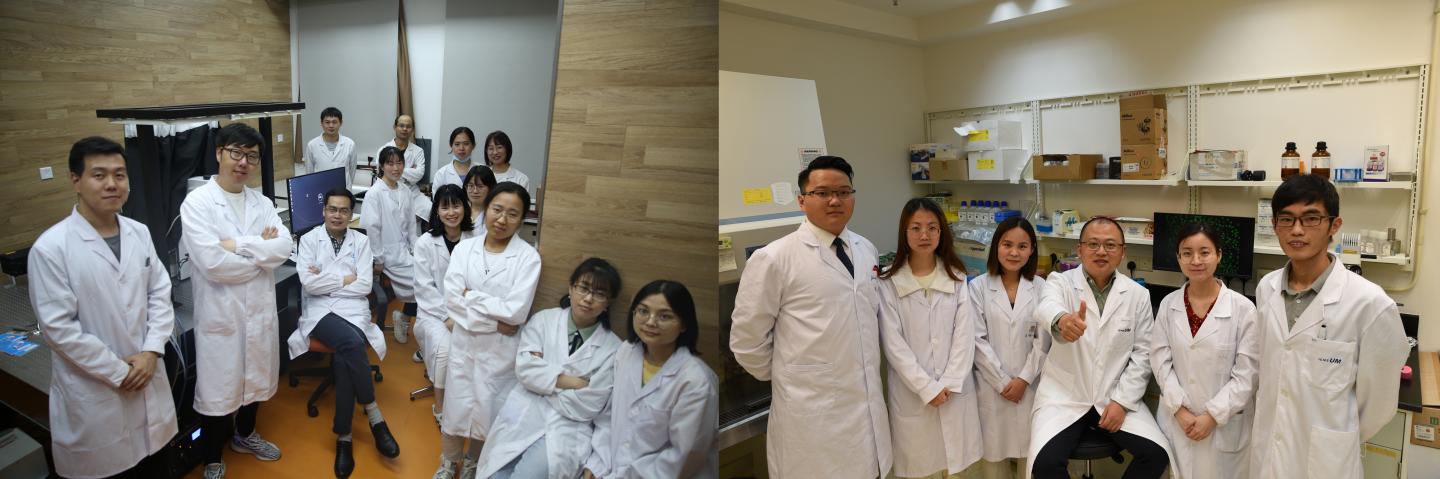
Credit: Lei Dong and Chunming Wang
Scientists from Nanjing University and University of Macau have transformed the spleen into a functioning liver in living mice, which could bring new hope for patients suffering from organ shortage worldwide.
For nearly ten million people with end-stage organ failures, implanting a new organ to replace the damaged one might be their last hope of survival. However, the shortage of donors, immune rejection and numerous other medical, ethical and economic factors have kept patients in a devastatingly long queue. And many never got one till the end. Each day, in the United States alone, twenty people die waiting for transplants.
In the past three decades, tissue engineering (TE) has promised to create functioning tissue from the tubes. This approach aims to culture living cells in 3D scaffolds, induce them to grow into the desired tissue and, finally, transplant this living tissue back to the body in substitution of the damaged one. ‘The goal of TE is to restore function through the delivery of living elements which become integrated into the patient’, wrote Joseph Vacanti and Robert Langer, two pioneers in regenerative medicine, in their manifesto paper published in Lancet in 1999.
This approach has made remarkable progress in providing promising solutions for repairing structurally simpler tissue. However, to regenerate vital and complex organs, such as the liver, TE still has a long way to go. The structure of an organ like the liver is too complicated for replication by current technologies – particularly its abundant, open, organised blood vessels connecting the body for nutrient supply. Simplified prototypes engineered from the laboratory survive poorly after transplantation without adequate blood supply.
To address this challenge, in their recent paper published in Science Advances, the team from Nanjing and Macau adopt a different way of thinking. Instead of engineering an organ for transplantation, they directly transform an existing organ – the spleen – into a ‘new’ organ in that fulfils the liver’s function in the same mouse. The researchers inject a pre-selected tissue extract to the spleen of mice, which shows lower immune response and produces more extracellular matrix required for cell growth. Then, they implant mouse, rat and human liver cells into the remodelled spleen in mice, observing in months that these cells not only survive from immune rejection and grow into liver-like structures but, more importantly, exert the liver’s function in the host body. As perhaps the most exciting finding, the spleen-transformed liver could rescue mice with 90% of their original liver removed.
This paper is published online with the title, ‘Transforming the spleen into a liver-like organ in vivo’. Professor Lei Dong of Nanjing University, the leading author of this work, believes this technology could ‘solve the fundamental challenges in tissue engineering, including insufficient cells, immune rejection and lack of blood vasculature, at one time’. Dong also suggests that, instead of focusing too much on the tissue structure, their strategy concentrates on restoring the tissue function in vivo, which should be the original goal of tissue engineering. Professor Chunming Wang of University of Macau, co-corresponding author of the paper, highlights the safety of the new strategy as ‘no any adverse responses were observed for as long as eight weeks, such as immune rejection or unwanted spreading of the transplanted cells’, which indicates the translational potential of the new strategy. The authors are confident of their approach overcoming the long-standing obstacles in regenerative medicine and, ultimately, helping to regenerate large organs ‘on-demand’.
Professor Xiaokun Li, an expert in regenerative medicine and Member of the Chinese Academy of Engineering, highly rates this work for its ‘unique strategy to achieve liver regeneration, solid findings on functionalities of transplanted cells, and impressive potential for translational medicine’. Li recommends future work be performed on larger animals with comprehensive evaluations in both efficacy and safety towards its clinical application.
###
Media Contact
Lei Dong
[email protected]
Related Journal Article
http://dx.