For the first time, a UNIGE team has been able to follow precisely the path taken by a protein within the cell, paving the way for the study of the transport and distribution network of vital elements necessary for its survival.
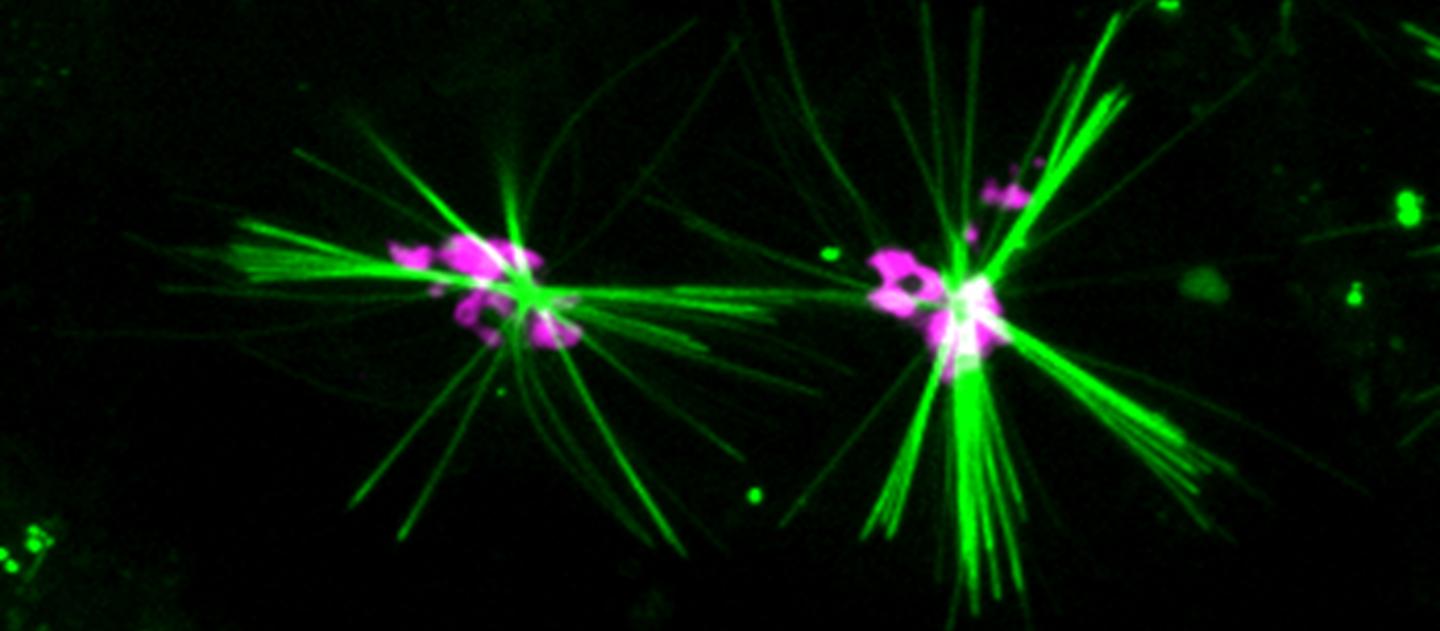
Credit: © UNIGE
In order to stay alive, the cell must provide its various organelles with all the energy elements they need, which are formed in the Golgi apparatus, its centre of maturation and redistribution of lipids and proteins. But how do the proteins that carry these cargoes – the kinesins – find their way and direction within the cell’s “road network” to deliver them at the right place? Chemists and biochemists at the University of Geneva (UNIGE), Switzerland, have discovered a fluorescent chemical dye, making it possible for the first time to track the transport activity of a specific motor protein within a cell. A discovery to be read in the magazine Nature communication.
“It all started from a research that didn’t go as planned,” laughs Nicolas Winssinger, professor at the Department of Organic Chemistry of the Faculty of Science at UNIGE. “Initially, we wanted to develop a molecule that would make it possible to visualise the stress level of the cell, i.e. when it accumulates too much active oxygen species. During the experiment, the molecule did not work, but crystallised. Why did it crystallise? What were these crystals?”
Three hypotheses emerged as possible and the team reached out to Charlotte Aumeier, professor in the Department of Biochemistry of the Faculty of Sciences of the UNIGE to verify them. The first hypothesis suggested that crystallisation was due to the microtubules that polymerise. “Microtubules are small, rigid tubes that can grow or shrink and constitute the “road network” that allows molecules to move around the cell,” explains Charlotte Aumeier. The second hypothesis made Golgi’s apparatus responsible for this chemical reaction. The last possibility suggested that the crystals were the result of the small steps made by the kinesin proteins in the microtubules as they moved within the cell.
The biochemists’ little thumb
To verify these different options, the UNIGE team joined forces with the National Institute of Health (NIH) in Bethesda (USA), which specialises in electron microscopy. “We first recreated microtubules that we purified, which takes 14 hours,” explains Charlotte Aumeier. “For the kinesins, the motor proteins that move on microtubules and transport cargo, we isolated them from bacteria.” The scientists then put together about 20 different mixtures containing the small molecule QPD, which is systematically present in the crystals, and observed which solution worked. “We wanted to know what was needed to form the crystals. The microtubules? The kinesin? Yet another protein?” asks Nicolas Winssinger.
Following various experiments, the team discovered that the formation of these crystals was caused by one of the 45 types of kinesin present in the cell. “With each small step that this kinesin protein takes on the microtubule, it uses energy that leaves a trace identified by the QPD molecule,” continues the Geneva-based researcher. It is from this recognition that the crystals are formed. In this way, the crystals are chemically left behind by the passage of the kinesin, which can be tracked by scientists like a small thumb.
The opening of a new field of study
“Until now, it has not been possible to track a particular protein. With current techniques, we couldn’t separate the individual kinesins, so we couldn’t see which path they took precisely,” continues Charlotte Aumeier. “Thanks to the development of our new chemical fluorescent dye, we can observe in detail how a protein behaves, which route it takes, its direction or even its preferred path.” For the first time, scientists can visualise the walking path of motor proteins and study the fundamental question of the transport activity and distribution of cargoes in cells.
###
Media Contact
Charlotte Aumeier
[email protected]
Related Journal Article
http://dx.