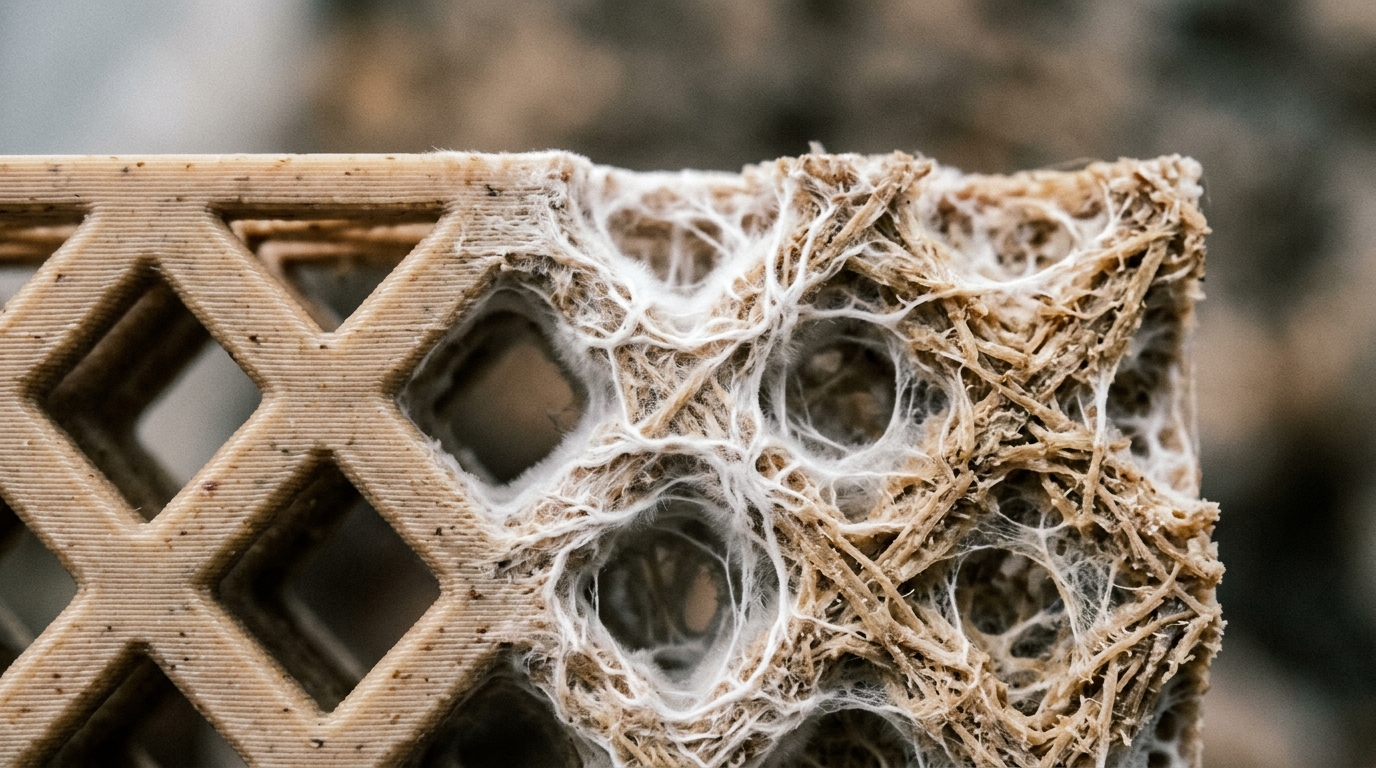
Researchers embedded standardized tensile specimens of polylactic acid, better known as PLA, and a hemp-particle-filled PLA variant into blocks of hemp shives densely overgrown with mycelium of Fomes fomentarius. After two weeks of colonization and subsequent tensile testing, the pure PLA specimens retained essentially all of their mechanical performance, with some configurations even gaining a few percent in stiffness. The hemp-filled material told a different story: its stiffness and strength dropped measurably, and the losses depended strongly on how long the fungus had been at work.
What remained unclear was how the fungus behaves when it meets an additively manufactured polymer directly, rather than a complex scaffold architecture. Earlier work had shown that 3D-printed gyroid scaffolds of wood-PLA could be colonized by Ganoderma lucidum with substantial reinforcement, but the fundamental interaction between biopolymers and fungal growth had not been isolated.
Three infill patterns were compared: linear at 0 degrees, diagonal at 45 degrees, and a grid pattern. Two filaments served as the base materials, a transparent purple TruePLA and a Prusament PLA Galaxy Silver, plus a PLA_Hemp filament whose hemp particles provide the lignocellulosic substrate that fungi naturally colonize.
The fungal side of the experiment followed a previously published protocol for cultivating Fomes fomentarius strain PaPF11. A pure culture isolated from a fruiting body was expanded on malt extract agar plates, then on autoclaved millet grain spawn, and finally on hemp shives, which were incubated for two weeks in the dark at approximately 25 degrees Celsius. The colonized shives were shredded, and the printed specimens were embedded between layers of this material in box-shaped growth chambers, compacted to eliminate hollow spaces, and incubated for two to five weeks. Before embedding, the specimens were sterilized by wiping with 70 percent ethanol for at least 30 to 60 seconds per surface, a method chosen after autoclaving proved infeasible because PLA degrades at elevated temperatures and direct UV exposure was avoided to prevent photodegradation of the polymer itself.
Untreated PLA 1 specimens showed a Young's modulus of 2797.25 newtons per square millimeter, and autoclaving raised this to 3418.33, an increase of 22.19 percent, while PLA_Hemp rose from 2856.48 to 3049.78, a gain of 6.77 percent; the authors caution, however, that such thermal treatment is often accompanied by embrittlement that reduces ductility. The authors attribute this to thermal promotion of polymer chain rearrangement, but caution that such changes are often accompanied by embrittlement that reduces ductility. Ethanol wiping, by contrast, shifted the modulus by less than half a percent in both materials, and UV treatment produced similarly minor increases likely attributable to surface photodegradation. On this basis the team identified ethanol as the most suitable pretreatment, preserving mechanical integrity while achieving sufficient germ reduction for embedding.
Once colonized and dried at 55 degrees Celsius to reduce moisture content from over 50 percent to a stable range of roughly 10 to 25 percent, the specimens were pulled to failure on a ZwickRoell Z2.5 universal testing machine at a constant crosshead speed of 2 millimeters per minute. In total, 21 experimental series of 10 specimens each were produced, amounting to 210 specimens, with additional time-series experiments using 30 specimens per filament tested without colonization, after two weeks, and after four weeks. Young’s modulus was calculated at strain points of 0.001 and 0.003, and statistical differences were assessed with one-way analysis of variance followed by Tukey’s post-hoc test.
The pure PLA results were strikingly benign. For Pattern I specimens, colonization raised the Young’s modulus by 2.9 percent, from 2867.36 to 2951.57 newtons per square millimeter, and the ultimate tensile strength edged up from 62.62 to 63.43. Pattern II showed a marginal 1.3 percent stiffness gain and a negligible strength decrease from 58.07 to 57.17. The most pronounced change appeared in the grid pattern, where stiffness rose 14.4 percent, from 665.69 to 761.78, and strength improved from 10.32 to 11.29; the authors suggest that the porous grid structure enabled more effective mycelial integration into the material's internal geometry, potentially reinforcing load-bearing zones. None of the PLA variants exhibited major mechanical degradation, which the authors interpret as evidence of fundamental resilience to fungal exposure.
The hemp-filled material behaved differently across the board. Colonized Pattern I specimens lost roughly 2.3 percent of their stiffness, dropping from 3072.42 to 3003.71 newtons per square millimeter, Pattern II lost about 1.5 percent, and the grid pattern lost 4.7 percent, from 592.64 to 564.98. The time series revealed a more dynamic picture: after two weeks of colonization the PLA_Hemp modulus fell significantly to 2694.86, a 10.8 percent drop relative to the fixed control, before partially recovering to 2824.25 after four weeks, still 6.5 percent below the control. Ultimate tensile strength followed the same trajectory, decreasing from 40.52 to 36.82 after two weeks and recovering to 39.36 at four weeks; the one-way ANOVA with Tukey's test showed a significant UTS decrease after two weeks (p < 0.0001) followed by partial recovery after four weeks. The porous structure introduced by hemp fibers, the authors suggest, may facilitate fungal infiltration and local degradation at the fiber-matrix interface, while prolonged exposure promotes denser mycelial coverage that can partially fill voids.
Microscopy at 50-fold magnification supported this interpretation. Mycelial growth remained mostly superficial on PLA specimens, with no clear penetration between individual deposition layers, consistent with their minimal mechanical changes. PLA_Hemp samples, in contrast, displayed rougher surfaces, microvoids and visible fiber-matrix gaps where hyphae attached and partially infiltrated. In grid-pattern specimens of both materials, hyphae extended into the rhombic voids formed by the infill geometry, indicating that print architecture, not just material composition, shapes how the fungus attaches and where it may contribute anisotropic mechanical effects. Non-colonized control specimens incubated under identical conditions showed slight but consistent differences, especially between lid-fixed and unfixed variants, confirming that passive exposure such as moisture absorption and polymer relaxation can affect mechanical performance, typically to a degree comparable to the effects observed in colonized specimens.
For anyone hoping to combine living fungi with printed polymers, the practical message is that pure PLA is a forgiving partner while hemp-filled PLA demands careful design attention. The authors note that mycelium from Fomes fomentarius can be used in extrusion-based 3D printing to produce composites with compressive strength comparable to expanded polystyrene, and that since EPS is primarily used as insulation rather than for load-bearing components, current mycelium-based composites should likewise be regarded as alternatives for nonstructural applications; further improvement in compressive strength would be necessary to meet construction standards for external insulation. They also flag a research gap concerning how different natural fillers and scaffold compositions govern the balance between reinforcement and long-term degradation, and recommend that future work systematically investigate how various fiber reinforcements and biopolymer blends influence colonization dynamics. The data underlying the study are publicly available on GitHub, and the authors emphasize that the feasibility of hybrid biocomposites, in which the printed framework remains mechanically stable while the mycelium contributes functional, regenerative or aesthetic properties, has now been demonstrated under controlled laboratory conditions.
Subject of Research: How Fomes fomentarius mycelium colonization affects the tensile properties of 3D-printed PLA and PLA-hemp biopolymers
Article Title: Impact of Fomes fomentarius growth on the mechanical properties of material extrusion additively manufactured PLA and PLA/Hemp biopolymers
Article References: Panjalipoursangari, N., Ou, Y., Schmidt, B., Müller, W. H., & Völlmecke, C. (2025). Impact of Fomes fomentarius growth on the mechanical properties of material extrusion additively manufactured PLA and PLA/Hemp biopolymers. Fungal Biology and Biotechnology, 12(1), Article 14. https://doi.org/10.1186/s40694-025-00205-9
Image Credits: AI Generated
DOI: 10.1186/s40694-025-00205-9
Keywords: Fomes fomentarius, mycelium, 3D printing, PLA, hemp fibers, biocomposites, tensile testing, additive manufacturing, biodegradable polymers, material extrusion, sterilization, sustainable materials
News Source: Denise Maddox. (November 6, 2026). Tinder fungus meets 3D printing: mycelium barely dents PLA but softens hemp-filled bioplastic. Scienmag.