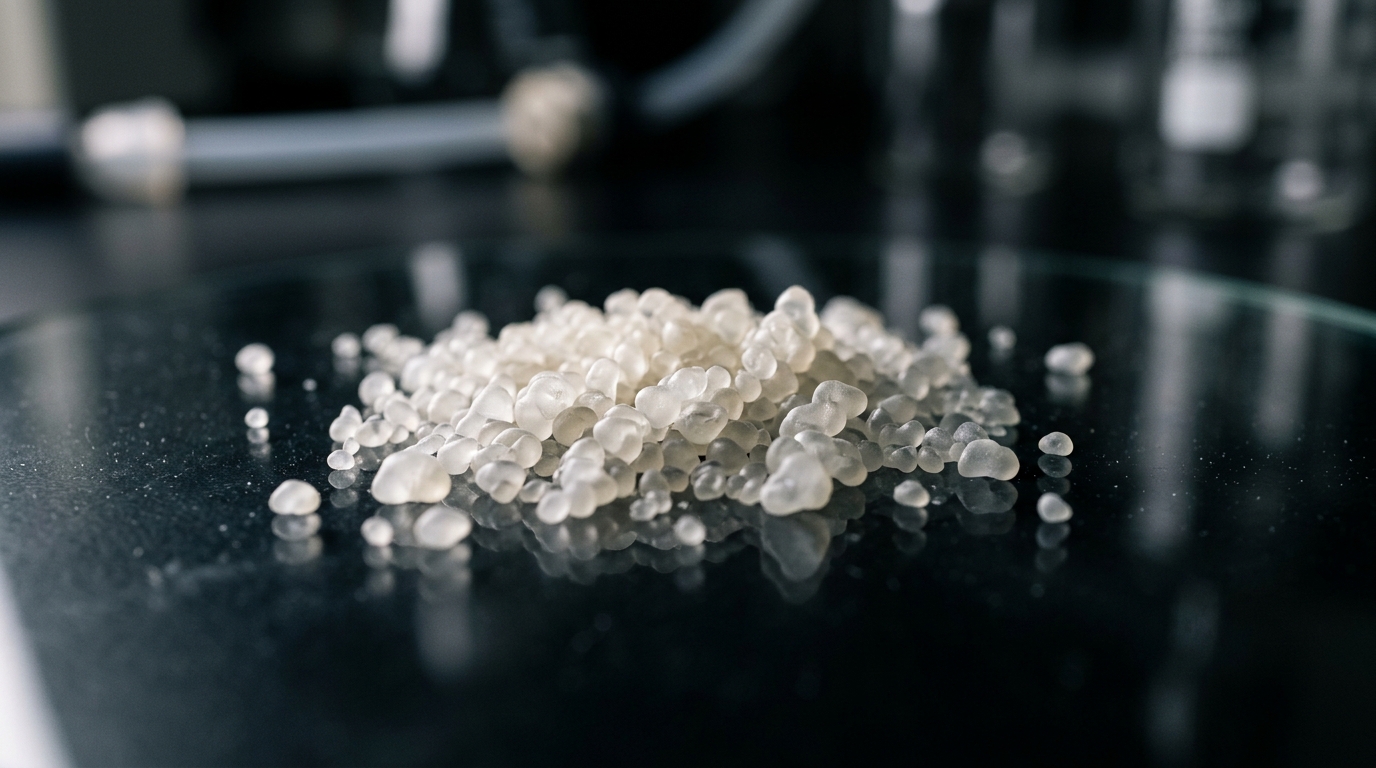
Amorphous solid dispersions are one of the pharmaceutical industry’s favorite tricks for rescuing poorly water-soluble drugs: dissolve the active ingredient molecularly inside a polymer carrier, lock it in a glassy amorphous state, and let it burst into supersaturated solution the moment it meets intestinal fluid. The catch is that supersaturation is metastable. Left alone, the drug tends to crash back out of solution, either crystallizing or separating into drug-rich liquid droplets, and the promised absorption window evaporates. A new study published in AAPS Open by Christian Luebbert of BASF and colleagues, including David S. Nakhla, Saurabh M. Mishra, Luis Mejia, Kess Agatovure and Andreas Sauer, now dissects why one particular polymer, hydroxypropyl methylcellulose acetate succinate (HPMCAS), manages to hold nifedipine in that fragile supersaturated state while other common polymers fail.
The work builds directly on a previous investigation in which the team showed that HPMCAS-H plays a double role in high drug-load nifedipine tablets made by hot-melt extrusion: it acts as a dry binder and simultaneously as a precipitation inhibitor. The experiments clearly demonstrated prolonged supersaturation and improved tablet performance when HPMCAS-H was added, but the thermodynamic origin of that protection remained unexplained. The present study fills that gap by combining dissolution experiments with thermodynamic modeling based on perturbed-chain statistical associating fluid theory, or PC-SAFT, an equation of state developed by Gross and Sadowski in 2001 that describes intermolecular interactions in complex fluids and polymers through segment-based association sites and chain-like molecular structures.
The researchers compared two fundamentally different carrier systems. One used PVP-VA64, a fully water-soluble vinylpyrrolidone-vinyl acetate copolymer; the other used HPMCAS, a weakly acidic, pH-responsive enteric polymer that is water-dispersible rather than truly soluble. Milled extrudates of nifedipine with either polymer were added directly to pH 6.8 phosphate buffer at 37 degrees Celsius in a USP apparatus II, and the amount of drug passing a 0.45-micrometer PTFE filter was tracked by HPLC-UV over four hours. Because HPMCAS-containing structures smaller than 450 nanometers can slip through that filter, the measured quantity is described as filter-passing apparent nifedipine concentration, a value that may include both molecularly dissolved drug and drug associated with colloidal polymer particles.
Both systems initially generated apparent supersaturation, but their fates diverged sharply. The PVP-VA64-based dispersions lost filter-passing nifedipine rapidly, dropping to roughly 25 percent of the initial maximum within 100 minutes for the 14 weight-percent formulation. The HPMCAS-based tablets behaved very differently depending on substitution grade: AS-H formulations at 20 and 33 weight-percent drug loading showed no measurable decline over 250 minutes, while the 50 weight-percent tablets lost a moderate fraction of filter-passing drug. AS-L tablets, by contrast, showed a pronounced initial spring followed by a consistent decline, indicating that this more hydrophilic grade did not maintain apparent supersaturation under the tested conditions.
The decisive test came when polymers were pre-dispersed in the dissolution medium before the drug-loaded particles were added. At 100 micrograms per milliliter, neither PVP-VA64 nor hydroxypropyl cellulose (HPC-EXF) improved the maintenance of filter-passing nifedipine for either the AS-L or PVP-VA64 dispersions. Pre-dispersed AS-HF, however, transformed the picture entirely. For the nifedipine/AS-L 33 weight-percent extrudates, the filter-passing apparent drug fraction remained near 100 percent over 240 minutes. For the PVP-VA64 14 weight-percent system, it stabilized at approximately 75 percent. This carrier- and additive-specific response is the experimental heart of the paper.
To rationalize these differences, the team predicted ternary nifedipine/polymer/water phase diagrams at 37 degrees Celsius using PC-SAFT. For the water-soluble PVP-VA64 system, the calculated diagram contains a broad liquid-liquid demixing region rooted in the poor miscibility of nifedipine with water. When the dispersion hydrates, the local interfacial composition crosses the binodal boundary and the system splits into a water- and polymer-rich, drug-lean phase and a drug-rich, polymer-lean phase. Because PVP-VA64 dissolves molecularly into the bulk medium, it cannot provide a separate polymer-rich reservoir, and the tie lines direct the drug toward an API-rich environment where loss of apparent supersaturation becomes thermodynamically favored.
The HPMCAS-H system tells a different story. The calculated polymer-rich binodal boundary sits at approximately 47.9 weight-percent nifedipine at 37 degrees Celsius on the water-free edge, but as hydration progresses the limiting drug fraction in the polymer-rich phase decreases toward approximately 28 weight-percent. Compositions at or below roughly 28 weight-percent are predicted to retain the drug in the polymer-rich phase along the modeled hydration path; those between 28 and 47.9 weight-percent may undergo partial or late-stage segregation; and those above 47.9 weight-percent enter the miscibility gap even before water arrives. An isothermal three-phase flash calculation additionally revealed a liquid-liquid-liquid tie triangle whose HPMCAS-rich vertex contains about 28 weight-percent nifedipine, defining a phase-composition-based capacity for the reservoir.
That capacity estimate can be translated into a first-order mass balance. At 100 micrograms per milliliter in one liter of medium, 100 milligrams of AS-HF are present. Applying the 28:72 drug-to-polymer mass ratio yields an approximate upper capacity of 39 milligrams of nifedipine per 100 milligrams of polymer. The authors stress this remains approximate because the actual amount is also limited by amorphous and crystalline solubility, ionization, and the fraction of polymer actually participating in the dispersed phase. No critical aggregation concentration was measured, and colloid formation was inferred from phase behavior and literature rather than directly confirmed by dynamic light scattering in this study.
The contrast between HPMCAS grades proved equally instructive. The L grade absorbs more water than the H grade, which makes it less hydrophobic and promotes faster plasticization of the matrix, stronger reduction of the glass transition temperature, and greater molecular mobility in the interfacial gel layer. That explains the pronounced initial spring effect of AS-L tablets. But the calculated AS-L topology partitions nifedipine toward an API-rich, polymer-lean phase, suggesting a lower capacity of the AS-L-rich phase to accommodate the drug. The authors are candid about a model limitation here: the 20 weight-percent AS-L vacuum-compression-molded disc appeared optically transparent, showing that the calculated binary boundary is not quantitatively validated by that experiment, so the AS-L diagrams are interpreted qualitatively rather than as quantitatively validated equilibrium boundaries.
The broader lesson the authors draw is that precipitation inhibition is not a universal property of polymer hydrophilicity. Molecularly dissolved water-soluble polymers can still inhibit nucleation or crystal growth in other drug-polymer systems through specific adsorption or molecular interactions, a mechanism the present framework does not exclude. What this study adds is a distinct thermodynamic criterion: a persistent polymer-rich phase with sufficient drug affinity can act as a partitioning reservoir that suppresses or delays loss of filter-passing drug. The authors also flag important limitations, including the single model API, the omission of explicit HPMCAS ionization from the non-electrolyte PC-SAFT treatment, the use of a thermodynamic model for a kinetically controlled dissolution process, and the quantification of filter-passing rather than exclusively molecularly dissolved drug. Within those limits, the work offers formulators a predictive tool for selecting precipitation inhibitors in high-drug-load amorphous solid dispersion systems, particularly where reduced pill burden is the goal.
Subject of Research: Thermodynamic modeling of precipitation inhibition by HPMCAS in nifedipine amorphous solid dispersions
Article Title: Mechanistic understanding of the precipitation inhibition effect of HPMCAS via thermodynamic modeling
Article References: Luebbert, C., Nakhla, D. S., Mishra, S. M., Mejia, L., Agatovure, K., & Sauer, A. (2026). Mechanistic understanding of the precipitation inhibition effect of HPMCAS via thermodynamic modeling. AAPS Open, 12(1), Article 68. https://doi.org/10.1186/s41120-026-00204-z
Image Credits: AI Generated
DOI: 10.1186/s41120-026-00204-z
Keywords: amorphous solid dispersions, HPMCAS, nifedipine, PC-SAFT, precipitation inhibition, supersaturation, ternary phase diagrams, hot-melt extrusion, polymer-rich phase, dissolution testing, pharmaceutical formulation, thermodynamic modeling
News Source: Ophelia Keating. (November 5, 2026). Thermodynamic model reveals how HPMCAS keeps supersaturated drug from crashing out. Scienmag.