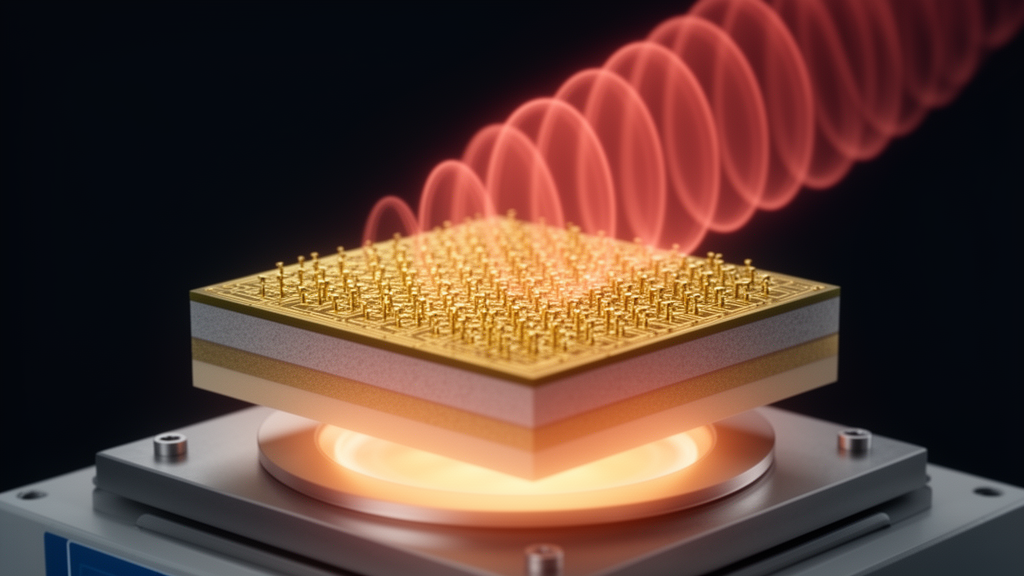
Below about 68 degrees Celsius, the device lets terahertz waves pass through almost untouched; above that threshold, it swallows them, absorbing close to ninety percent of the incoming energy. The design, described in the journal Results in Optics, also responds selectively to the handedness of circularly polarized light, a combination the authors say remains rare among tunable terahertz absorbers.
The key ingredient is vanadium dioxide, a material famous among photonics researchers for its dramatic phase transition. At room temperature VO2 is an insulator with a conductivity of roughly 10 siemens per meter. Heat it past its transition temperature of about 68 degrees Celsius and its conductivity leaps by more than four orders of magnitude, reaching as high as 4 x 10^5 siemens per meter.
The proposed device stacks three layers. On top sits a patterned gold resonator combining an H-shaped element with asymmetric split-ring resonators, the classic workhorses of metamaterial engineering. Beneath the metal lies a 9-micrometer polyimide dielectric spacer, chosen for its low loss in the terahertz band and its stability: its dielectric properties barely change between 20 and 80 degrees Celsius, so any temperature-driven behavior shift can be attributed to the VO2 alone. The bottom layer is the VO2 film itself, 0.9 micrometers thick.
The researchers modeled the structure using the frequency-domain finite integration technique in CST Microwave Studio, representing VO2 with a Drude model in which the plasma frequency depends on conductivity. In the insulating state, the weakly conducting VO2 layer allows the patterned resonators to couple in a particular way: the H-shaped element supports a radiative bright mode, while the asymmetric split rings host a subradiant dark mode.
In this dielectric state, the simulated device transmits up to 93.54 percent of the incident wave at 0.5806 terahertz. Switch the temperature above 68 degrees Celsius and the VO2 becomes highly conductive, altering the coupling between the resonant elements and converting the structure into an absorber. The absorption peak reaches 89.63 percent at 0.5977 terahertz in one configuration, with the absorption and transmission curves crossing at 0.5932 terahertz, where both responses equal 86.44 percent. In a refined optimization aimed at fabrication tolerance, the team aligned the peaks more tightly: 87.85 percent absorption and 91.14 percent transmission at a common working frequency of 0.5779 terahertz, so that even if manufacturing errors shift the resonance slightly, the device still delivers roughly 80 percent performance in either mode.
Field maps reveal why the structure works. At resonance, the electric field concentrates intensely along the edges and gaps of the split rings, confirming that capacitive coupling across the splits dominates the response. The magnetic field, meanwhile, bunches within the closed loops of the resonators, the signature of LC-type magnetic modes. The team interprets each split ring as an equivalent inductance-capacitance circuit, in which circulating surface currents provide the inductance and the split gap provides the capacitance. Widening the gap angle reduces the capacitance and pushes the resonance higher in frequency, though it can simultaneously increase the effective inductance and pull the resonance back down, a trade-off the designers had to balance.
Because the top patterned layer is asymmetric, the structure distinguishes between right-hand and left-hand circular polarization, absorbing both circular states strongly while remaining largely unresponsive to linearly polarized waves. The authors emphasize that this circular polarization selectivity, combined with single-frequency thermal switching, is what sets their design apart from earlier VO2-based terahertz absorbers. Previous devices, they note, either lacked dynamic tunability, ignored polarization behavior, or switched wholesale between transparency and multi-band absorption without being able to interchange absorption and transmission at one fixed frequency.
The device also exhibits slow-light behavior, a byproduct of the strong phase dispersion near resonance. In the dielectric state, the simulated group delay reaches 5.61 picoseconds at the transparency window near 0.577 terahertz. In the metallic state, the delay rises to about 9.4 picoseconds at the absorption resonance, indicating that energy lingers longer within the resonant structure when VO2 is conductive. Group delays of this magnitude, the authors argue, make the platform interesting for terahertz delay lines, sensing, and switching applications, where slowing a pulse without absorbing it entirely is often the goal.
Everything reported so far is computational. The study presents no fabricated sample and no measurement; all results come from full-wave electromagnetic simulation. The authors do, however, sketch a plausible microfabrication route: a 30-nanometer chromium adhesion layer sputtered onto quartz, followed by 200 nanometers of gold, photolithographic patterning of the resonator geometry, and ion beam etching to define the final metallic microstructure. Whether the simulated performance survives real-world imperfections, such as variations in layer thickness that shift resonances, is precisely the question their peak-alignment optimization strategy is meant to address, but experimental confirmation remains future work.
If realized, the researchers see the platform feeding into technologies that need reconfigurable terahertz components: tunable filters, active switches, modulators, sensors, and eventually elements of sixth-generation communication systems, a band whose enormous bandwidth potential has driven much of the current interest in terahertz photonics. The authors acknowledge the practical hurdles, including fabrication challenges and the requirement for precise thermal control, since the entire functionality hinges on nudging VO2 back and forth across its 68-degree transition. Still, they argue, the combination of temperature-switchable absorption and transmission at a single frequency, circular polarization selectivity, and pronounced slow-light dispersion marks a step toward fully reconfigurable terahertz metasurfaces built from phase-change materials.
Subject of Research: A simulated VO2-based terahertz metasurface that thermally switches between EIT-like transparency and absorption with circular polarization selectivity.
Article Title: Multi-functional vanadium dioxide based THz metasurface absorber with polarization selective operation
Article References: Khalilzadeh, Z., Vahed, H., & Soofi, H. (2026). Multi-functional vanadium dioxide based THz metasurface absorber with polarization selective operation. Results in Optics, Article 101206. https://doi.org/10.1016/j.rio.2026.101206
Image Credits: AI Generated
DOI: 10.1016/j.rio.2026.101206
Keywords: terahertz, metasurface, vanadium dioxide, absorber, EIT, phase transition, circular polarization, slow light, 6G, simulation, photonics, Multi-functional
News Source: Denise Maddox. (October 28, 2026). Thermally Switchable Terahertz Metasurface Absorbs and Transmits on Demand. Scienmag.