Researchers at the University of Waterloo’s Institute for Quantum Computing (IQC) have brought together two Nobel prize-winning research concepts to advance the field of quantum communication.
Credit: University of Waterloo
Researchers at the University of Waterloo’s Institute for Quantum Computing (IQC) have brought together two Nobel prize-winning research concepts to advance the field of quantum communication.
Scientists can now efficiently produce nearly perfect entangled photon pairs from quantum dot sources.
Entangled photons are particles of light that remain connected, even across large distances, and the 2022 Nobel Prize in Physics recognized experiments on this topic. Combining entanglement with quantum dots, a technology recognized with the Nobel Prize in Chemistry in 2023, the IQC research team aimed to optimize the process for creating entangled photons, which have a wide variety of applications, including secure communications.
“The combination of a high degree of entanglement and high efficiency is needed for exciting applications such as quantum key distribution or quantum repeaters, which are envisioned to extend the distance of secure quantum communication to a global scale or link remote quantum computers,” said Dr. Michael Reimer, professor at IQC and Waterloo’s Department of Electrical and Computer Engineering. “Previous experiments only measured either near-perfect entanglement or high efficiency, but we’re the first to achieve both requirements with a quantum dot.”
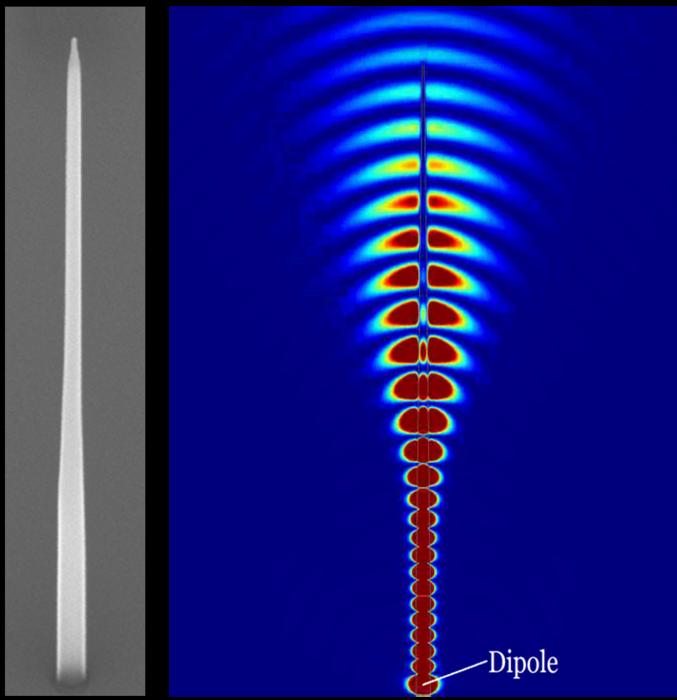
By embedding semiconductor quantum dots into a nanowire, the researchers created a source that creates near-perfect entangled photons 65 times more efficiently than previous work. This new source, developed in collaboration with the National Research Council of Canada in Ottawa, can be excited with lasers to generate entangled pairs on command. The researchers then used high-resolution single photon detectors provided by Single Quantum in The Netherlands to boost the degree of entanglement.
“Historically, quantum dot systems were plagued with a problem called fine structure splitting, which causes an entangled state to oscillate over time. This meant that measurements taken with a slow detection system would prevent the entanglement from being measured,” said Matteo Pennacchietti, a PhD student at IQC and Waterloo’s Department of Electrical and Computer Engineering. “We overcame this by combining our quantum dots with a very fast and precise detection system. We can basically take a timestamp of what the entangled state looks like at each point during the oscillations, and that’s where we have the perfect entanglement.”
To showcase future communications applications, Reimer and Pennacchietti worked with Dr. Norbert Lütkenhaus and Dr. Thomas Jennewein, both IQC faculty members and professors in Waterloo’s Department of Physics and Astronomy, and their teams. Using their new quantum dot entanglement source, the researchers simulated a secure communications method known as quantum key distribution, proving that the quantum dot source holds significant promise in the future of secure quantum communications.
This research, Oscillating photonic Bell state from a semiconductor quantum dot for quantum key distribution, was recently published in Communications Physics by Pennacchietti, Reimer, Jennewein, Lütkenhaus, Brady Cunard, Shlok Nahar, and Sayan Gangopadhyay from IQC, alongside their collaborators Dr. Mohd Zeeshan, Dr. Philip Poole, Dr. Dan Dalacu, Dr. Andreas Fognini, Dr. Klaus Jöns, and Dr. Val Zwiller.
Journal
Communications Physics