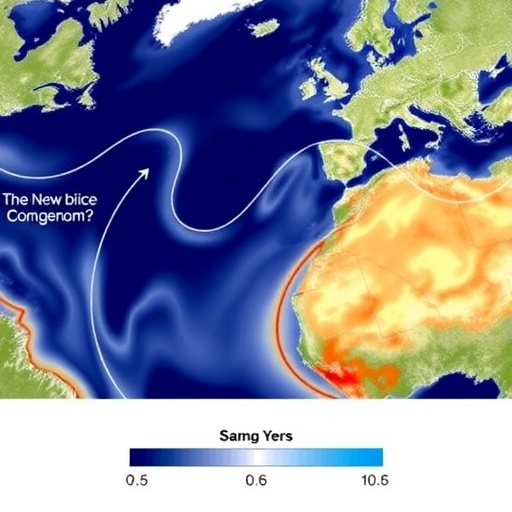
The Atlantic Meridional Overturning Circulation, or AMOC, has long been described as one of Earth’s great climate engines: a vast ocean conveyor that moves warm surface water northward and returns colder, denser water toward the deep Atlantic. New evidence from the seafloor off Brazil now suggests that this system may be far more volatile during periods of abrupt climate disruption than previously believed. Rather than remaining steadily suppressed throughout the last major Heinrich event, the AMOC appears to have repeatedly surged back to strength, with powerful intensifications lasting for centuries.
The finding comes from a study published in Nature Communications by researchers from MARUM – Center for Marine Environmental Sciences at the University of Bremen and Brazilian universities. The team reconstructed changes in Atlantic overturning during Heinrich Stadial 1, a cold interval that occurred approximately 14,600 to 17,500 years ago. During this period, enormous quantities of ice were released from the Northern Hemisphere ice sheets into the North Atlantic. The resulting influx of cold, fresh water is thought to have disrupted deep-water formation and weakened the circulation, triggering major climate shifts around the world.
Heinrich Stadial 1 lasted roughly 2,000 to 3,000 years, but the exact behavior of the AMOC during that interval has remained uncertain. Many earlier reconstructions treated it as a prolonged period of greatly reduced overturning, with little evidence that the system recovered before the stadial ended. The new study challenges that simplified picture. According to the researchers, the AMOC did weaken substantially, but it did not remain locked in one state. Instead, it fluctuated dramatically, including at least two episodes when the circulation became significantly stronger for several hundred years.
That discovery was possible because of an unusually detailed sediment archive collected during an oceanographic expedition off the Brazilian coast. The sampling site receives a continuous and relatively rapid supply of particles that settle from the water column to the seafloor. Over time, these particles form layered sediments, creating a natural record of changing ocean conditions. At the Brazilian site, the sedimentation rate was high enough for the researchers to recover approximately three meters of material deposited during Heinrich Stadial 1 alone. Such a thick, rapidly accumulated sequence offers a level of temporal resolution that is rarely available in deep-sea climate research.
The scientists used radiocarbon measurements from benthic foraminifera, microscopic organisms that live on or within the seafloor sediment. These organisms record the chemical characteristics of the bottom water surrounding them. In particular, the radiocarbon age of benthic foraminifera can reveal how long a water mass has been isolated from the atmosphere. Deep waters formed in the North Atlantic generally carry relatively young radiocarbon signatures because they were recently in contact with the atmosphere before sinking. As these waters travel through the deep ocean, their radiocarbon decays. By comparing radiocarbon ages in the sediment record, researchers can estimate changes in the residence time and renewal of deep Atlantic waters, providing an indirect measure of AMOC strength.
The Brazilian sediment core showed that the circulation was not uniformly weak during the Heinrich interval. Instead, the record contained pronounced variations, including two distinct phases of intensified overturning. Each strengthening persisted for several centuries, long enough to influence climate well beyond the deep Atlantic. A stronger AMOC would have transported more heat northward and altered the distribution of heat between the ocean and atmosphere. The researchers say these changes were associated with shifts in tropical precipitation and affected the ocean’s capacity to store carbon.
The connection between overturning circulation and rainfall arises from the AMOC’s role in redistributing energy. When the circulation changes, the temperature contrast between the Northern and Southern hemispheres can shift, moving tropical rain belts and changing the position of large-scale atmospheric circulation systems. Even a temporary strengthening of the AMOC can therefore produce climate effects far from the North Atlantic. In the tropics, changes in rainfall influence river discharge, vegetation, erosion and the delivery of nutrients and carbon to the ocean. The new record indicates that these effects may have repeatedly emerged during Heinrich Stadial 1 rather than occurring only once during a long, stable weakening.
The findings also matter for the global carbon cycle. The deep ocean stores vast quantities of carbon, much of it transported downward through the biological pump or carried into the abyss by sinking water masses. Variations in overturning can change how efficiently carbon is transferred from the atmosphere and surface ocean into the deep sea. Periods of intensified circulation may have altered the ventilation of deep waters and the distribution of dissolved carbon across the Atlantic. Although the sediment record cannot by itself provide a complete estimate of atmospheric carbon dioxide changes, it demonstrates that circulation-driven carbon storage was capable of varying on timescales of only a few centuries.
For climate scientists, the most important implication is that the AMOC may respond to freshwater forcing in a more dynamic and less predictable way than conventional reconstructions suggest. The system is governed by a delicate balance among temperature, salinity, density and ocean circulation. Freshwater from melting ice reduces surface-water salinity and density, making it harder for water to sink and form deep water. But the new evidence indicates that a weakened state may be interrupted by temporary recoveries, even while the broader climate remains cold and the circulation is under stress. This does not mean that every future weakening would reverse itself, nor does it establish that an abrupt collapse is imminent. It does, however, show that the pathway between a strong and weak AMOC can include rapid, century-scale variability.
The study arrives as researchers intensify efforts to determine whether the modern AMOC is already weakening under human-driven climate change. Rising temperatures are accelerating ice loss and increasing freshwater input into the North Atlantic, while warming seawater reduces density at the surface. Climate models generally project a decline in AMOC strength during the coming century if greenhouse-gas emissions remain high, although the timing and magnitude of that decline remain uncertain. The new paleoceanographic evidence cannot directly predict the future, but it provides a crucial test for climate models by revealing how the circulation behaved during a past episode of major ice-sheet discharge. It suggests that future changes may involve powerful fluctuations with consequences for heat transport, rainfall, ecosystems, sea ice and carbon storage. Understanding those fluctuations will be essential for assessing how close the modern Atlantic may be to a threshold—and how the climate system might behave if that threshold is approached.
Subject of Research: Variability and temporary intensifications of the Atlantic Meridional Overturning Circulation during Heinrich Stadial 1.
Article Title: Centennial-scale intensifications of the Atlantic Meridional Overturning Circulation during Heinrich Stadial 1
News Publication Date: 19 May 2026
Web References: https://doi.org/10.1038/s41467-026-73364-x
References: Jena, P. S., Chiessi, C. M., Mulitza, S. et al., “Centennial-scale intensifications of the Atlantic Meridional Overturning Circulation during Heinrich Stadial 1,” Nature Communications, DOI: 10.1038/s41467-026-73364-x.
Keywords
Atlantic Meridional Overturning Circulation, AMOC, Heinrich Stadial 1, paleoclimate, ocean circulation, climate change, deep-water formation, radiocarbon dating, benthic foraminifera, tropical precipitation, ocean carbon storage, paleoceanography
Tags: abrupt climate disruptions and ocean dynamicsAtlantic Meridional Overturning Circulationclimate change impacts on ocean circulationdeep-water formation and cold freshwater influximpacts of ice sheet melting on Atlantic circulationimplications for future climate stabilityocean circulation surges during climate eventsocean conveyor belt and global climate regulationpaleoceanography and reconstruction of past ocean currentsrole of Heinrich Stadial 1 in climate historyseafloor evidence of ocean circulation shiftsvariability of AMOC during Heinrich events