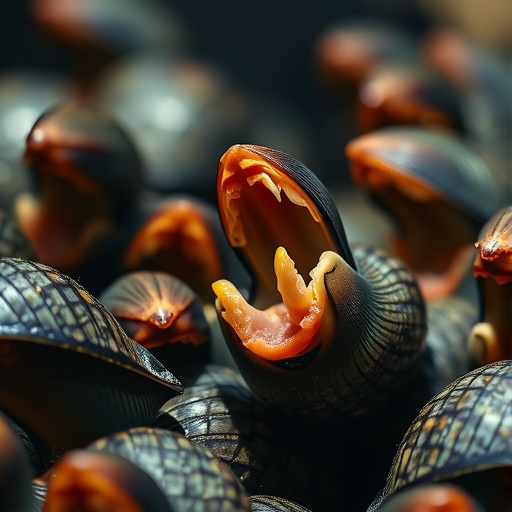
For a blue mussel, eating can be a dangerous business. The animal survives by filtering seawater through its body, extracting microscopic algae and other particles as food. Yet the same current that delivers nourishment can also carry the free-swimming larvae of parasitic flatworms. New research from Aarhus University shows that blue mussels can respond to this hidden threat before infection occurs. When chemical or biological signals indicate that parasites may be nearby, the mussels reduce the rate at which they filter water. Under especially risky conditions, they may close their shells entirely. The response could protect individual mussels, but it may also influence the ecological functions performed by entire mussel beds.
Blue mussels, Mytilus edulis, are far more than passive shellfish attached to rocks, piers and seabeds. A large individual can process as much as 100 litres of seawater per day, while dense mussel beds may contain millions of animals. Through filtration, they remove microscopic algae and suspended organic material from the water column, helping shape water clarity, nutrient cycling and the movement of energy through coastal ecosystems. Their shells also create a complex three-dimensional habitat, providing spaces where small crustaceans, worms, fish and plants can live. If many mussels reduce filtration at the same time, the consequences could extend beyond the animals themselves.
The study, published in the Journal of Helminthology, examined whether blue mussels could alter their behaviour when exposed to larvae from three species of parasitic flatworm. Two of the parasites are capable of infecting blue mussels, while the third normally infects fish and represents a lower or different threat to the mussels. The strongest behavioural response occurred in the presence of Himasthla elongata, a parasite whose larvae can penetrate and develop within mussel tissues. Exposed mussels reduced their filtration activity by 34 per cent compared with control animals. When H. elongata was combined with another mussel parasite, Renicola roscovita, filtration fell by 51 per cent.
The researchers also identified a direct relationship between the mussels’ feeding behaviour and parasite infection. Animals that continued filtering water at higher rates subsequently contained more parasites. This suggests that filtration is not merely a general physiological activity but also represents an important route of exposure. A mussel draws water across its gills, where food particles are captured and transferred into the digestive system. Parasite larvae present in the surrounding water can be swept into the same filtering system. By slowing the flow of water, the mussel may reduce the probability that infectious larvae will enter its body.
“This response is particularly interesting because the mussel changes its behaviour before the parasite has caused harm,” says PhD researcher Pernille Kibak, one of the study’s authors. The finding illustrates what ecologists call the “ecology of fear,” a concept first developed through studies of predators and prey. Animals often respond not only to direct attacks but also to the possibility of danger. A prey species may move away from a risky habitat, spend less time feeding or increase its vigilance even when no predator is visible. Similar mechanisms are now being identified in host-parasite relationships, where the costs of infection can include reduced growth, impaired reproduction and lower survival.
The experiments did not provide definitive evidence that blue mussels can identify individual parasite species with precision. The animals reacted differently to the three flatworms, but the responses varied substantially between individual mussels. This variation prevented the researchers from concluding that the mussels can reliably distinguish parasites that infect them from those that do not. Instead, the mussels may be responding to a broader chemical signature associated with biological danger. Their sensory systems can detect dissolved compounds in seawater, including chemical traces released by food, predators, injured members of their own species and potentially infected organisms.
A second series of experiments revealed that mussels reacted strongly even when the parasites themselves were absent. The researchers exposed the animals to seawater containing chemical cues from common periwinkles, small marine snails that do not directly harm blue mussels. However, periwinkles are important hosts in the life cycles of several parasitic flatworms. Parasite larvae can develop and reproduce inside the snails before being released into the water and moving on to later hosts, including mussels. Water containing only periwinkle cues caused mussel filtration to decline by almost 42 per cent compared with control conditions. The snails may therefore function as an indirect warning signal that parasite larvae are likely to be present.
The exact chemical compounds responsible for the reaction remain unknown. Water containing cues from parasites and infected snails did not reduce filtration significantly more than water containing cues from the snails alone. This result suggests that the periwinkle signal may be especially important, although it does not establish how the mussels detect it or whether the cue is produced by the snails, their associated microorganisms or the parasites living inside them. Because blue mussels are fixed in place by strong byssal threads, they cannot escape a dangerous area in the way a mobile animal can. Their main defence may instead be to interpret information carried by the water and temporarily reduce contact with it.
The protective value of this behaviour creates an ecological paradox. A mussel that filters less water may lower its chance of becoming infected, but it also takes in less food and contributes less to the removal of particles from the surrounding sea. Across a large mussel bed, widespread reductions in filtration could influence the deposition of organic material on the seabed, nutrient availability and the transfer of energy between the water column and bottom habitats. The researchers stress, however, that laboratory results cannot be transferred directly to natural ecosystems. Wild mussels experience fluctuating food concentrations, currents, temperatures and parasite densities, and they may compensate for short periods of reduced filtration by increasing activity later.
Climate change could make the question more urgent. Parasites pass through several life stages, and the development, survival and distribution of those stages are strongly influenced by temperature. Warmer seas may allow some parasites to expand into regions where they are currently rare or absent. Temperature also affects mussel metabolism, filtration and immune function, meaning that host and parasite responses may change simultaneously. The Aarhus University team is now studying mussels from colder areas with little or no current exposure to these parasites. If warming enables parasites to establish in those regions, the mussels may encounter a novel threat. Whether their behaviour will differ because they lack previous exposure could help scientists understand how parasite range shifts may reshape mussel ecology and coastal ecosystems.
Subject of Research: Blue mussel behavioural and filtration responses to parasitic flatworms and chemical cues from periwinkles.
Article Title: Avoidance of parasites by blue mussels Mytilus edulis: effect of parasite species and chemosensory cues
Web References: https://doi.org/10.1017/S0022149X26101643
References: Journal of Helminthology; DOI: 10.1017/S0022149X26101643
Image Credits: Karolin Janina Demtröder
Keywords: blue mussels, Mytilus edulis, parasites, ecology of fear, filtration, chemosensory cues, periwinkles, marine ecosystems, climate change, Aarhus University
Tags: Blue mussel parasite detectionchemical signals indicating parasite presenceeffects of parasite avoidance on mussel populationsimpact of mussel behavior on coastal ecosystemsinfluence of mussel responses on water claritymussel beds ecological functionsmussel filtration response to parasitic threatsmussel shell behavior under threatmussel shell closure as defense mechanismmussels as habitat providersparasitic flatworms in marine environmentsrole of mussels in nutrient cycling