• HOME
  • NEWS
  • EXPLORE
    • CAREER
      • Companies
      • Jobs
    • EVENTS
    • iGEM
      • News
      • Team
    • PHOTOS
    • VIDEO
    • WIKI
  • BLOG
  • COMMUNITY
    • FACEBOOK
    • INSTAGRAM
    • TWITTER
Monday, August 17, 2026
BIOENGINEER.ORG
No Result
View All Result
  • Login
  • HOME
  • NEWS
  • EXPLORE
    • CAREER
      • Companies
      • Jobs
        • Lecturer
        • PhD Studentship
        • Postdoc
        • Research Assistant
    • EVENTS
    • iGEM
      • News
      • Team
    • PHOTOS
    • VIDEO
    • WIKI
  • BLOG
  • COMMUNITY
    • FACEBOOK
    • INSTAGRAM
    • TWITTER
  • HOME
  • NEWS
  • EXPLORE
    • CAREER
      • Companies
      • Jobs
        • Lecturer
        • PhD Studentship
        • Postdoc
        • Research Assistant
    • EVENTS
    • iGEM
      • News
      • Team
    • PHOTOS
    • VIDEO
    • WIKI
  • BLOG
  • COMMUNITY
    • FACEBOOK
    • INSTAGRAM
    • TWITTER
No Result
View All Result
Bioengineer.org
No Result
View All Result
Home NEWS Science News Chemistry

The exhaust gas from a power plant can be recovered and used as a raw reaction material

Bioengineer by Bioengineer
June 19, 2020
in Chemistry
Reading Time: 3 mins read
0
IMAGE
Share on FacebookShare on TwitterShare on LinkedinShare on RedditShare on Telegram

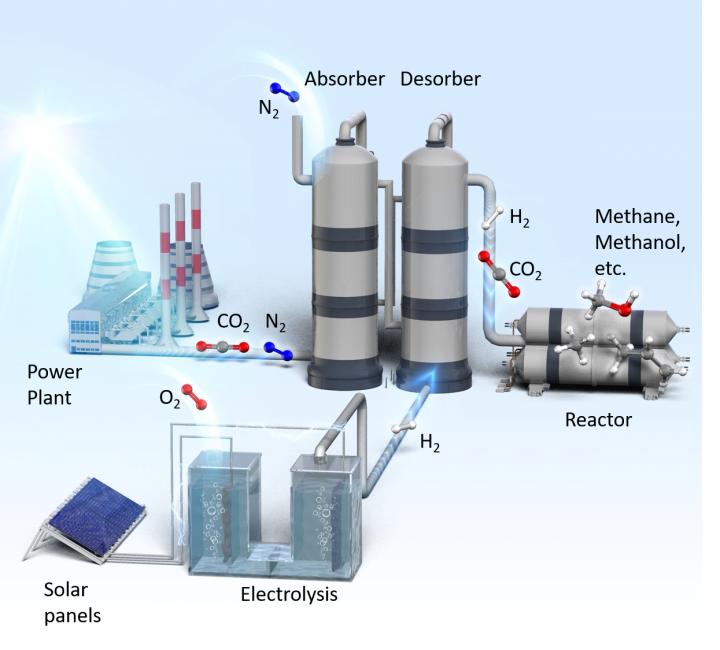
Energy-saving CO2 capture technology with H2 gas is developed by integrating the CO2 separation and conversion process
IMAGE

Credit: Nagoya University

A research group at Nagoya University has developed a new technology that can drastically conserve the energy used to capture carbon dioxide (CO2), one of the greenhouse gases, from facilities such as thermal power plants. Conventionally, a significant amount of energy (3 to 4 GJ/ton-CO2) or high temperatures exceeding 100 deg.C has been required to capture CO2 from gases exhausted from a concentrated source, and there are expectations of the development of CO2 capture technology that consumes less energy.

The research group led by Assistant Professor Hiroshi Machida has developed an unprecedented CO2 capture technology, namely H2 stripping regeneration technology(1), in which hydrogen (H2) gas is supplied to the regeneration tower (desorber)(2). It is indicated in this research that, with the implementation of this new technology, combustion exhaust gas can be replaced by CO2/H2 gas at lower temperatures (85 deg.C) than those used in conventional technology. The further reduction of energy can be achieved when it is combined with technologies such as those involved in the promotion of exhaust heat utilization and recovery of reaction heat.

This new technology can exhibit the world’s highest energy-saving performance (i.e., separation and collection of energy required is less than 1 GJ/ton-CO2 when a desorber temperature is 60 deg.C) when it is combined with the phase-separation solvent that this research group has also developed.

This technology is expected to be applicable to value-added material production such as the syntheses of methane, methanol, gasoline, etc., from CO2 in the combustion exhaust gas and H2 from renewable energy, and is expected to contribute to carbon recycling.

1) H2 stripping regeneration technology

In the conventional process to synthesize fuel or chemicals from CO2 and renewable H2, pure CO2 is collected and is then mixed with H2 before being supplied to the reduction reactor. In the H2 stripping regeneration technology, H2 gas is supplied at the bottom of the desorber. As a result, CO2 partial pressure in the desorber is lowered, which promotes regeneration and lowers the regeneration temperature. The mixture of CO2 and H2 gases collected from the head of the desorber is supplied directly to the synthesis reactor.

2) Regeneration tower (Desorber)

In the amine absorption method, CO2 absorption and regeneration towers (i.e., absorber and desorber) are used to separate and collect CO2 in the exhaust gas mixture from facilities like power plants. Gases such as N2 and O2, in addition to CO2, are included in the combustion exhaust gas from these facilities and pure CO2 gas is collected with this amine absorption method. Only the CO2 gas is absorbed in the absorber by amine solution, and it is then heated in the desorber to regenerate pure CO2 gas. In other words, only CO2 gas can be extracted from the mixture of gases.

This study has been supported by Advanced Low Carbon Technology Research and Development Program (ALCA ) of JST Strategic Basic Research Programs.

###

Media Contact
Machida Hiroshi
[email protected]

Original Source

https://www.jst.go.jp/pr/announce/20200603-4/index_e.html

Related Journal Article

http://dx.doi.org/10.1021/acssuschemeng.0c02459

Tags: Chemistry/Physics/Materials SciencesClimate ChangeEnergy/Fuel (non-petroleum)Industrial Engineering/Chemistry
Share12Tweet8Share2ShareShareShare2

Related Posts

Machine learning accelerates climate solutions from ideas to real-world impact

Machine learning accelerates climate solutions from ideas to real-world impact

August 17, 2026
Labrador Sea Helps Supply Oxygen Supporting Life in the Deep North Atlantic

Labrador Sea Helps Supply Oxygen Supporting Life in the Deep North Atlantic

August 17, 2026

From Google to ChatGPT: How Students Now Search for Knowledge

August 17, 2026

Protein-Foldamer Building Blocks Enable Self-Assembling Hybrid Architectures

August 17, 2026
Please login to join discussion

POPULAR NEWS

  • Study compares cold-stored and room-temperature platelets during cardiac surgery

    29 shares
    Share 12 Tweet 7
  • Ocean research offers opportunities for healthier, more sustainable futures

    29 shares
    Share 12 Tweet 7
  • Researchers improve triple-junction solar cells through defect passivation and optical management

    29 shares
    Share 12 Tweet 7
  • Arabidopsis Reveals Imbalance Between Chloroplast Proton Motive Force and ATP Levels

    29 shares
    Share 12 Tweet 7

About

We bring you the latest biotechnology news from best research centers and universities around the world. Check our website.

Follow us

Recent News

Study compares cold-stored and room-temperature platelets during cardiac surgery

Ocean research offers opportunities for healthier, more sustainable futures

Researchers improve triple-junction solar cells through defect passivation and optical management

Subscribe to Blog via Email

Enter your email address to subscribe to this blog and receive notifications of new posts by email.

Join 85 other subscribers
  • Contact Us

Bioengineer.org © Copyright 2023 All Rights Reserved.

Welcome Back!

Login to your account below

Forgotten Password?

Retrieve your password

Please enter your username or email address to reset your password.

Log In
No Result
View All Result
  • Homepages
    • Home Page 1
    • Home Page 2
  • News
  • National
  • Business
  • Health
  • Lifestyle
  • Science

Bioengineer.org © Copyright 2023 All Rights Reserved.