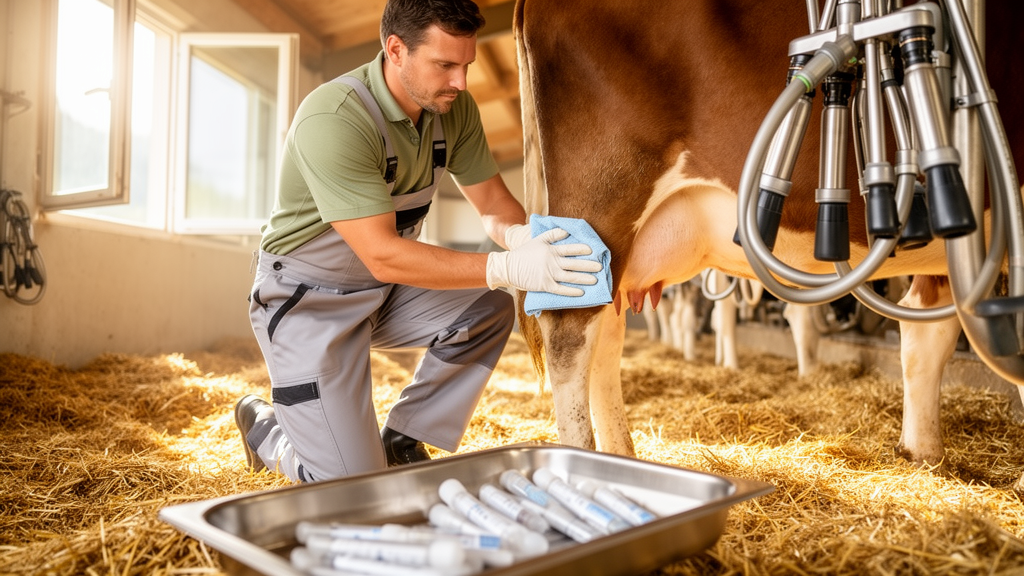
The quality of raw milk begins on the surface of the cow’s teat, and a new study of Austrian dairy farms has mapped how that microbial landscape shifts with the seasons, differs from farm to farm, and responds to routine cleaning.
In total, the researchers analysed 192 teat skin swabs taken from 382 cows. The focus on Clostridium spp. is significant for the dairy industry, because these endospore-forming bacteria are a major concern for cheesemakers, primarily causing the late blowing defect in hard and semi-hard cheeses.
The study’s central finding is that seasonal differences and variations in farm management significantly affected the diversity of the teat skin microbiota and the presence of Clostridium spp. In other words, the microbial community on a cow’s teat skin is not a fixed entity but one that changes with the time of year and with the specific conditions and practices of each farm.
Cleaning, by contrast, told a more nuanced story. Bacterial diversity before and after cleaning was not significantly different, meaning that routine teat cleaning did not measurably reshape the overall composition of the microbial community. However, cleaning did have a substantial effect on clostridial numbers: teat cleaning resulted in a mean reduction in clostridial pta-gene copy number of 83.3 percent.
This distinction matters because the pta gene serves as a molecular marker for quantifying clostridia, and the quantitative PCR approach allowed the researchers to specifically measure C. tyrobutyricum, a species of concern for cheesemakers because Clostridium spp. primarily cause the late blowing defect in hard and semi-hard cheeses. The culture-independent quantification of C. tyrobutyricum strongly correlated with culture-dependent results, although the mean counts obtained by culture-dependent analyses were higher.
Beyond the clostridia themselves, the study’s correlation analysis revealed the co-occurrence of other bacterial genera with C. tyrobutyricum on teat skin, including Acinetobacter and Facklamia. The correlation analysis revealed the co-occurrence of these bacterial genera with C. tyrobutyricum on teat skin, and the authors discuss the potential relevance of such findings for raw milk quality.
The connection between teat skin hygiene and cheese quality is the practical thread running through the work. As the authors note, the quality and microbial composition of raw milk critically influence cheese quality, and ensuring high-quality raw milk with minimal bacterial contamination requires adequate teat skin hygiene.
By combining sequencing and quantitative PCR across multiple farms and seasons, the study provides what the authors describe as a comprehensive analysis of the teat skin microbiota of Austrian dairy cows, revealing pronounced differences among farms, seasons and cleaning practices. The findings underscore that managing clostridial contamination at its source — the teat skin — involves both the consistency of cleaning routines and the broader context of farm management and seasonal conditions.
For dairy producers and cheesemakers, the study offers a detailed, culture-independent baseline of what lives on teat skin under real farming conditions, and quantifies how much routine cleaning can reduce the clostridial load even when it does not alter the broader bacterial community. The work was published as an open access article on 15 October 2026.
Subject of Research: Seasonal, farm and cleaning-related differences in the teat skin microbiota of Austrian dairy cows, with emphasis on Clostridium spp.
Article Title: Teat skin microbiota of dairy cows: a study of seasonal-, farm-, and cleaning-related differences with emphasis on Clostridium spp.
Article References: Peham, T., Burtscher, J., Zwirzitz, B., Neubauer, V., & Domig, K. J. (2026). Teat skin microbiota of dairy cows: a study of seasonal-, farm-, and cleaning-related differences with emphasis on Clostridium spp.. Animal Microbiome. https://doi.org/10.1186/s42523-026-00645-7
Image Credits: AI Generated
DOI: 10.1186/s42523-026-00645-7
Keywords: dairy cows, teat skin microbiota, Clostridium, raw milk quality, cheese defects, 16S rRNA sequencing, qPCR, farm hygiene, seasonal variation, Austria, late blowing defect, C. tyrobutyricum
News Source: Alan Morgan. (October 28, 2026). Teat skin microbes on Austrian dairy farms vary by season and farm, with cleaning cutting Clostridium sharply. Scienmag.