


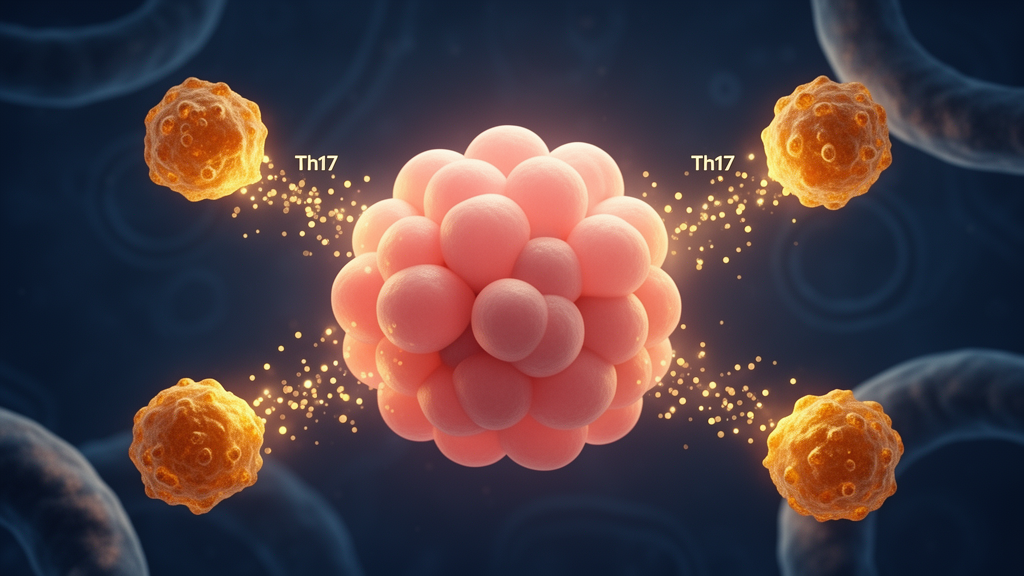
Cervical cancer cells can be coached into tolerating the very treatment meant to kill them, according to a laboratory study published in BMC Molecular and Cell Biology. Researchers report that Th17 cells — a subset of CD4-positive T helper cells defined by their production of the inflammatory cytokine IL-17 — reduced the sensitivity of cervical carcinoma cell lines to cisplatin, radiation, and the combination of both, and that this protection depended on activation of the AKT signaling pathway inside the tumor cells. The work, led by Fanglei Cao and Na Li, was published on 6 April 2026.
The finding matters because chemoradiotherapy, the combination of platinum-based chemotherapy with radiation, is the standard of care for locally advanced cervical carcinoma at stages beyond FIGO IIB. Yet relapse remains a substantial clinical problem. According to staging-based figures cited in the study, 8 to 26 percent of patients with cervical carcinoma experience disease recurrence, and recurrences most often appear within the first two years after primary therapy is completed. Drug tolerance in a subset of cases remains a significant challenge, and the mechanisms behind treatment resistance are only partly understood.
The experimental design was entirely in vitro. The team first generated Th17 cells in the laboratory by isolating naive CD4-positive T cells from peripheral blood mononuclear cells and culturing them for five to seven days with anti-CD3/CD28 stimulation together with TGF-beta, IL-6, IL-1beta, and IL-23, while neutralizing interferon-gamma and IL-4. Successful differentiation was confirmed by detecting IL-17A secretion in the culture supernatants using ELISA. The conditioned medium from these cultures, as well as recombinant human IL-17 alone, was then used to stimulate cervical carcinoma cells before cytotoxic treatment.
In the first set of experiments, HeLa cells were co-cultured with the in vitro-generated Th17 cells at a ratio of one Th17 cell to twenty cancer cells overnight. After the Th17 cells were removed, the cancer cells were exposed to escalating concentrations of cisplatin. The prior co-culture significantly reduced the sensitivity of HeLa cells to cisplatin-induced cell death and improved their viability. Parallel experiments showed that pre-stimulating SiHa and SW756 cells with recombinant IL-17A markedly enhanced cell viability after cisplatin treatment, with the effect most pronounced at the highest cisplatin dose tested, 6.25 micrograms per milliliter.
Radiation produced a parallel pattern. A single 6 Gy dose delivered with a calibrated X-ray irradiator reduced survival in all three tested cell lines, but pre-stimulation with recombinant IL-17 significantly enhanced survival after irradiation. To mimic clinical chemoradiotherapy in the dish, the researchers treated cells with cisplatin at 1.56 micrograms per milliliter for two hours as a radiosensitizer and then irradiated them with 6 Gy. The combined treatment significantly decreased viability across all three cell lines, yet preconditioning with recombinant IL-17 markedly blunted this response, leaving more cells alive. Conditioned medium from Th17 cultures similarly reduced the cells’ reactivity to chemoradiotherapy-induced death.
A key control experiment pointed to IL-17 as the responsible factor. When a neutralizing anti-IL-17 antibody, added to the conditioned medium two hours before administration at a concentration of 1 microgram per milliliter, was used to block IL-17 signaling, the protection conferred by the Th17-conditioned medium was completely abolished. The authors interpret this as evidence that IL-17 plays a crucial role in the Th17 cell-mediated chemoresistance they observed, although the experiments measure cell viability in culture rather than tumor behavior in patients.
To identify the pathway downstream of the IL-17 receptor, the team measured phosphorylated AKT at two regulatory sites, Thr308 and Ser473, using ELISA-based kits. Stimulation of SiHa and HeLa cells with Th17-derived conditioned medium produced a significant elevation of both pThr308-AKT and pSer473-AKT, indicating activation of the PI3K/AKT survival pathway. The researchers then used small interfering RNAs to knock down the two main AKT isoforms, AKT1 and AKT2, in the cancer cells. Both knockdowns markedly reduced the IL-17- or conditioned-medium-induced tolerance to treatment, and concomitant elimination of AKT1 and AKT2 achieved a complete reversal of the Th17-induced resistance. The authors conclude that Th17-induced resistance to combined therapy is determined by the AKT pathway.
The study was not without technical constraints, which the authors acknowledge. CaSki cells were initially included in the panel but displayed high variability in baseline growth and inconsistent responses to cisplatin and irradiation, so they were excluded from the mechanistic analyses. The remaining cell lines — HeLa, SiHa, and SW756 — carry distinct HPV backgrounds, and the authors note that IL-17-mediated AKT activation produced consistent trends in therapeutic tolerance across them, suggesting the mechanism is not restricted to a single HPV subtype. The authors also state that although the observed changes in cell viability were modest, they were consistent and reproducible across multiple cell lines and at least three independent biological replicates, while noting that the small sample size limits the generalizability of the findings.
Mechanistically, the result fits a broader picture in which inflammation shapes the tumor microenvironment of HPV-driven cancers. The introduction to the paper reviews prior work showing that HPV-transformed keratinocytes help establish a pro-inflammatory, pro-tumor milieu during cervical oncogenesis, that invasive cervical neoplasms are often associated with intense inflammatory infiltration, and that elevated inflammatory cytokine levels correlate with adverse prognosis. Previous studies have also documented an increase in immune-suppressive monocytes in the circulation of cervical carcinoma patients after chemoradiotherapy, and Th17 cells have been characterized as effector cells with high proliferative capacity and an anti-apoptotic phenotype. The new study adds a specific, testable axis: IL-17 engaging its receptors on cervical carcinoma cells and activating AKT, which promotes survival and anti-apoptotic signaling under cytotoxic stress.
The clinical implications, at this stage, are hypotheses rather than established practice. The authors suggest that inhibiting Th17 differentiation or function, or targeting AKT directly with small-molecule inhibitors or monoclonal antibodies, could in principle restore the sensitivity of cancer cells to chemoradiotherapy in tumors characterized by Th17 infiltration and AKT pathway activation. They also cite prior observations that PIK3CA mutations in cervical carcinoma patients lead to aberrant AKT activation associated with worsened post-chemotherapy prognosis, making the PI3K/AKT pathway an attractive target for clinical studies. But every step supporting these ideas was performed in cultured cells, with cell viability as the readout. Whether Th17-derived IL-17 contributes to treatment resistance in actual patients, and whether intercepting this axis would improve outcomes or reduce early recurrence, will require patient-based studies. What the current work establishes is a plausible, AKT-dependent mechanism by which an inflammatory T cell population could help cervical cancer cells survive the standard treatment — a lead that the authors hope will guide future strategies combining immune modulation with chemoradiation.
Subject of Research: Th17 cell-derived IL-17 signaling and AKT-mediated chemoradiotherapy tolerance in cervical carcinoma cell lines
Article Title: Chemoradiotherapy-induced Th17/IL-17 signaling correlates with therapeutic tolerance and early recurrence in cervical carcinoma
Article References: Cao, F., & Li, N. (2026). Chemoradiotherapy-induced Th17/IL-17 signaling correlates with therapeutic tolerance and early recurrence in cervical carcinoma. BMC Molecular and Cell Biology, 27(1), Article 29. https://doi.org/10.1186/s12860-026-00586-8
Image Credits: AI Generated
DOI: 10.1186/s12860-026-00586-8
Keywords: cervical cancer, Th17 cells, IL-17, AKT signaling, chemoradiotherapy resistance, cisplatin, cell culture study, PI3K/AKT pathway, tumor microenvironment, HPV, siRNA knockdown, therapeutic tolerance
News Source: Nathaniel Bowman. (October 30, 2026). Immune Cells That Sabotage Treatment: Th17 Signals Help Cervical Cancer Cells Survive Therapy. Scienmag.



