


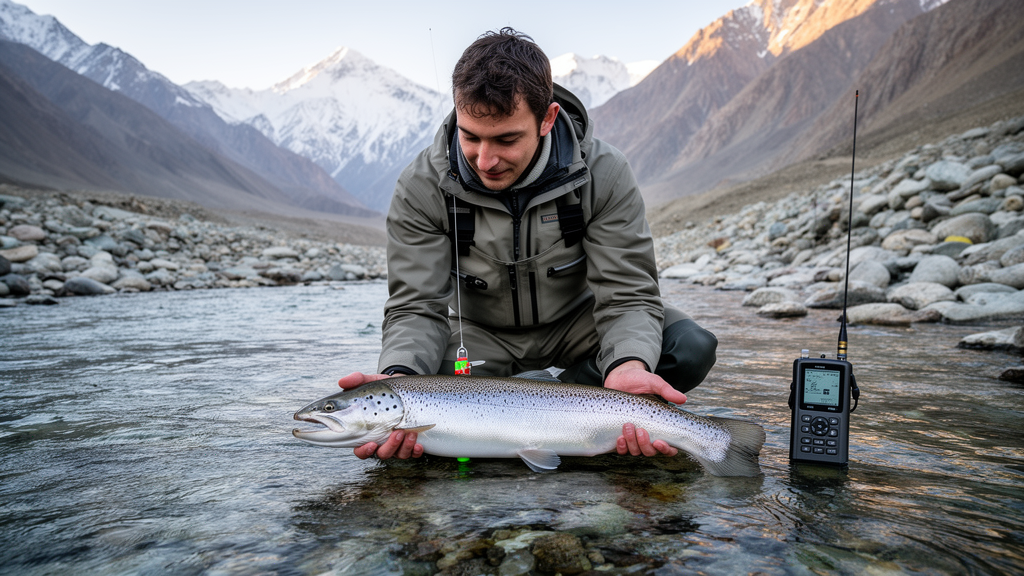
Freshwater fish in Central Asia have long remained a biological blank spot, but a new telemetry study has produced the first detailed picture of how one important species moves through a mountain river system. Researchers tracked 27 snow trout (Schizothorax eurycephalus), cyprinid fish of ecological and economic importance in the region, using radio transmitters in the transboundary Shakhimardan River basin in the Alay mountain range, which spans Uzbekistan and Kyrgyzstan. The tracking continued for almost two years, making it the first biotelemetry-based research on fish in Central Asia.
The study, published open access in the journal Animal Biotelemetry, found that the fish moved over distances of up to 18 kilometers and followed a clear seasonal migration pattern: they traveled downstream in spring and returned upstream in autumn.
Habitat preferences emerged as clearly as movement patterns. The tracked snow trout mostly used habitats in medium-to-fast flowing sections of the rivers with large substrates on the riverbed. To quantify these patterns, the team analyzed movement distances and directions with descriptive statistics and linear mixed models, while habitat use was assessed using ordinal logistic regression, allowing them to relate fish positions to the physical characteristics of the river environment.
The motivation for the work lies in the mounting pressure on freshwater biodiversity in Central Asia from anthropogenic impacts. Snow trout of the genus Schizothorax are among the region’s most significant fish, yet fundamental knowledge needed for their conservation, such as seasonal movement patterns and habitat preferences, has been limited. By filling this gap, the study provides baseline information that conservation planners in Uzbekistan, Kyrgyzstan and neighboring countries have previously lacked.
The authors argue that their findings underline the need to preserve aquatic connectivity and structurally diverse habitats in mountain rivers. Migratory species like snow trout depend on unobstructed routes between seasonal habitats, including the wintering grounds in groundwater-influenced tributaries. Incorporating these insights into hydropower development and design, as well as river restoration programs, the study concludes, can help maintain ecological integrity while supporting sustainable development in the region. Because the article was released as an accepted-manuscript version subject to further edits before the final Version of Record, some details may be refined in the published final version.
Subject of Research: Seasonal migration and habitat use of radio-tracked snow trout in a Central Asian mountain river
Article Title: Seasonal migration and habitat shifts of the cyprinid fish Schizothorax eurycephalus in a Central Asian mountain river
Article References: Omonov, O., Verhelst, P., Coeck, J., Dockx, R., Goethals, P., Karimov, B. K., Karimov, E., Oldoni, D., Schletterer, M., & Hayes, D. S. (2026). Seasonal migration and habitat shifts of the cyprinid fish Schizothorax eurycephalus in a Central Asian mountain river. Animal Biotelemetry. https://doi.org/10.1186/s40317-026-00488-8
Image Credits: AI Generated
DOI: 10.1186/s40317-026-00488-8
Keywords: snow trout, Schizothorax eurycephalus, biotelemetry, fish migration, Central Asia, Shakhimardan River, habitat use, thermal refugia, mountain rivers, aquatic connectivity, hydropower, river conservation
News Source: Drew Townsend. (October 30, 2026). Radio-Tracked Snow Trout Reveal First Fish Migration Data From Central Asia. Scienmag.



