


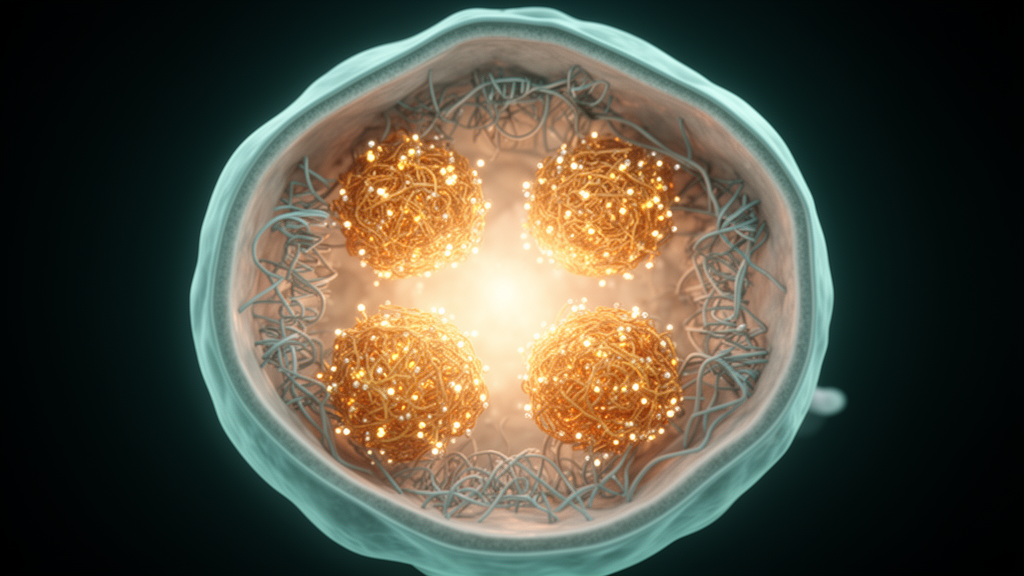
A new study published in EMBO Reports shows that the protein ZC3H14, once switched on by the enzymes CDK12 and CDK13, is required to build nuclear speckles — subnuclear compartments where newly made pre-messenger RNA is spliced — during zygotic splicing activation, the burst of RNA processing that accompanies the major wave of zygotic genome activation at the two-cell stage in mice. When that phosphorylation is blocked, either genetically or with a small-molecule inhibitor, nuclear speckles fail to assemble properly, splicing falters, incomplete transcripts pile up in the nucleus, and embryos arrest at the two-cell stage.
The research, led by Yang Wang, Hua Zhang and colleagues in Heng-Yu Fan’s laboratory, began with a localization question. Using immunofluorescence staining, the team tracked endogenous ZC3H14 across oocyte and early embryonic stages in mice. The protein formed prominent nuclear speckles in growing oocytes and again at the two-cell stage, when major zygotic genome activation takes place and thousands of new zygotic transcripts must be capped, tailed and spliced. In fully grown oocytes the speckles became sparser, and in ovulated metaphase II oocytes — a transcriptionally silent stage — the protein adopted a diffuse distribution. Weak speckles reappeared at the pronuclear stages coinciding with minor zygotic genome activation, then increased dramatically in number and size at the two-cell stage.
That pattern suggested a functional link between ZC3H14 speckles and active RNA processing. The team confirmed that ZC3H14 completely co-localized with SRSF2 and SRRM2, canonical nuclear speckle components, and with PABPN1, another RNA-binding protein, as well as with poly(A) RNA itself. ZC3H14 is one of four core components of the PAXT complex, a nuclear RNA degradation pathway that targets long polyadenylated RNAs, including prematurely terminated RNAs known as ptRNAs. Its expression was high in oocytes and early embryos, consistent with a specialized role during the maternal-to-zygotic transition.
To test that role, the researchers generated Zc3h14 knockout mice. The animals were viable, but female fertility was markedly reduced: over seven months of fertility testing, knockout females produced fewer total pups and fewer pups per litter than wild-type controls. Their ovaries were smaller, and after superovulation they released significantly fewer mature oocytes — roughly 35 on average in wild-type four-week-old females versus significantly fewer in knockouts. The most striking defect emerged after fertilization. About 70 percent of embryos from knockout females arrested during the one-cell to two-cell transition, and almost none reached the blastocyst stage. Microinjecting ZC3H14 mRNA into knockout zygotes partially rescued development, indicating that the oocyte-supplied, maternal protein is what matters at this stage.
ZC3H14 carries four known phosphorylation sites at serine residues 343, 409, 475 and 515, identified in earlier work on zebrafish, where failure to phosphorylate the protein in CDK13-mutant cells leads to ptRNA accumulation and melanoma. The team mutated all four serines to alanine to create a phosphorylation-deficient 4SA mutant, and to aspartic acid to create a phospho-mimicking 4SD mutant. When 4SA mutant mRNA was microinjected into wild-type fertilized eggs, most embryos arrested at the two-cell stage and failed to reach the blastocyst, whereas control embryos expressing either GFP or wild-type ZC3H14 developed normally. The 4SA mutation also caused ZC3H14 speckles to disappear or diminish in growing oocytes and two-cell embryos, with the strongest effect at the two-cell stage.
To identify the kinase responsible, the researchers used THZ531, a small-molecule inhibitor that binds the C-terminal domain of CDK12 and CDK13 and blocks their enzymatic activity. THZ531 treatment arrested zygotes at the two-cell stage, mirroring the 4SA phenotype, and sharply reduced endogenous ZC3H14 speckles in one-cell and two-cell embryos. Notably, the inhibitor did not significantly affect oocyte meiotic maturation, as germinal vesicle breakdown and polar body emission rates were unchanged, suggesting the requirement is specific to early embryonic development under these conditions. Small interfering RNA knockdown of Cdk13 produced the same two-cell arrest, providing an independent genetic validation. Crucially, when the phospho-mimicking 4SD mutant was overexpressed in THZ531-treated embryos, some fertilized eggs developed normally to the blastocyst stage, indicating that the drug’s developmental effect is largely mediated through ZC3H14.
The team then ruled out simpler explanations. An ethynyl uridine incorporation assay and staining for phosphorylated RNA polymerase II showed that THZ531 at this concentration did not suppress global transcription in two-cell embryos. Alpha-amanitin, a potent transcription inhibitor, did not disrupt ZC3H14 localization either, showing that speckle assembly does not depend on newly transcribed zygotic RNAs. And pladienolide B, an SF3B1-targeting splicing inhibitor, reduced but did not abolish ZC3H14 speckle formation, indicating that speckles are not merely a downstream byproduct of active splicing. Together, these experiments support a causal model in which CDK12/13-mediated phosphorylation of ZC3H14 acts upstream of nuclear speckle reassembly during zygotic splicing activation.
Transcriptome analysis reinforced the mechanistic picture. Smart-seq2 sequencing of THZ531-treated and control embryos revealed transcriptional differences already at the one-cell stage, but far stronger effects at the two-cell stage: 3,247 genes were downregulated and only 54 upregulated in treated embryos. Downregulated genes were enriched for RNA splicing and degradation, ribosome biogenesis and p53 signaling pathways, and 34.5 percent of the 353 known mouse splicing factors showed reduced expression. Analysis of alternative splicing events showed reductions across all five major classes — skipped exons, retained introns, mutually exclusive exons and alternative 5′ and 3′ splice sites. Full-length transcriptome sequencing on the PacBio platform confirmed a shift in isoform structure and a decrease in isoform switch events after treatment.
The downstream consequence was an accumulation of prematurely terminated RNAs. By comparing first-exon and last-exon expression — the first exon marks both ptRNAs and full-length mRNAs, while the last exon marks only full-length products — the researchers found that first-exon levels rose globally in THZ531-treated two-cell embryos while last-exon levels stayed flat. RT-qPCR validation on individual transcripts, including Ddx39b, Phgdh and Gsto2, confirmed the pattern, and integrative genomics viewer traces showed complete 5′ exons with missing 3′ exons. To test whether ptRNA accumulation itself harms embryos, the team overexpressed a truncated Ddx39b construct lacking its final four exons in zygotes; this caused significant two-cell arrest, while full-length DDX39B had no effect. Phosphorylation-site mutations also weakened ZC3H14’s binding to target mRNAs, including PABPN1 transcripts and several splicing factor mRNAs, and disrupted its direct interaction with PABPN1, linking phosphorylation to both RNA binding and speckle assembly.
The authors emphasize the limits of their model. The work was conducted entirely in mice, and whether the same mechanism operates in human embryos, where major zygotic genome activation occurs later, at the four- to eight-cell stage, remains untested. Systemic knockout mice are viable and develop normally apart from reduced female fertility, pointing to a context-specific requirement during the extraordinary splicing demand of zygotic genome activation rather than a universal role in all cell types, where redundant RNA-binding proteins may compensate. The knockout produces a fully penetrant two-cell arrest, whereas acute THZ531 treatment is quantitatively less severe, likely because drug inhibition is incomplete and reversible. Still, the study establishes ZC3H14 phosphorylation as a critical regulatory node connecting kinase activity, nuclear architecture and RNA quality control at one of the most fragile junctures of early mammalian life — and raises the possibility that mutations in this pathway could contribute to some cases of human infertility.
Subject of Research: The role of ZC3H14 phosphorylation by CDK12/13 in nuclear speckle assembly and zygotic splicing activation during early mouse embryo development
Article Title: ZC3H14 phosphorylation is required for nuclear speckle assembly during zygotic splicing activation in mice
Article References: Wang, Y., Zhang, H., Hu, Z.-W., Su, D., Zhao, J., Fan, X.-Y., Liu, L.-L., & Fan, H.-Y. (2026). ZC3H14 phosphorylation is required for nuclear speckle assembly during zygotic splicing activation in mice. EMBO Reports. https://doi.org/10.1038/s44319-026-00950-x
Image Credits: AI Generated
DOI: 10.1038/s44319-026-00950-x
Keywords: ZC3H14, CDK12/13, nuclear speckles, zygotic genome activation, splicing, mouse embryos, female fertility, ptRNA, PAXT complex, THZ531, maternal-effect gene, preimplantation development
News Source: Juliet Wilcox. (October 30, 2026). Phosphorylated RNA-binding protein drives nuclear speckle assembly in mouse embryos. Scienmag.



