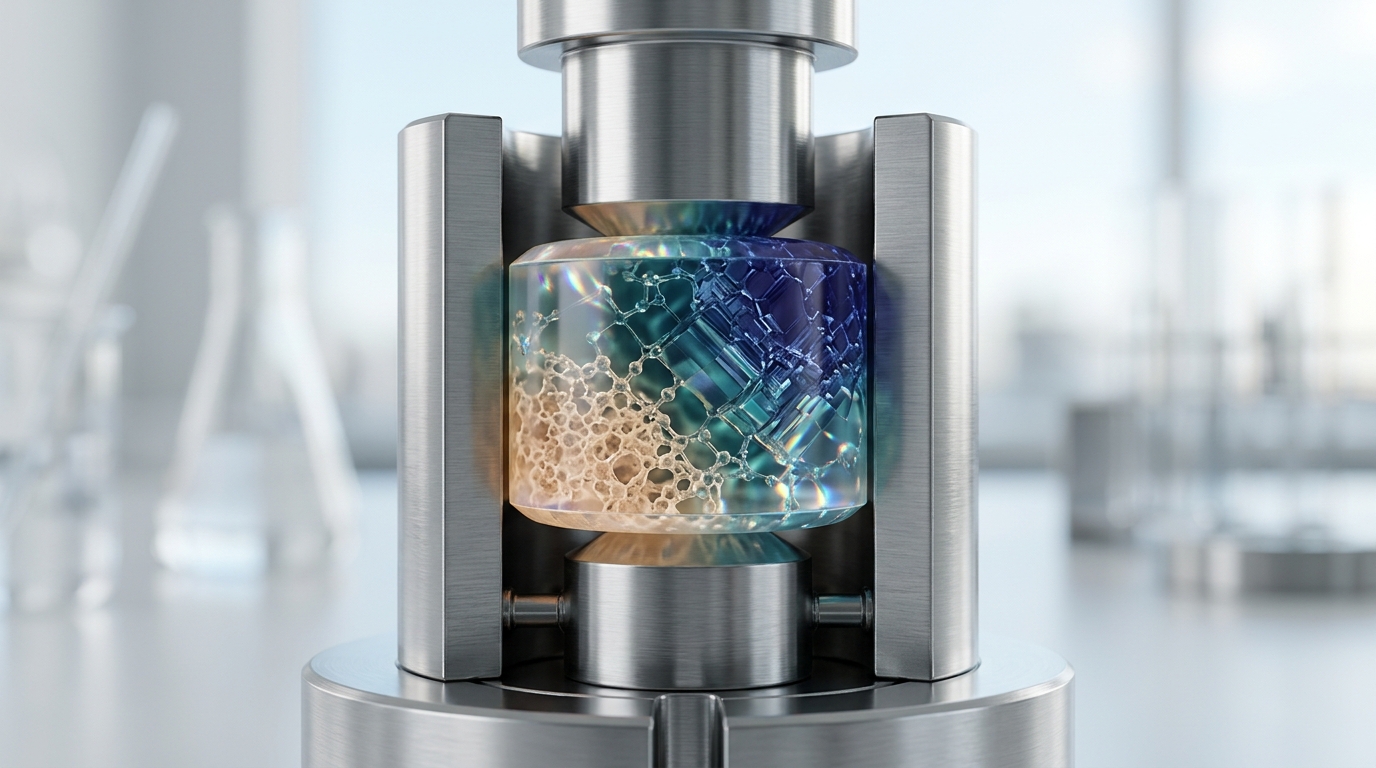
Pharmaceutical tablets are not just pressed powders; they are dense, high-pressure environments where the very crystals inside a drug can be forced to rearrange themselves. A new study shows that a laboratory device called a compaction simulator can catch these hidden transformations in real time by simply tracking how the density of the powder bed changes as pressure rises and falls. The work, published in AAPS Open, demonstrates the approach on urea, a small organic compound long known to switch between two crystalline forms under pressure, and establishes the technique as a fast, material-sparing way to probe whether an active pharmaceutical ingredient will survive tableting with its solid form intact.
Polymorphism, the ability of a single molecule to pack into multiple distinct crystalline arrangements, is a central concern in drug development. Different polymorphs can differ in thermodynamic stability, dissolution behavior, mechanical properties, and spectroscopic signatures, all of which feed directly into a drug product’s stability, appearance, and manufacturability.
Historically, researchers have detected compression-induced phase changes in drugs such as caffeine, sulfabenzamide, matprotiline hydrochloride, fostedil, famotidine, carbamazepine, and chlorpropamide using off-line techniques like differential scanning calorimetry, powder X-ray diffraction, or Raman spectroscopy applied after the tablet was made. More recently, in-situ mechanical Raman spectroscopy has allowed real-time observation of the transformation as it happens. The new study adds a complementary, remarkably simple option: instead of measuring a spectroscopic fingerprint, it watches the bulk density of the compact inside the die, using the fact that a switch from one crystal form to another with a different density should produce a visible kink in the density-pressure curve.
The underlying logic rests on how powders densify. Under normal conditions, the relationship between applied pressure and compact density is smoothly concave, reflecting progressive deaeration of the powder bed, particle rearrangement, and elastic and plastic deformation of the particles. A sudden, step-like jump in density at a particular pressure range therefore signals that the solid itself has changed form, because the new packing occupies a different volume per unit mass. In the study, the authors used a Styl’One Evolution compaction simulator with 6-millimeter flat-faced tooling, applying a five-cycle compression profile of successive one-second rise and one-second fall segments at roughly 2.6 millimeters per second, with pressures reaching up to 1200 megapascals. Force-displacement data were recorded continuously and converted into pressure-density profiles using the punch dimensions and the measured mass of each ejected compact.
When powdered urea in its ambient-pressure form I was compressed, the density-pressure profile showed a sharp increase between 600 and 900 megapascals. Microcrystalline cellulose, a common tablet excipient, showed no such jump, confirming that the feature was specific to urea’s solid-state behavior rather than a generic artifact of compression. Urea is known from high-pressure physics to transform from form I, with a crystal density of 1.331 grams per cubic centimeter, to form III, with a density of 1.505 grams per cubic centimeter, at roughly 500 megapascals under hydrostatic conditions, and to a denser form IV near 3 gigapascals. The density increase observed in the simulator, approximately 0.15 grams per cubic centimeter, closely matches the 0.17 grams per cubic centimeter difference between forms I and III, pointing squarely to that transition. The shift to slightly higher pressures compared with the classical 500-megapascal threshold likely reflects the difference between uniaxial die compression and the hydrostatic pressure of a diamond anvil cell.
Crucially, the transformation proved reversible. During decompression, the density began to fall around 500 megapascals, indicating that form III converted back to form I as the load was released. This reversibility persisted across repeated compression-decompression cycles; the second cycle’s profile was closely reproduced in subsequent cycles up to five. The authors attribute the small difference between the first and later cycles to irreversible particle rearrangement, breakage, and plastic deformation that occur only during the initial compaction, while the remaining curvature in later cycles reflects ordinary reversible elastic deformation. A slight drift toward higher densities in cycles two through five was traced to a small amount of urea escaping into the gap between punch and die, forming visible flash along the tablet edges; because density was calculated assuming constant mass, the reduced powder volume registered as a modest density increase.
X-ray diffraction of both the starting powder and the ejected tablet confirmed that each was phase-pure form I, providing an independent check that the in-die density signature was tracking a transient, pressure-driven transformation rather than a permanent chemical or physical change. The authors note that fully characterizing the transformation over the broad high-pressure range would require in-die structural probes that were not available in this study, so the density method identifies the event and its reversibility but does not by itself determine the crystal structure of the high-pressure phase inside the die.
To sharpen detection, the researchers examined the first derivative of the density-pressure curve, that is, the rate of density change with pressure. For microcrystalline cellulose, this derivative decreases monotonically, as expected for a phase-stable excipient. For urea, the derivative exhibits a distinct peak in the 600 to 900 megapascal window, corresponding to the abrupt crystal density change of the phase transformation. The derivative approach is more sensitive than the raw density profile when the density difference between forms is small or when only a partial transformation, including amorphization, occurs. It also naturally cancels the effect of material lost into the punch-die gap, because the rate of density change with pressure is independent of the absolute amount of material being compressed, yielding reproducible rate plots across successive compressions. An additional diagnostic is that decompression and subsequent recompressions will show no sudden density change if the transformation is irreversible, so the shape of the cycling curves itself helps distinguish reversible from one-way transitions.
The practical appeal of the method lies in its economy. Because in-die data collection typically requires less than 200 milligrams of active ingredient, a formulator can screen a candidate compound for pressure-induced phase transformations using a tiny sample, without dedicating material to large-scale trials or waiting for off-line spectroscopic analysis. The study’s authors emphasize that the approach is an indicator of gross phase transformation and should not be the sole tool for detecting compression-induced changes in active ingredients; systems where the polymorphs differ only minimally in density, or where transformation is partial, may evade detection by density alone.
Overall, the work showcases compaction simulation as a material-sparing, in-process window into the solid-state behavior of drugs under the exact mechanical conditions of tableting. By dynamically measuring density and its pressure derivative, the technique caught a known reversible polymorph transition of urea in situ, illustrating how a routine compaction run can double as a solid-state screening experiment. The authors suggest that further investigation into the method’s broader utility, particularly for cases where density differences between forms are subtle, will help define its place alongside established analytical techniques in pharmaceutical development.
Subject of Research: Pressure-induced reversible polymorph transformation of urea detected by monitoring in-die density during powder compaction
Article Title: Revealing a pressure-induced reversible polymorph transformation by monitoring in-die density during powder compression
Article References: Vreeman, G., & Sun, C. C. (2026). Revealing a pressure-induced reversible polymorph transformation by monitoring in-die density during powder compression. AAPS Open, 12(1), Article 69. https://doi.org/10.1186/s41120-026-00206-x
Image Credits: AI Generated
DOI: 10.1186/s41120-026-00206-x
Keywords: polymorphism, urea, compaction simulator, in-die density, tablet compression, phase transformation, form I, form III, pharmaceutical analysis, material-sparing, solid-state, X-ray diffraction
News Source: Ophelia Keating. (November 4, 2026). Tablet Press Trick: Watching Density Shifts Expose Hidden Drug Crystal Changes. Scienmag.