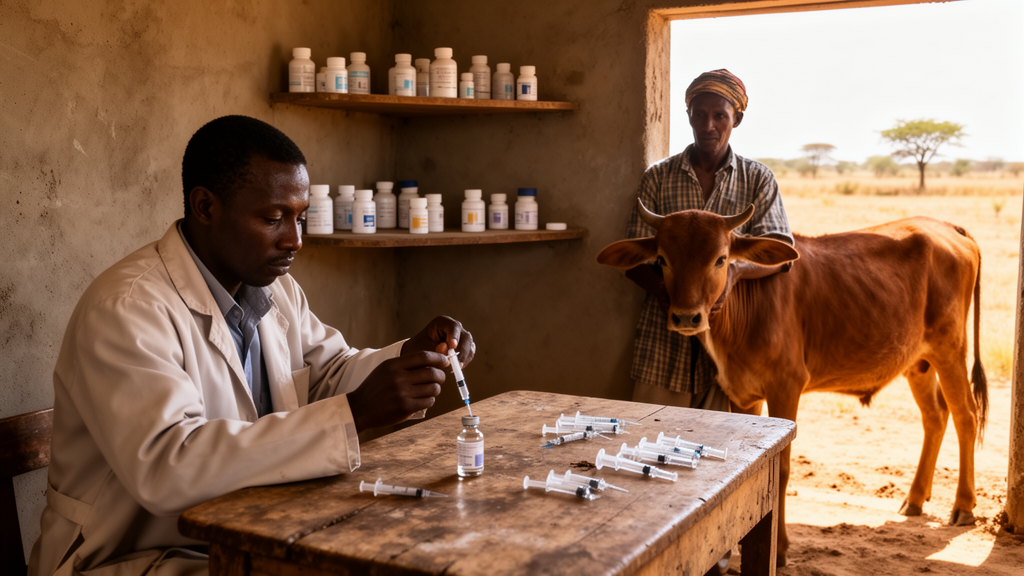
A cross-sectional survey of veterinary drug practices in Ethiopia’s Wolaita Zone has documented a chain of supply and use riddled with weak points: a narrow range of mostly imported antimicrobials and anthelmintics, questionable transport and storage conditions, drugs sold without prescriptions, and animals routinely treated by farmers themselves rather than trained professionals. The study, conducted between May and August 2021 and published in the journal Dairy Science and Management, surveyed 101 animal health professionals and 149 livestock owners across five districts and offers one of the first region-specific pictures of how veterinary medicines circulate in this part of southern Ethiopia.
Sites were selected purposively based on accessibility, the availability of veterinary services and participants’ willingness to take part, a design choice the authors themselves flag as a potential source of bias.
What the teams found in the drug stores was striking for its narrowness. Only twenty-three different brands of antimicrobial and anthelmintic drugs were circulating in the study districts. Antibiotics accounted for 60.86 percent of these brands and anthelmintics for 39.14 percent. Oxytetracycline was the single most common antibiotic, making up 26.1 percent of the brands identified, followed by the penicillin-streptomycin combination PenStrep and sulfa drugs. Among the antiparasitic products, albendazole and ivermectin each represented 17.4 percent of brands, while antiprotozoal agents including isometamidium chloride hydrochloride and diminazene diaceturate together accounted for 21.7 percent. These drugs were used against a wide spread of conditions affecting the musculoskeletal system, skin, digestive tract, respiratory system, reproductive tract and general systemic health.
The supply side was equally concentrated. Of the twenty-three brands, 60.9 percent were manufactured in and imported from China, followed by India at 21.8 percent and the Netherlands at 8.7 percent. Chinese-made products were the most widely distributed across the zone’s veterinary drug stores, a pattern consistent with earlier Ethiopian studies that found antiprotozoal agents in particular flowing largely from Chinese manufacturers. Supply reached the districts through both government veterinary suppliers and licensed private traders: 73.3 percent of animal health professionals reported purchasing from licensed private traders, 45.6 percent obtained drugs from government pharmacies, and among livestock owners, 54.4 percent said they bought medicines from licensed private drug stores. The authors also note that illegal drug smugglers obtain products from unauthorized retailers and the black market, raising the possibility that smuggled, quality-unverified drugs are reaching end users through the same clinic and pharmacy networks.
The handling picture was mixed and, in places, contradictory. On the positive side, 86.14 percent of the surveyed professionals said they used special vehicles to transport drugs, 89.11 percent reported storing drugs according to manufacturer instructions, 93.07 percent said they sold drugs only with appropriate prescriptions, and 84.16 percent claimed to inform owners about withdrawal periods. Nearly all professionals, 98.02 percent, said they checked expiration dates, and 94.06 percent disposed of expired drugs by burial or burning. Most determined doses from both the animal’s age and body weight. Yet the direct observations told a darker story: the study identified inappropriate transportation and storage conditions, the sale of drugs without prescriptions, failure to advise owners on withdrawal periods, and the administration of veterinary drugs by non-professionals. Every one of the 101 professionals relied on tentative, empirical diagnosis, with no definitive diagnoses recorded anywhere in the survey.
The farmers’ side of the data explains why these gaps matter. About 53 percent of the 149 animal owners reported buying and administering drugs themselves when their animals fell ill, 32 percent preferred visiting a nearby veterinary clinic, and 14 percent relied on traditional medicines. All owners said they received instructions on drug use from a veterinarian or pharmacist, but treatment outcomes were uneven: 53 percent were satisfied with the therapeutic response, 43.62 percent reported only partial relief, and 3.36 percent said the drug had no effect at all. Many of the interviewed farmers had limited formal education, 38.26 percent could not read, which the authors note hampers the ability to read drug labels, typically written in English, leading some farmers to identify medicines by color alone.
The disease burden reported by owners helps explain the demand for these drugs. Conditions with general systemic signs, including acidosis, anthrax, lumpy skin disease, foot and mouth disease, orf, tetanus, trypanosomosis, Newcastle disease and babesiosis, accounted for 34.89 percent of reported cases. Musculoskeletal and integumentary problems such as blackleg, ectoparasites, mastitis, lameness, actinomycosis and warts made up 28.86 percent, digestive complaints including bloat, gastrointestinal parasites, fasciolosis and Peste des Petits Ruminants accounted for 20.13 percent, respiratory conditions for 10.1 percent, and reproductive problems such as dystocia and abortion for 6.04 percent. Both owners and professionals singled out trypanosomosis as a major cattle health challenge with high mortality and substantial economic impact, which helps explain why diminazene diaceturate was among the most commonly purchased drugs by local farmers despite evidence from other researchers that it fails to cure clinical cases of dourine in horses.
The public health stakes are considerable. Ethiopia holds the largest livestock population in Africa, with roughly 65 million cattle, 40 million sheep, 51 million goats, 8 million camels and 49 million chickens as of 2020, and veterinary drugs underpin much of that productivity. But the same survey data feed into a well-documented risk chain: inappropriate antibiotic use in animals contributes to the emergence of resistant bacteria that can be transmitted to humans, and gastrointestinal organisms such as Escherichia coli, Salmonella, Campylobacter and Enterococcus are already developing resistance. The authors also emphasize that antimicrobial resistance can develop even under correct and judicious use because of natural evolutionary pressure on bacteria, and that misuse adds allergic reactions and economic burdens on top of the resistance threat. Drug residues in meat and animal-derived products from treated animals pose a further hazard to consumers.
The study’s limitations deserve emphasis. The purposive sampling may have introduced bias and limits representativeness, self-reported answers are vulnerable to social desirability bias, the cross-sectional design cannot capture change over time, and the focus on a single zone restricts generalizability. Language and literacy barriers may also have affected response accuracy. The authors describe the work as a preliminary, pilot survey rather than a definitive account of the region.
Even with those caveats, the recommendations follow directly from the findings: continuous awareness programs for food animal producers, capacity building and training for veterinary professionals, routine drug quality assessments, and strict regulation and enforcement of drug control and administration. The authors also call for a broader range of effective, licensed antimicrobials and anthelmintics in the region, noting that Ethiopia has limited veterinary drug supplies and no newly approved alternatives to combat resistance. In a system where more than half of farmers treat their own animals, where every professional diagnosis is tentative, and where nearly two-thirds of the drug supply comes from a single exporting country, the margin between a working treatment and a failed one, between a safe food product and a contaminated one, depends on practices the survey suggests are frequently not being followed.
Subject of Research: Handling, sources and use of veterinary antimicrobials and anthelmintics among animal owners and veterinary practitioners in the Wolaita Zone, Southern Ethiopia
Article Title: Veterinary drugs handling and usage among the animal owners and veterinary practitioners in Wolaita Zone, Southern Ethiopia
Article References: Fesseha, H., Gashaw, M., Mathewos, M., & Kebede, I. A. (2025). Veterinary drugs handling and usage among the animal owners and veterinary practitioners in Wolaita Zone, Southern Ethiopia. Dairy Science and Management, 2(1), Article 16. https://doi.org/10.1186/s44363-025-00016-8
Image Credits: AI Generated
DOI: 10.1186/s44363-025-00016-8
Keywords: veterinary drugs, antimicrobials, anthelmintics, Ethiopia, Wolaita Zone, livestock, drug handling, antimicrobial resistance, self-medication, withdrawal periods, drug storage, cross-sectional survey
News Source: William Thompson. (October 29, 2026). Survey Finds Unsafe Veterinary Drug Practices in Southern Ethiopia. Scienmag.