Their analysis focuses on 18 fungal and oomycete quarantine organisms that threaten forests or trees in the EU, most of which have either never been reported in Europe or persist only in limited distributions.
The regulatory architecture itself is layered and sophisticated. The Plant Health Regulation establishes quarantine organisms as pests with a clearly defined identity, absence or limited distribution within the EU, the capacity to enter and spread, significant environmental and economic impact, and feasible measures to prevent their entry or establishment. Operationally, the system works through three complementary layers: import controls that prevent quarantine organisms from arriving, a plant passport system that regulates movement of plants within the EU internal market, and coordinated national surveillance programs in which field operators conduct visual inspections, collect symptomatic tissues, and submit samples for official laboratory analysis. High-risk taxa such as Abies, Castanea, Quercus, and Pinus, along with bark materials, are outright prohibited from import from third countries under Implementing Regulation (EU) 2019/2072.
The EU has regulated plant health since 1977, when Council Directive 77/93/EEC created the first list of regulated quarantine organisms, including 17 fungal species, some still regulated today. Major milestones followed: the removal of internal border controls and introduction of plant passports in 1993, a 2000 update that redefined regulated pests and strengthened survey obligations, the 2016 Plant Health Regulation with its risk-based approach and formalized pest categories, and 2024 amendments creating an EU plant health emergency team. As of March 2026, the implementing regulation lists more than 350 quarantine organisms not known to occur in the EU, including 20 priority pests requiring annual surveys. Notably, none of those priority pests is a fungal or oomycete pathogen of forest trees, which means the 18 forest pathogens examined in this analysis represent a selected subset rather than the top of the official priority list.
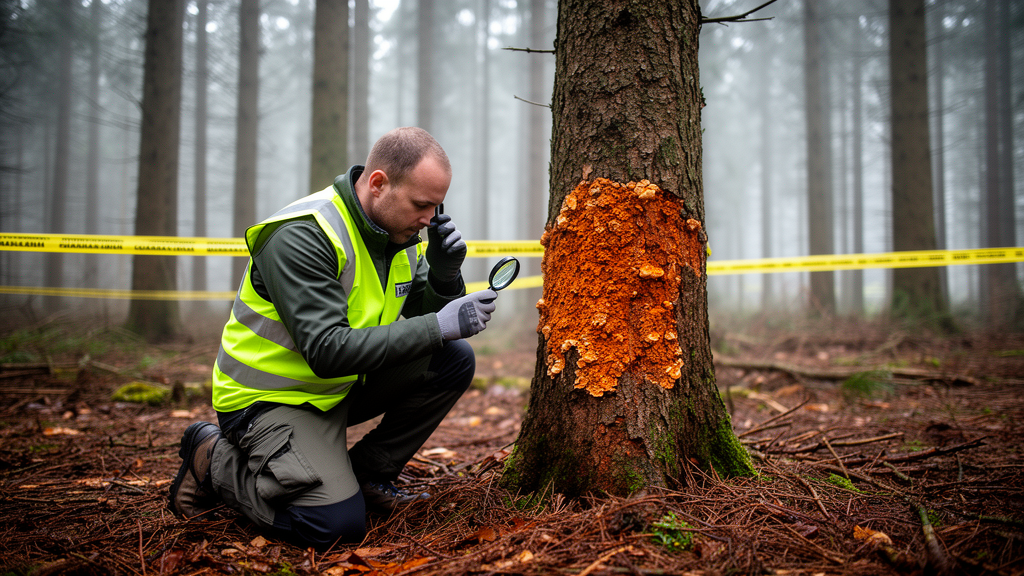
The first practical weakness lies in the field. Monitoring quarantine organisms in forest ecosystems is inherently difficult because of the vast areas involved relative to limited observation effort, particularly in natural forests; European forests cover more than 230 million hectares, roughly 35 percent of the total land area. Symptoms on standing trees are often subtle, transient, and highly dependent on season, host organ, and environmental conditions. Field operators rarely encounter quarantine organisms during routine monitoring, which limits their familiarity with the relevant symptomatology and raises the risk of overlooking infections or misattributing them to common European pathogens or abiotic stresses. Oak wilt, caused by Bretziella fagacearum, exemplifies the problem: its early leaf-wilting symptoms closely resemble bacterial leaf scorch, anthracnose, bur oak blight, drought stress, or chemical injury.
Timing and biology compound the difficulty. Root pathogens often require the labor-intensive exposure of roots for confirmation, while above-ground dieback may appear only years after infection, as seen with Coniferiporia species. Some pathogens offer extremely narrow sampling windows: Cronartium rusts produce their key diagnostic structures, aecia, only briefly in spring. Fusarium circinatum may remain latent, requiring surveillance of asymptomatic trees or spore trapping, and can persist symptomless in local grasses and weeds that serve as inoculum reservoirs. The authors propose remedies including visual symptom repositories built with experts from regions where the pathogens are endemic, sentinel plantations of susceptible European species established under natural infection pressure abroad, and stronger knowledge of sporulation dynamics, latency, and environmental triggers.
Deeper still are gaps in basic biology. For many quarantine organisms, host range and pathogenicity are unknown or only partially known, which undermines the precision of targeted surveillance. Host vulnerability, the ability to develop disease, and competence, the capacity to produce and transmit the pathogen, are generally poorly understood, and rust genera such as Cronartium and Gymnosporangium involve multi-host life cycles with taxonomically unrelated alternate hosts that remain only partially characterized. Unpredictable host jumps add another layer of uncertainty. Phytophthora ramorum is the cautionary tale: European surveys initially focused on Fagaceae based on the pathogen’s behavior in North America, yet in the United Kingdom its main host turned out to be the conifer Larix kaempferi, a mismatch that fundamentally altered management and jeopardized eradication. More recently, Davidsoniella virescens, a maple pathogen from North America, was detected on dead Fagus sylvatica trunks and logs in Poland.
Where surveillance should be concentrated is itself an open question. Nurseries, ports of entry, commercial log storage sites, and regions receiving imported timber are well-known hotspots, but deciding which forest areas to prioritize requires integrating entry pathways, host range, economic evaluation, and environmental niche modeling. Species distribution models offer one framework but have limitations: statistical models depend heavily on high-quality occurrence data and often extrapolate poorly to new regions, which is precisely what quarantine surveillance demands. Mechanistic models avoid that dependency but require detailed ecological and epidemiological information and exist for relatively few species, such as Phytophthora ramorum. The authors also advocate hierarchical surveillance strategies, stakeholder involvement, and citizen-science smartphone applications, which have helped detect pests, discover new hosts, and raise public awareness in UK and US campaigns against P. ramorum. Integrated monitoring pays off: the first French detection of Geosmithia morbida came from a survey targeting its insect vector, the walnut twig beetle, whose captures in urban areas triggered inspections that revealed the pathogen.
Diagnostics present a separate set of obstacles. The EU regulation lists entire genera, including Cronartium, Gymnosporangium, and Atropellis, as quarantine organisms when non-EU, producing wide heterogeneity in available detection methods. Rust fungi can hardly or not at all be cultured in vitro, complicating the production of reference material. For Atropellis, no pathogenicity tests have been conducted on potential hosts beyond a few known Pinus hosts in North America, sequences for the four known species were absent from public databases as of March 2026, no reference strains exist in international culture collections, and no molecular detection methods have been developed. Rapidly evolving fungal taxonomy creates further complications: the description and later synonymization of Phyllosticta paracitricarpa triggered costly species-specific assays and extensive surveys that ultimately proved unnecessary, while Phytophthora ramorum is regulated simultaneously as a quarantine organism and a regulated non-quarantine pest depending on the geographic origin of isolates.
The infrastructure for reliable identification is also incomplete. Diagnostic protocols based on morphology or DNA sequences require authenticated isolates or representative herbarium specimens, but for several listed tree pathogens such reference material is absent from major public collections, and genetic or genomic sequence data for some listed pathogens are not publicly available. Fully validated, officially recognized standard protocols exist for only a small number of listed tree pathogens; no validated methods currently exist for Atropellis species or Stegophora ulmea, and resources remain scarce for Melampsora farlowii, Mycodiella laricis-leptolepidis, and several genus-level taxa. Since 2019, the European Commission has designated an EU reference laboratory for mycology alongside counterparts in virology, bacteriology, nematology, and entomology, tasked with validating detection methods, maintaining reference collections of living strains, and coordinating annual proficiency tests for national reference laboratories. Field-deployable tools such as rapid ELISA assays for Phytophthora and portable isothermal DNA amplification methods for P. ramorum could further support decentralized early detection, though the ELISA tests detect only the genus and occasionally cross-react with Pythium.
The authors conclude that implementing the regulation demands coordinated effort across fieldwork and laboratory testing at national and international scales, and they call for strengthened cooperation and research networks to close the gaps in invasion pathways, climate niches, host ranges, reference isolates, and diagnostic tools. They acknowledge that quarantine lists built through risk assessment cannot be perfect, that political considerations influence EU decision-making, and that proposals such as phasing out trade in high-risk, low-economic-value plant products, though scientifically justified in the Montesclaros Declaration, remain impractical under EU trade rules. Nevertheless, they note the framework’s positive record, including interceptions of quarantine organisms in the EU between 1996 and 2025, and its demonstrated effectiveness in preventing major introductions, provided the scientific gaps beneath the legal framework are actively filled.
Subject of Research: Constraints on EU surveillance and diagnostics of exotic fungal and oomycete quarantine pathogens of forest trees
Article Title: Challenges associated with the surveillance of exotic fungal and oomycete pathogens of forest trees under the European quarantine regulation
Article References: Aguayo, J., Gómez-Gallego, M., Husson, C., Ioos, R., Marçais, B., Parra-Giraldo, P. P., & Robin, C. (2026). Challenges associated with the surveillance of exotic fungal and oomycete pathogens of forest trees under the European quarantine regulation. Annals of Forest Science, 83(1), Article 30. https://doi.org/10.1186/s13595-026-01348-4
Image Credits: AI Generated
DOI: 10.1186/s13595-026-01348-4
Keywords: forest pathology, quarantine organisms, Plant Health Regulation, fungal pathogens, oomycetes, surveillance, diagnostics, Phytophthora ramorum, invasive species, biosecurity, European Union, tree health
News Source: Alan Morgan. (October 30, 2026). Europe’s Forest Quarantine System Struggles Against Unknown Fungal Invaders. Scienmag.