


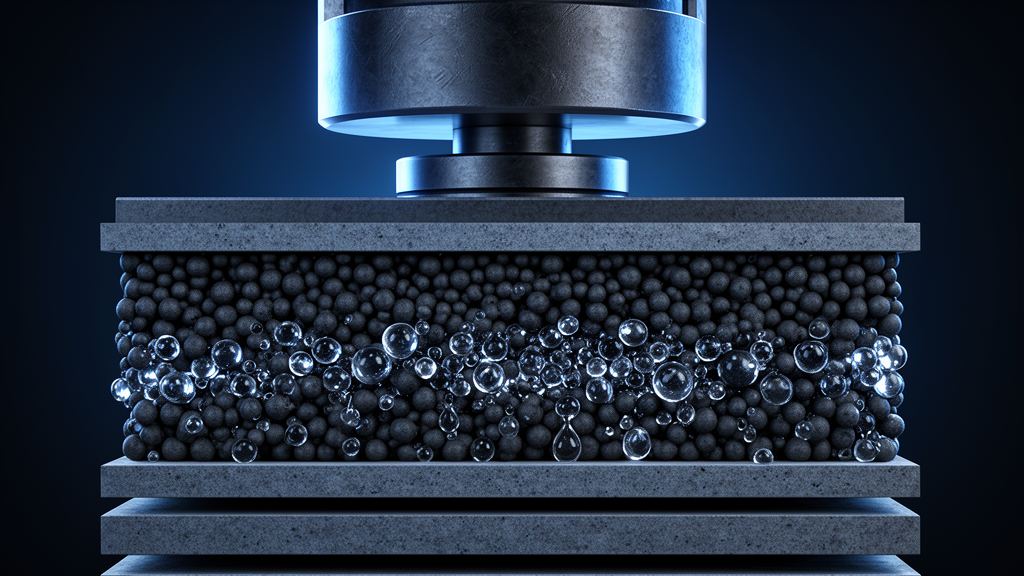
High-temperature polymer electrolyte membrane fuel cells, or HT-PEMFCs, promise a practical route to powering heavy-duty vehicles because they run above 160 degrees Celsius and manage heat and water with unusual ease. Yet their Achilles heel has always been the phosphoric acid electrolyte that dopes the polymer membrane: under high current densities, this acid steadily leaks out of the cell, and the fuel cell’s voltage decays until it can no longer do useful work. A new study published in the journal Carbon Neutrality reports that a carefully engineered gas diffusion layer can dramatically slow that leakage, keeping the acid where it belongs and extending stable operation at currents that would normally cripple the device.
The research team, led by Weiwei Ni, Zhangxun Xia and colleagues working with Gongquan Sun’s group, did not invent new materials. Instead, they took three commercially available gas diffusion layers from Freudenberg, each with a different internal pore architecture, and asked a deceptively simple question: how does the microscopic structure of this porous carbon layer control where phosphoric acid goes when the cell is pushed hard? Their answer, backed by accelerated stress testing and in-operando three-dimensional X-ray microscopy, offers a practical design rule for the membrane electrode assemblies that next-generation heavy-duty applications will demand.
To understand why the gas diffusion layer matters, it helps to know what it does. Sitting between the catalyst layer and the bipolar plate, this component provides mechanical support, protects the membrane, conducts electrons and distributes reactant gases evenly. It consists of a carbon backing layer topped by a thinner microporous layer. In low-temperature fuel cells, engineers often deliberately crack this microporous layer to help manage liquid water. But in a high-temperature cell there is no liquid water to worry about; the enemy is phosphoric acid migration, and cracks turn out to be highways for acid escape rather than useful features.
The physics hinges on capillary pressure. Because the contact angle between phosphoric acid and the hydrophobized carbon surfaces was nearly identical across all three tested layers, the decisive variable was pore size. The capillary pressure that resists liquid acid intrusion scales inversely with pore radius, so a layer full of fine pores builds a stronger barrier. The three designs tested were a dense microporous layer with low mesoporosity, labeled DL-GDL; a dense layer with high mesoporosity, DH-GDL; and a loose microporous layer with low mesoporosity, LL-GDL. Mercury-intrusion porosimetry and nitrogen adsorption measurements confirmed that DL-GDL held the largest fraction of pores smaller than 100 nanometers, while LL-GDL’s looser morphology gave it the highest gas permeability.
That permeability came at a cost. At the beginning of lifetime, the loose-structure cell delivered the best raw performance: peak power densities of 448 milliwatts per square centimeter on hydrogen and air, and 1153 milliwatts per square centimeter on hydrogen and oxygen, compared with 343 and 917 for the dense-layer cell. Higher permeability relieved mass-transport bottlenecks at high current, and switching to pure oxygen narrowed the gap between designs, confirming that gas transport, not catalysis, drove the differences. Impedance spectra showed that denser layers slightly reduced ohmic resistance but raised charge-transfer resistance.
The picture reversed under the accelerated stress protocol. The team cycled cells between 0.6 and 1.6 amperes per square centimeter on hydrogen and oxygen feeds, an ultra-high-current regime chosen to accelerate acid migration and isolate liquid-phase loss from cathodic mass-transfer complications. All three single cells survived more than 200 hours and over 600 cycles, but their degradation rates diverged sharply. Voltage decay at 1.6 amperes per square centimeter measured 0.230 millivolts per cycle for the dense-layer cell, 0.380 for the high-mesoporosity variant and 0.613 for the loose layer. Only the dense-layer cell settled into steady operation, with a break-in period over roughly 150 cycles during which current-driven acid redistribution actually homogenized the electrolyte film and enlarged the three-phase boundary where reactions occur.
The mechanistic explanation follows from the pore structure. Electromigration under the intense electric field drives dihydrogen phosphate ions toward the anode, and liquid acid escapes chiefly where cracks in the catalyst layer overlap with large pores or cracks in the microporous layer. The densest microporous layer generated the highest capillary barrier, minimizing the overlap between catalyst-layer cracks and large microporous pores, and thereby preserved the largest electrolyte inventory. Quantitative collection of acid lost in the exhaust and adsorbed on the bipolar plates told the same story: total loss was lowest for the dense-layer cell at 91 milligrams, against 136 and 135 milligrams for the other two designs.
Post-test performance confirmed the durability gap. Peak power densities under hydrogen and oxygen fell by 36.4 percent for the dense-layer cell, 49.8 percent for the high-mesoporosity variant and 54.3 percent for the loose layer. The loose-layer cell, despite its superior starting permeability, ended the test with the largest diffusion impedance at 0.8 amperes per square centimeter, apparently because acid became trapped in the abundant intersections between microporous pores and macropores. The authors caution that voltage decay likely reflects multiple coupled degradation processes, including catalyst degradation and structural changes, but the clear correlation between acid loss rate and voltage decay points to electrolyte migration as the dominant factor under these extreme conditions.
The in-operando X-ray microscopy added a striking visual dimension. Using an in-house imaging device and nondestructive computed tomography, the team tracked acid distribution inside a single operating cell. Because phosphorus and carbon absorb X-rays similarly, they boosted contrast by adding 10 mole percent cesium dihydrogen phosphate during acid doping, and treated the acid-infused electrode as a mixed phase. As current density increased, the mixed-phase volume fraction at the cathode dropped from 0.13 to 0.06 while the pore fraction rose from 0.27 to 0.30, indicating acid migrating from cathode to anode. The anode pore fraction barely changed, suggesting incoming acid partially compensated for anodic leaching, and acid droplets were found in the anode flow channel upon disassembly. The authors note that their segmentation approach introduces uncertainty in absolute values, so they emphasize relative changes rather than exact quantities.
The broader context makes the result consequential. Previous work summarized by the authors shows that phosphoric-acid-doped membrane electrode assemblies can achieve vanishingly small decay rates of 0.5 to 2 microvolts per hour below 0.2 amperes per square centimeter, with lifetimes exceeding 13,000 to 18,000 hours, but decay rates climb above 25 to 100 microvolts per hour beyond 0.8 amperes per square centimeter, with durability typically falling below 1,000 hours. Every 0.3 to 0.4 amperes per square centimeter increase in current density can raise the acid loss rate two- to tenfold. By showing that a dense, refined microporous layer suppresses liquid acid migration while its overall porosity compensates for the added mass-transport resistance, the study establishes a concrete, materials-level strategy for pushing high-temperature fuel cells into the high-current regime that heavy-duty trucks and other demanding applications require. The trade-off remains real, since densifying the microporous layer inevitably reduces gas permeability, so the optimal design must balance acid retention against gas transport. But the demonstration that structure alone, without new chemistry, can cut the degradation rate nearly threefold marks a meaningful step toward fuel cells that stay durable exactly where it is hardest to be durable: under full load.
Subject of Research: How gas diffusion layer microstructure regulates phosphoric acid loss in high-temperature polymer electrolyte membrane fuel cells under high-current operation.
Article Title: Gas diffusion layer regulated phosphoric acid distribution for durable high-temperature polymer electrolyte membrane fuel cells under high-current loading
Article References: Ni, W., Xia, Z., Sun, R., Zhang, Z., Chen, X., Hu, Y., Huang, J., Wang, S., & Sun, G. (2026). Gas diffusion layer regulated phosphoric acid distribution for durable high-temperature polymer electrolyte membrane fuel cells under high-current loading. Carbon Neutrality, 5(1), Article 15. https://doi.org/10.1007/s43979-026-00169-8
Image Credits: AI Generated
DOI: 10.1007/s43979-026-00169-8
Keywords: high-temperature PEM fuel cells, phosphoric acid loss, gas diffusion layer, microporous layer, accelerated stress test, X-ray microscopy, heavy-duty vehicles, hydrogen, durability, porosity, diffusion, layer
News Source: Victoria Harrison. (October 30, 2026). Dense Microporous Layers Keep Phosphoric Acid Inside Fuel Cells Under Heavy Loads. Scienmag.



