• HOME
  • NEWS
  • EXPLORE
    • CAREER
      • Companies
      • Jobs
    • EVENTS
    • iGEM
      • News
      • Team
    • PHOTOS
    • VIDEO
    • WIKI
  • BLOG
  • COMMUNITY
    • FACEBOOK
    • INSTAGRAM
    • TWITTER
Tuesday, May 12, 2026
BIOENGINEER.ORG
No Result
View All Result
  • Login
  • HOME
  • NEWS
  • EXPLORE
    • CAREER
      • Companies
      • Jobs
        • Lecturer
        • PhD Studentship
        • Postdoc
        • Research Assistant
    • EVENTS
    • iGEM
      • News
      • Team
    • PHOTOS
    • VIDEO
    • WIKI
  • BLOG
  • COMMUNITY
    • FACEBOOK
    • INSTAGRAM
    • TWITTER
  • HOME
  • NEWS
  • EXPLORE
    • CAREER
      • Companies
      • Jobs
        • Lecturer
        • PhD Studentship
        • Postdoc
        • Research Assistant
    • EVENTS
    • iGEM
      • News
      • Team
    • PHOTOS
    • VIDEO
    • WIKI
  • BLOG
  • COMMUNITY
    • FACEBOOK
    • INSTAGRAM
    • TWITTER
No Result
View All Result
Bioengineer.org
No Result
View All Result
Home NEWS Science News

Surface waves can help nanostructured devices keep their cool

Bioengineer by Bioengineer
October 12, 2020
in Science News
Reading Time: 2 mins read
0
IMAGE
Share on FacebookShare on TwitterShare on LinkedinShare on RedditShare on Telegram

IMAGE

Credit: Institute of Industrial Science, the University of Tokyo

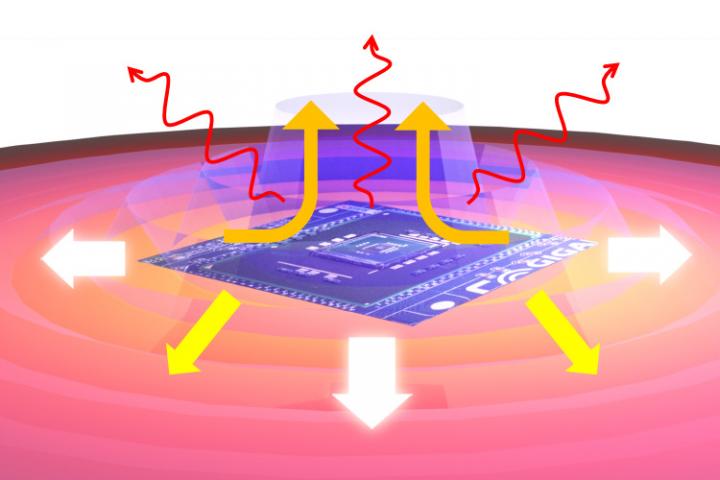
Tokyo, Japan — The continuing progress in miniaturization of silicon microelectronic and photonic devices is causing cooling of the device structures to become increasingly challenging. Conventional heat transport in bulk materials is dominated by acoustic phonons, which are quasiparticles that represent the material’s lattice vibrations, similar to the way that photons represent light waves. Unfortunately, this type of cooling is reaching its limits in these tiny structures.

However, surface effects become dominant as the materials in nanostructured devices become thinner, which means that surface waves may provide the thermal transport solution required. Surface phonon-polaritons (SPhPs) – hybrid waves composed of surface electromagnetic waves and optical phonons that propagate along the surfaces of dielectric membranes – have shown particular promise, and a team led by researchers from the Institute of Industrial Science, the University of Tokyo has now demonstrated and verified the thermal conductivity enhancements provided by these waves.

“We generated SPhPs on silicon nitride membranes with various thicknesses and measured the thermal conductivities of these membranes over wide temperature ranges,” says lead author of the study Yunhui Wu. “This allowed us to establish the specific contributions of the SPhPs to the improved thermal conductivity observed in the thinner membranes.”

The team observed that the thermal conductivity of membranes with thicknesses of 50 nm or less actually doubled when the temperature increased from 300 K to 800 K (approximately 27°C to 527°C). In contrast, the conductivity of a 200-nm-thick membrane decreased over the same temperature range because the acoustic phonons still dominated at that thickness.

“Measurements showed that the dielectric function of silicon nitride did not change greatly over the experimental temperature range, which meant that the observed thermal enhancements could be attributed to the action of the SPhPs,” explains the Institute of Industrial Science’s Masahiro Nomura, senior author of the study. “The SPhP propagation length along the membrane interface increases when the membrane thickness decreases, which allows SPhPs to conduct much more thermal energy than acoustic phonons when using these very thin membranes.”

The new cooling channel provided by the SPhPs can thus compensate for the reduced phonon thermal conductivity that occurs in nanostructured materials. SPhPs are thus expected to find applications in thermal management of silicon-based microelectronic and photonic devices.

###

The article, “Enhanced thermal conduction by surface phonon-polaritons,” was published in Science Advances at DOI: 10.1126/sciadv.abb4461.

Media Contact
Masahiro Nomura
[email protected]

Original Source

https://www.iis.u-tokyo.ac.jp/en/news/3365/

Related Journal Article

http://dx.doi.org/10.1126/sciadv.abb4461

Tags: Chemistry/Physics/Materials SciencesElectromagneticsMaterialsNanotechnology/MicromachinesOptics
Share12Tweet8Share2ShareShareShare2

Related Posts

Humans and Zebra Finches Share Similar Speech Learning Techniques #ASA190 — Chemistry

Humans and Zebra Finches Share Similar Speech Learning Techniques #ASA190

May 11, 2026
New Study Uncovers How Fungal Parasites Attack Strawberries and Raspberries — Agriculture

New Study Uncovers How Fungal Parasites Attack Strawberries and Raspberries

May 11, 2026

City of Hope Researchers to Present Groundbreaking Immunotherapy and Precision Medicine Advances Across Multiple Cancer Types at ASCO 2026

May 11, 2026

Medicaid Expansion Reduces Mortality in Young Adults with Kidney Failure

May 11, 2026
Please login to join discussion

POPULAR NEWS

  • Research Indicates Potential Connection Between Prenatal Medication Exposure and Elevated Autism Risk

    841 shares
    Share 336 Tweet 210
  • New Study Reveals Plants Can Detect the Sound of Rain

    728 shares
    Share 290 Tweet 182
  • Salmonella Haem Blocks Macrophages, Boosts Infection

    62 shares
    Share 25 Tweet 16
  • Breastmilk Balances E. coli and Beneficial Bacteria in Infant Gut Microbiomes

    57 shares
    Share 23 Tweet 14

About

We bring you the latest biotechnology news from best research centers and universities around the world. Check our website.

Follow us

Recent News

Humans and Zebra Finches Share Similar Speech Learning Techniques #ASA190

New Study Uncovers How Fungal Parasites Attack Strawberries and Raspberries

City of Hope Researchers to Present Groundbreaking Immunotherapy and Precision Medicine Advances Across Multiple Cancer Types at ASCO 2026

Subscribe to Blog via Email

Enter your email address to subscribe to this blog and receive notifications of new posts by email.

Join 82 other subscribers
  • Contact Us

Bioengineer.org © Copyright 2023 All Rights Reserved.

Welcome Back!

Login to your account below

Forgotten Password?

Retrieve your password

Please enter your username or email address to reset your password.

Log In
No Result
View All Result
  • Homepages
    • Home Page 1
    • Home Page 2
  • News
  • National
  • Business
  • Health
  • Lifestyle
  • Science

Bioengineer.org © Copyright 2023 All Rights Reserved.