• HOME
  • NEWS
  • EXPLORE
    • CAREER
      • Companies
      • Jobs
    • EVENTS
    • iGEM
      • News
      • Team
    • PHOTOS
    • VIDEO
    • WIKI
  • BLOG
  • COMMUNITY
    • FACEBOOK
    • INSTAGRAM
    • TWITTER
Monday, October 5, 2026
BIOENGINEER.ORG
No Result
View All Result
  • Login
  • HOME
  • NEWS
  • EXPLORE
    • CAREER
      • Companies
      • Jobs
        • Lecturer
        • PhD Studentship
        • Postdoc
        • Research Assistant
    • EVENTS
    • iGEM
      • News
      • Team
    • PHOTOS
    • VIDEO
    • WIKI
  • BLOG
  • COMMUNITY
    • FACEBOOK
    • INSTAGRAM
    • TWITTER
  • HOME
  • NEWS
  • EXPLORE
    • CAREER
      • Companies
      • Jobs
        • Lecturer
        • PhD Studentship
        • Postdoc
        • Research Assistant
    • EVENTS
    • iGEM
      • News
      • Team
    • PHOTOS
    • VIDEO
    • WIKI
  • BLOG
  • COMMUNITY
    • FACEBOOK
    • INSTAGRAM
    • TWITTER
No Result
View All Result
Bioengineer.org
No Result
View All Result
Home NEWS Science News Biology

Superhydrophobic magnetic sponge to help purify water from oil products

Bioengineer by Bioengineer
March 5, 2020
in Biology
Reading Time: 3 mins read
0
IMAGE
Share on FacebookShare on TwitterShare on LinkedinShare on RedditShare on Telegram

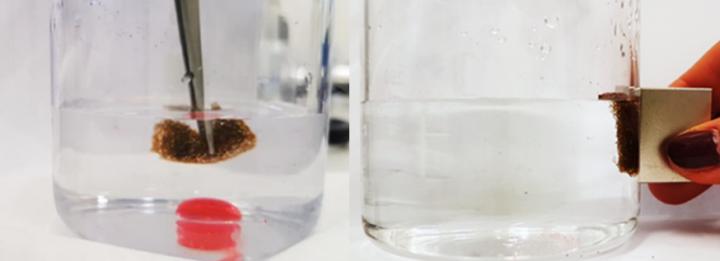
TPU jointly with the University of Lille developed a new material capable of purifying water effectively from oil products. It is based on an ordinary household polyurethane sponge; it repels water, while effectively sorbing oil product molecules
IMAGE

Credit: TPU


Scientists of Tomsk Polytechnic University jointly with the University of Lille (France) have developed a new material capable of purifying water effectively from oil products. It is based on an ordinary household polyurethane sponge. The research team made it superhydrophobic – it repels water, while effectively sorbing oil product molecules. The results were published in Separation and Purification Technology (IF: 5,107; Q1).

“New oil production methods, especially the ones related to production on the seabed and ocean floor, raise up the risk of spills. We all know about the environmental impact of the accident that happened on a drilling platform in the Gulf of Mexico in 2010. Therefore, one of the most urgent scientific problems is to obtain selective sorbents capable to extract oil products from a water-oil mixture, avoiding interactions with water.

The latter point is crucially important since interactions with water basically result in some resultant products to end up in the water and affect the ecosystem. Furthermore, water saturation drops the sorbent effectiveness. Therefore, we had to find affordable material and make it hydrophobic and efficient for the mentioned goal. We decided in favor of a regular washing sponge,” Pavel Postnikov, associate professor at TPU Research School of Chemistry & Applied Biomedical Sciences, says.

Diazonium salts, special organic compounds, were used to make a sponge hydrophobic. The sponge was placed in an aqueous solution with diazonium salts and heated to 60 °C. The resulting active radicals attacked the sponge and formed on the surface new organic groups with hydrophobic properties, being at the same time sensitive to oil products. They act as sorbents that selectively absorb oil molecules.

“The second issue is to find an efficient way to remove this material from water. We chose a magnetic sorbent collection. We added iron nanoparticles in the structure of the sponge, obtained by our original method and characterized by increased susceptibility to nonpolar molecules. We also added hydrophobic organic groups. As a result, we obtained material that almost does not interact with water despite the fact that it is a sponge,” the scientist explains.

Petroleum products in water are in the form of an emulsion. This implies that their microscopic droplets are distributed in another liquid, in our case, in the water. According to the researchers, in practice, such emulsions are often highly stabilized. It means they are difficult to separate into individual components.

“We tested our material with both highly stabilized and low stabilized emulsions. The experiments demonstrated that the material is excellent. We also tested its effectiveness on industrial oils that can pollute natural water bodies. The material also showed its high efficiency,” Pavel Postnikov says.

Furthermore, the studies showed that the new material can be reused several times. “In experiments, we used it at least five times and there was no drop in its efficiency,” the scientist says.

###

The study was supported by the Russian Science Foundation (17-73-20066).

Media Contact
Vitalii Sdelnikov
[email protected]
7-382-260-6404

Original Source

https://news.tpu.ru/en/news/2020/03/05/35935/

Related Journal Article

http://dx.doi.org/10.1016/j.seppur.2020.116627

Tags: Biomedical/Environmental/Chemical EngineeringChemistry/Physics/Materials Sciences
Share12Tweet8Share2ShareShareShare2

Related Posts

From Painkillers to Sunscreens: How Everyday Chemicals Are Hitting the Microscopic Engines of Aquatic Ecosystems

From Painkillers to Sunscreens: How Everyday Chemicals Are Hitting the Microscopic Engines of Aquatic Ecosystems

October 5, 2026
AI Toxicity Predictions Overstated: New Benchmark Exposes Hidden Data Leakage

AI Toxicity Predictions Overstated: New Benchmark Exposes Hidden Data Leakage

October 5, 2026

Computers Take the Guesswork Out of Antisense Drug Design

October 5, 2026

A Hidden DNA Insertion Paints Quinoa Leaves in Red and Green

October 5, 2026
Please login to join discussion

POPULAR NEWS

  • Alloys That Shrink Their Own Grains: New PIX Mechanism Refines Metals With Heat Alone

    Alloys That Shrink Their Own Grains: New PIX Mechanism Refines Metals With Heat Alone

    29 shares
    Share 12 Tweet 7
  • Endurance Exercise Reshapes the Liver in Males and Females Through Distinct Molecular Routes

    29 shares
    Share 12 Tweet 7
  • Single Transcription Factor PU.1 Rapidly Converts Fibroblasts into Macrophage-Lineage Cells

    29 shares
    Share 12 Tweet 7
  • New Scale Measures How Ready Nurse Educators Really Are for the AI Era

    29 shares
    Share 12 Tweet 7

About

We bring you the latest biotechnology news from best research centers and universities around the world. Check our website.

Follow us

Recent News

Alloys That Shrink Their Own Grains: New PIX Mechanism Refines Metals With Heat Alone

Endurance Exercise Reshapes the Liver in Males and Females Through Distinct Molecular Routes

Single Transcription Factor PU.1 Rapidly Converts Fibroblasts into Macrophage-Lineage Cells

Subscribe to Blog via Email

Success! An email was just sent to confirm your subscription. Please find the email now and click 'Confirm' to start subscribing.

Join 85 other subscribers
  • Contact Us

Bioengineer.org © Copyright 2023 All Rights Reserved.

Welcome Back!

Login to your account below

Forgotten Password?

Retrieve your password

Please enter your username or email address to reset your password.

Log In
No Result
View All Result
  • Homepages
    • Home Page 1
    • Home Page 2
  • News
  • National
  • Business
  • Health
  • Lifestyle
  • Science

Bioengineer.org © Copyright 2023 All Rights Reserved.