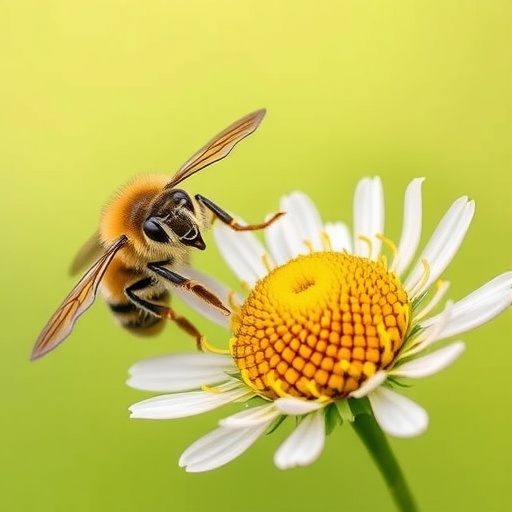
In a groundbreaking new study published in Scientific Reports, researchers have unveiled the profound effects of sulfoxaflor, a widely used systemic insecticide, on the solitary bee species Osmia bicornis. This investigation provides crucial insights into how exposure to this chemical disrupts fundamental behaviors such as food intake and cognitive capabilities, potentially threatening the survival and ecological contributions of these vital pollinators.
Solitary bees, unlike social hive-dwelling species, lead independent lives, making their exposure to environmental toxins particularly impactful in subtle yet severe ways. Osmia bicornis, commonly known as the red mason bee, is an essential pollinator across many temperate regions, contributing significantly to both wild plant reproduction and agricultural crop pollination. The study led by Dr. Schwarz and colleagues focuses on the insecticide sulfoxaflor, which has been increasingly adopted as an alternative to neonicotinoids following regulatory restrictions due to their harmfulness to bees. However, uncertainties have persisted over the safer profile of sulfoxaflor, especially concerning solitary bees.
The research team meticulously designed experiments to assess two critical dimensions of bee behavior: the quantity of food consumed and the efficiency of learning—an essential aspect of foraging success and adaptability in fluctuating environments. The findings are alarming: even sublethal doses of sulfoxaflor lead to a significant decrease in the amount of food ingested by Osmia bicornis females, implicating potential energetic deficits that could impair survival and reproductive capacity.
Learning efficiency was evaluated via conditioning assays that measure the bees’ ability to associate specific olfactory cues with rewards, mimicking natural foraging situations where flowers emit distinct scents signaling nectar availability. Bees exposed to sulfoxaflor showed markedly reduced learning rates, indicating that the insecticide interferes with neural processes underlying memory formation and sensory discrimination. These cognitive disruptions can cascade into poorer foraging success, reduced pollination performance, and ultimately impact population dynamics.
The mechanistic basis of sulfoxaflor’s effects involves its action as an agonist on nicotinic acetylcholine receptors in insect nervous systems. These receptors are fundamental for signal transmission in neural circuits governing motor activity, sensory integration, and higher-order cognitive functions. By overstimulating these receptors, sulfoxaflor can induce neuronal fatigue or altered synaptic plasticity, explaining the behavioral impairments observed in the study.
Importantly, this study underscores that even nonlethal encounters with pesticides may exact a heavy cost on solitary bees, which do not benefit from colony-level buffering seen in social species. The individual-level impairments in energy intake and neural function can directly translate into compromised reproductive fitness and diminished pollination services. Given the crucial ecological roles of Osmia bicornis, these findings raise urgent concerns about current pest management practices relying on sulfoxaflor.
Further compounding the issue is the hidden nature of such sublethal effects. Unlike immediate mortality after pesticide exposure, behavioral impairments may go unnoticed in standard risk assessments focusing on bee deaths. This research advocates for an expanded framework that incorporates cognitive and physiological endpoints to truly gauge the ecological risk posed by agrochemicals.
The timing of pesticide application and the phenology of solitary bee activity are also critical considerations. The researchers highlight that exposure during key life stages, such as nest provisioning and brood development, may amplify the negative consequences, potentially leading to population declines over time. These complex interactions underscore the necessity of integrative field studies complementing laboratory findings.
In terms of broader agricultural implications, impaired foraging and decreased pollination efficiency by Osmia bicornis could threaten yield stability for several crops reliant on insect pollination. Agricultural landscapes that have replaced floral diversity with monocultures are already challenging for solitary bees; chemical stressors like sulfoxaflor may further exacerbate these pressures, calling for holistic and bee-friendly pest management strategies.
The study also prompts reconsideration of the regulatory status of sulfoxaflor. While it has been promoted as a bee-safer alternative, the growing body of evidence, including the current data, suggests that its risks have been underestimated. Policymakers and industry stakeholders must weigh these findings carefully, balancing pest control needs with the preservation of pollinator health and biodiversity.
One of the pivotal takeaways is the necessity to develop and implement innovative approaches to protect solitary bees. Habitat restoration, creation of pesticide-free floral corridors, and breeding programs for chemical-resilient bee strains are promising avenues. Simultaneously, more selective and biologically based pest control methods should be prioritized to mitigate adverse impacts on non-target beneficial insects.
Moreover, this study exemplifies the importance of expanding pollinator research beyond the well-studied honeybee models. Solitary bees, despite their ecological significance, have been underrepresented in toxicological evaluations. The nuanced insights gained here concerning sulfoxaflor’s sublethal effects provide a valuable foundation for future investigations involving diverse bee species, fostering a more comprehensive understanding of agrochemical risks.
The implications for environmental sustainability and food security are immense, as pollinator declines can ripple through ecosystems and agricultural systems alike. Studies like this one by Schwarz et al. are vital components of the knowledge base guiding more informed and responsible management choices. Maintaining pollinator populations under increasing anthropogenic pressures is a collective challenge demanding urgent scientific and policy attention.
In summary, sulfoxaflor’s interference with the feeding behavior and cognitive capacities of the solitary Osmia bicornis bee revealed in this study represents a significant threat to pollinator health and ecosystem stability. The research highlights the pressing need for re-evaluation of insecticide use and the promotion of more pollinator-conscious agricultural practices. Protecting these indispensable insects is essential for preserving biodiversity and ensuring resilient food production in the face of global environmental changes.
This landmark study not only raises alarms but also provides a roadmap for prioritizing solitary bees in both research and conservation frameworks. By elucidating the subtle yet impactful sublethal effects of insecticides, it challenges current paradigms and advocates for an integrated approach that values pollinator well-being alongside human agricultural demands. The future of pollination services hinges on such transformative shifts in understanding and management.
With the mounting evidence of chemical pollutants’ deleterious effects on pollinators, interdisciplinary collaborations across entomology, ecology, toxicology, and agronomy will be paramount. Extending the scope to other pollinator taxa and examining cumulative effects of multiple stressors present promising yet demanding frontiers for future research. The knowledge generated will be indispensable in forging sustainable landscapes where solitary bees like Osmia bicornis can thrive.
Ultimately, the health of solitary bees serves as a bellwether for environmental integrity, reflecting broader ecosystem resilience in an era marked by human-induced change. This insightful research not only sheds light on the vulnerabilities of Osmia bicornis to sulfoxaflor but also invigorates the ongoing discourse on safeguarding our indispensable pollinators for generations to come.
Subject of Research: Effects of sulfoxaflor insecticide on food intake and learning efficiency in the solitary bee species Osmia bicornis
Article Title: Sulfoxaflor reduces food intake and learning efficiency of solitary Osmia bicornis bees
Article References:
Schwarz, J.M., Arnet, N.L., Knauer, A.C. et al. Sulfoxaflor reduces food intake and learning efficiency of solitary Osmia bicornis bees. Sci Rep (2026). https://doi.org/10.1038/s41598-026-55827-9
Image Credits: AI Generated
Tags: agricultural impact on bee healthbehavioral disruption in red mason beesconservation of Osmia bicornis populationsecological risks of sulfoxaflor usefood intake reduction in solitary beesimpact of insecticides on Osmia bicornislearning impairment from sulfoxaflor exposurepollinator cognitive function declinesolitary bee foraging behaviorsulfoxaflor effects on solitary beessulfoxaflor vs neonicotinoids safetysystemic insecticide toxicity in pollinators