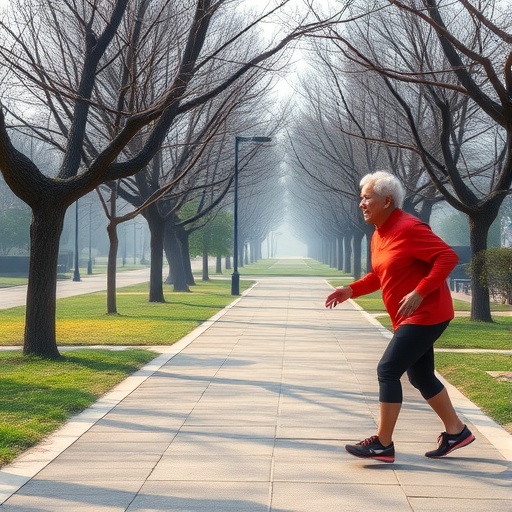
Older adults in China are not experiencing health improvements evenly, and a new study links part of that gap to how physical activity is distributed across communities. Researchers report that physical activity is associated with better health outcomes, but the benefits are not uniform—creating measurable health inequality rather than a single “one-size-fits-all” effect.
The findings focus on older adults and examine whether differences in activity levels translate into unequal health trajectories across demographic and socioeconomic conditions. Instead of treating “activity” as a simple yes-or-no behavior, the analysis considers how gradients of movement relate to disparities in health.
To quantify inequality, the study employs population-level metrics commonly used in health economics and epidemiology. These approaches can separate overall health variation into components that reflect group differences, allowing investigators to estimate how much of the inequality is potentially attributable to physical activity patterns.
The work also emphasizes that health inequality can widen even when average health improves. In this scenario, some groups may adopt or maintain activity more easily—because of access to safe spaces, health literacy, social support, or fewer mobility constraints—while other groups fall behind.
Technically, the authors analyze observational data and control for key confounders that might otherwise explain both activity and health status. This helps reduce the chance that the observed association is merely driven by factors such as baseline chronic disease burden, education, or geography.
Importantly, the results suggest that physical activity does not just correlate with health—it may act as a modifiable lever shaping how evenly health benefits are shared. If interventions can shift activity patterns among disadvantaged groups, the study implies that inequality could shrink, not just outcomes improve.
Because the paper is based on real-world evidence from China, it also highlights cultural and structural realities that shape behavior. Urban design, community programming, and the availability of age-friendly exercise options may influence who can be active consistently.
From a “viral science news” perspective, the headline takeaway is straightforward: getting older doesn’t have to mean accepting unequal health. The study frames physical activity as both a health tool and an inequality amplifier—meaning targeting participation gaps could deliver outsized public health impact.
Subject of Research: Health inequality among older adults; physical activity effects
Article Title: The impact of physical activity on health inequality among older adults: evidence from China
Article References: Dang, X., Pan, J., Xing, X. et al. The impact of physical activity on health inequality among older adults: evidence from China. BMC Geriatr (2026). https://doi.org/10.1186/s12877-026-08008-2
Image Credits: AI Generated
DOI: https://doi.org/10.1186/s12877-026-08008-2
Keywords: physical activity; health inequality; older adults; China; public health; epidemiology
Tags: health inequality and socioeconomic factors in aging populationshealth inequality widening despite overall health improvementshealth literacy and social support in older adult healthhealth trajectory differences across demographic groupsimpact of community environment on physical activity and health outcomesinfluence of mobility constraints on physical activity levelsmeasuring health disparities with epidemiological and economic metricsobservational study methods in aging health researchphysical activity as a social determinantPhysical activity disparities among older adults in Chinarole of safe spaces and access to recreational facilities in health equity