• HOME
  • NEWS
  • EXPLORE
    • CAREER
      • Companies
      • Jobs
    • EVENTS
    • iGEM
      • News
      • Team
    • PHOTOS
    • VIDEO
    • WIKI
  • BLOG
  • COMMUNITY
    • FACEBOOK
    • INSTAGRAM
    • TWITTER
Thursday, May 14, 2026
BIOENGINEER.ORG
No Result
View All Result
  • Login
  • HOME
  • NEWS
  • EXPLORE
    • CAREER
      • Companies
      • Jobs
        • Lecturer
        • PhD Studentship
        • Postdoc
        • Research Assistant
    • EVENTS
    • iGEM
      • News
      • Team
    • PHOTOS
    • VIDEO
    • WIKI
  • BLOG
  • COMMUNITY
    • FACEBOOK
    • INSTAGRAM
    • TWITTER
  • HOME
  • NEWS
  • EXPLORE
    • CAREER
      • Companies
      • Jobs
        • Lecturer
        • PhD Studentship
        • Postdoc
        • Research Assistant
    • EVENTS
    • iGEM
      • News
      • Team
    • PHOTOS
    • VIDEO
    • WIKI
  • BLOG
  • COMMUNITY
    • FACEBOOK
    • INSTAGRAM
    • TWITTER
No Result
View All Result
Bioengineer.org
No Result
View All Result
Home NEWS Science News Health

Study gives clues to the origin of Huntington’s disease, and a new way to find drugs

Bioengineer by Bioengineer
September 17, 2019
in Health
Reading Time: 2 mins read
0
IMAGE
Share on FacebookShare on TwitterShare on LinkedinShare on RedditShare on Telegram

IMAGE

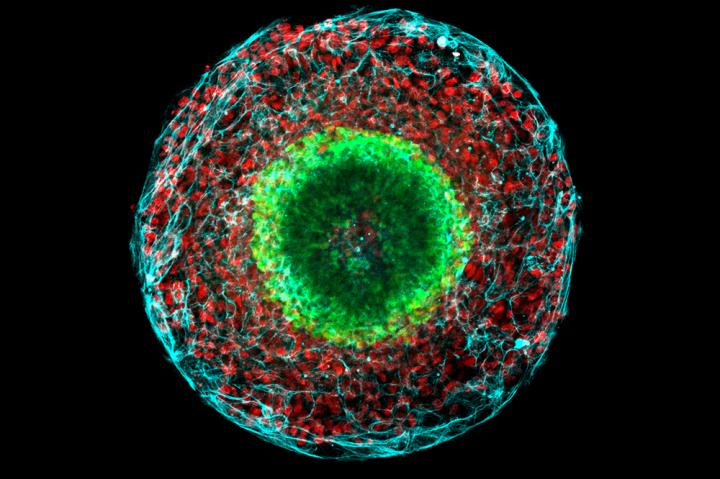
Credit: Laboratory of Stem Cell Biology and Molecular Embryology at The Rockefeller University

The first signs of Huntington’s, an inherited disease that slowly deteriorates bodies and minds, don’t typically surface until middle age. But new findings suggest that something in the brain might be amiss long before symptoms arise, and earlier than has ever been observed. Using a new technology, Rockefeller scientists were able to trace the causes of the disease back to early developmental stages when the brain has only just begun to form.

Developed in the lab of Ali Brivanlou, the Robert and Harriet Heilbrunn Professor, the system uses neuroloids–tiny, three-dimensional tissue cultures that serve as models for whole organs. The researchers create these cell clumps from human embryonic stem cells and manipulate them in the lab to study how developmental diseases arise.

Previous work in the Brivanlou lab found evidence that the disease arises in young neurons; but this latest study takes the developmental timeframe back even further, to the step in the brain’s development when cellular uniformity gives way to the emergence of particular structures, a process called neurulation. When the researchers introduced into neuroloids a mutation known to cause Huntington’s, it consistently caused dramatic effects with abnormally shaped tissue structures. “Something’s collapsed,” Brivanlou says.

The researchers have started using the technology to screen for drugs that prevent these abnormalities, an approach they hope will provide a powerful alternative to similar work being done in animal models.

“This technology really opens a door toward identifying that mechanisms that govern brain development, understanding how they go awry in disease, and testing drugs that set these mechanisms back on the right course,” says Brivanlou.

###

Media Contact
Katherine Fenz
[email protected]

Original Source

https://www.rockefeller.edu/news/26560-study-gives-clues-origin-huntingtons-disease-new-way-find-drugs/

Related Journal Article

http://dx.doi.org/10.1038/s41587-019-0237-5

Tags: BiologyBiotechnologyDevelopmental/Reproductive BiologyMedicine/HealthMolecular Biologyneurobiology
Share13Tweet8Share2ShareShareShare2

Related Posts

Tweaking Ligands Boosts Perovskite Solar Cells

May 14, 2026

ALS Progresses Through a Domino-Like Chain Reaction Initiated in Nerve Cells

May 14, 2026

Intense Precipitation Reduces Terrestrial Water Storage

May 14, 2026

Most Individuals Meeting Proposed CTE Criteria Lack Disease Signs at Autopsy

May 14, 2026
Please login to join discussion

POPULAR NEWS

  • Research Indicates Potential Connection Between Prenatal Medication Exposure and Elevated Autism Risk

    842 shares
    Share 337 Tweet 211
  • New Study Reveals Plants Can Detect the Sound of Rain

    729 shares
    Share 291 Tweet 182
  • Salmonella Haem Blocks Macrophages, Boosts Infection

    62 shares
    Share 25 Tweet 16
  • Breastmilk Balances E. coli and Beneficial Bacteria in Infant Gut Microbiomes

    57 shares
    Share 23 Tweet 14

About

We bring you the latest biotechnology news from best research centers and universities around the world. Check our website.

Follow us

Recent News

Tweaking Ligands Boosts Perovskite Solar Cells

ALS Progresses Through a Domino-Like Chain Reaction Initiated in Nerve Cells

Liquid Metal Nano-Gyroid Enables Ultra-Resilient Electronics

Subscribe to Blog via Email

Enter your email address to subscribe to this blog and receive notifications of new posts by email.

Join 82 other subscribers
  • Contact Us

Bioengineer.org © Copyright 2023 All Rights Reserved.

Welcome Back!

Login to your account below

Forgotten Password?

Retrieve your password

Please enter your username or email address to reset your password.

Log In
No Result
View All Result
  • Homepages
    • Home Page 1
    • Home Page 2
  • News
  • National
  • Business
  • Health
  • Lifestyle
  • Science

Bioengineer.org © Copyright 2023 All Rights Reserved.