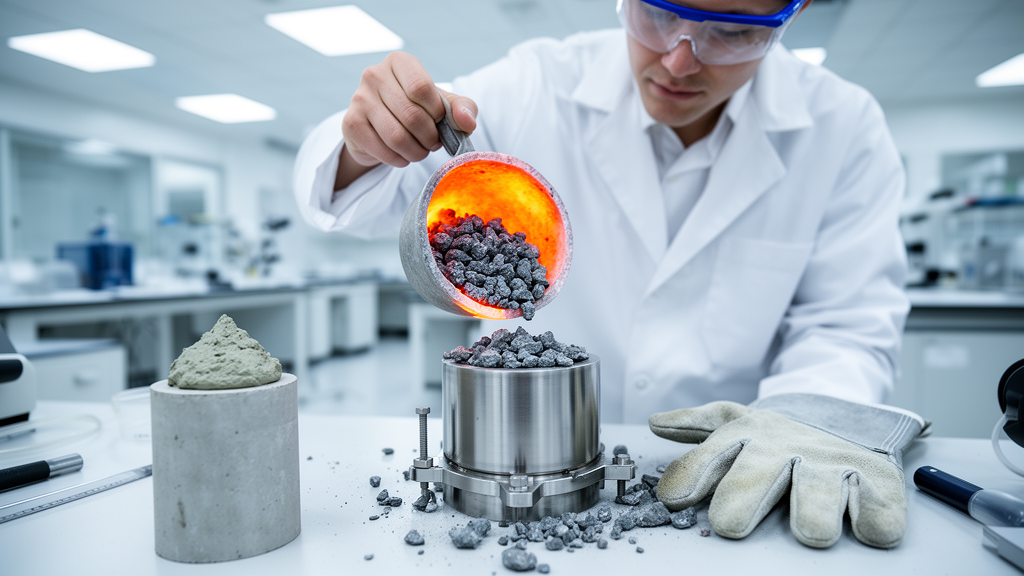
A new laboratory study published in the journal Carbon Neutrality reports a way to change that: by blending the molten slag with another hot waste stream from the same plant, blast furnace slag, researchers say they can recover up to 75 percent of the slag’s thermal energy while simultaneously converting the cooled material into a glassy powder suitable for cement production.
The scale of the opportunity is large. The global steel industry produced roughly 1.9 billion tons of crude steel in 2023, emitting about 3.6 gigatons of CO2 and consuming around 4 × 10^10 gigajoules of energy. Steel slag, a byproduct discharged in molten form at temperatures above 1800 kelvin, is generated at an estimated 200 million tons per year worldwide, with more than half of that produced in China. China emitted approximately 150 million tons of steel slag in 2023, and the country has accumulated more than a billion tons of the material. The hot slag carries roughly 100 terawatt-hours of thermal energy, yet the prevailing treatments—hot splashing, hot smothering and air blast cooling—focus on stabilizing the material and largely ignore the heat, letting it dissipate unused.
The central obstacle is the slag’s unfriendly physics. Molten steel slag is viscous, conducts heat poorly and is highly alkaline, containing free calcium oxide that expands unpredictably when exposed to water, which limits its use in construction. High viscosity also prevents the molten slag from being broken into the fine droplets needed for efficient cooling. The research team’s answer was to modify the melt rather than fight it. They blended the steel slag with 25 percent by weight of blast furnace slag, itself a hot waste stream discharged at around 1500 degrees Celsius in the same plants, plus 5 percent silica sand. The mixture lowered the viscosity from about 3 pascal-seconds to about 0.5 pascal-seconds, an 83 percent reduction, and reduced the free calcium oxide content to below 2 percent, close to the level found in blast furnace slag itself.
With the melt’s properties tamed, the researchers turned to a process they call centrifugation-granulation-assisted thermal energy recovery, or CGATER. In laboratory experiments, roughly 20-kilogram batches of the modified slag were heated to 1450 to 1550 degrees Celsius in a graphite crucible and then gravity-fed onto a high-speed rotating atomizer. The atomizer flung the liquid into an array of fine droplets that flew through a waste heat recovery chamber, cooling against air and water-cooled walls. Most of the resulting particles were smaller than 5 millimeters, concentrated in the 0.5 to 2.0 millimeter range, and very little slag wool formed because the ligaments cooled quickly. Particle size decreased with lower slag flowrate and higher rotary speed, while the initial melt temperature had a comparatively minor effect.
The heat recovery results were the study’s headline performance figure. At a rotary speed of 1800 rpm, the rig achieved a maximum heat recovery power of about 22 kilowatts, corresponding to an efficiency of roughly 75 percent, which the authors note is about 50 percent higher than conventional methods and comparable to the best reported values for high-temperature steel slag. The outlet temperature of the slag particles ranged from 300 to 700 degrees Celsius depending on operating conditions, reaching about 300 degrees at 2400 rpm. The team is candid about a caveat: in this small laboratory setup, the recovered hot air and water were at relatively low temperatures, giving the recovered heat limited quality, a limitation they attribute to the small slag throughput and substantial relative heat losses, and one they expect industrial-scale continuous operation to improve.
The material side of the process performed equally well in the characterization tests. X-ray diffraction showed that the cooled particles were almost entirely amorphous, with a glassy content exceeding 99 percent, comparable to blast furnace slag particles from the team’s earlier work. High glass content translates into good hydration activity, making the powder a candidate supplementary cementitious material that can partially replace cement clinker. Computed tomography revealed that the particles are porous, with porosity of roughly 7 to 8 percent, pore diameters from 2 to 400 micrometers, and more than 1.5 million pores in individual particles, features that might also suit the material for wastewater treatment or gas storage applications. An iron-containing residue found in the heating crucible, dominated by iron and carbon according to SEM-EDS analysis, hints that combining the process with carbothermic reduction could allow iron recovery as well, though the authors flag added CO2 emissions and economic viability as open questions for that extension.
Scaling the numbers to China’s entire steel industry, the authors’ assessment suggests substantial stakes. Assuming hot slag cools from 1400 to 200 degrees Celsius with a 75 percent heat recovery efficiency, yielding about 1.2 gigajoules recovered per ton, the protocol could save roughly 2.0 × 10^8 gigajoules of energy annually. Combining that energy saving with clinker substitution, the estimated CO2 reduction potential is about 82 million tons per year, equivalent to 9.4 percent of the steel sector’s total emissions, a contribution the authors say rivals what carbon capture and storage could deliver. In the IEA’s sustainable development scenario, with steel slag production projected at about 110 million tons by 2050, the carbon reduction potential ranges from 48 to 58 million tons depending on heat recovery efficiency, with cumulative reductions of about 1765 million tons through mid-century. The abstract also cites a potential annual revenue of 8.7 billion dollars from full deployment across Chinese steel plants.
The economics of a single treatment unit look favorable in the team’s levelized cost model. For a CGATER system sized to treat about 30 tons of slag per hour, the analysis projects an annual revenue of about 1.5 dollars per ton of slag in the first year when operating at full capacity, and payback within two years even in scenarios where only thermal energy recovery is counted. Carbon tax assumptions had a relatively minor effect on revenues, and the business-as-usual scenario still promises substantial returns over the system’s assumed 25-year lifespan, though the authors caution the results depend strongly on coal and slag waste prices. The model includes capital, operational, maintenance and decommissioning costs within predefined system boundaries, and the authors call for future assessments incorporating pilot-scale data and plant-specific conditions.
Important limitations temper the enthusiasm, and the authors devote a dedicated section to them. The entire demonstration—modification, granulation and heat recovery—was conducted at laboratory scale with limited throughput and short operating durations, and industrial deployment would require solving slag transportation over distances of 1 to 3 kilometers, thermal management, mixing uniformity and long-term operational stability. The cement-ready claim rests on material characterization alone: grinding performance, hydration behavior and practical cement application were not experimentally tested. Only one representative steel slag composition was validated, and slag properties vary with steelmaking route and operating conditions. The team also notes that in laboratory trials the feedstocks were mixed at room temperature and heated to 1550 degrees Celsius, whereas industrial deployment would need agitator facilities to homogenize molten streams at high temperature, and that melting the silica additive imposes an energy penalty the process offsets by pretreating the silica with discharged slag particles.
Even with those caveats, the study offers a concrete template for a problem that has resisted conventional solutions. By using one hot waste stream to tame another, the approach avoids the energy penalties and water consumption of traditional slag treatments while converting a liability into both fuel savings and cement feedstock. The authors say future work will move to pilot-scale demonstrations, optimize energy-material trade-offs and explore cross-sector synergies such as using recovered heat for district heating or carbon capture. If those trials confirm the laboratory numbers, steel slag—long a stockpiled burden for the world’s largest steel producer—could become a meaningful lever in the industry’s push toward net-zero emissions.
Subject of Research: A laboratory process that modifies molten steel slag with blast furnace slag to recover waste heat and produce cementitious material for decarbonizing steelmaking.
Article Title: Harnessing the heat and material potential in steel slag to decarbonize China’s steel industry
Article References: Lv, Y., Wu, J., Han, Z., Xiang, Y., Sun, Z., Liu, X., Wang, H., Ren, W., Zhu, X., & Liao, Q. (2026). Harnessing the heat and material potential in steel slag to decarbonize China’s steel industry. Carbon Neutrality, 5(1), Article 25. https://doi.org/10.1007/s43979-026-00179-6
Image Credits: AI Generated
DOI: 10.1007/s43979-026-00179-6
Keywords: steel slag, blast furnace slag, waste heat recovery, centrifugal granulation, supplementary cementitious material, decarbonization, China steel industry, CO2 emissions, circular economy, clinker substitution, metallurgical slag, laboratory study
News Source: Sloane Callahan. (October 28, 2026). Steel slag gets a second life as heat and cement in new lab process. Scienmag.