


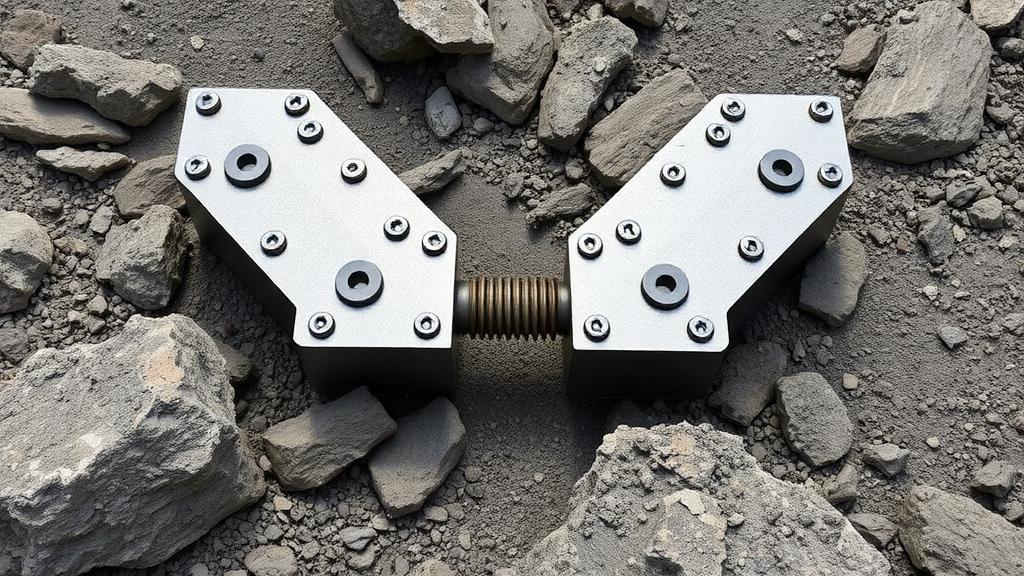
Engineers studying how to keep underground coal mine roadways intact during rockbursts have proposed a new energy-absorption joint, or EAJ, for U-shaped steel supports, and put it through laboratory tests and finite element analysis to characterize its static behavior. The joint incorporates patterned steel blades at the connection between support members, so that when the connected steel pieces move relative to one another, the blades stretch and deform plastically, dissipating energy while the cover plates bend inward. The work, published open access in Geomechanics and Geophysics for Geo-Energy and Geo-Resources, addresses a persistent difficulty in rockburst-prone mines: metallic roadway supports must maintain load-bearing capacity even as they accommodate large deformation and absorb energy.
The experimental program examined how the area of patterned material and the configuration of the blades affect performance. One notable observation was that blade fracture in the laboratory tests coincided with an abrupt drop in load near the peak, marking the point at which the joint’s resistance gave way. The accompanying finite element model reproduced the principal deformation pattern and correctly ranked the peak loads of the tested configurations, giving the researchers confidence in the numerical approach. The model’s accuracy varied by metric: absolute errors in peak load ranged from 2.97 to 14.55 percent and errors in absorbed energy from 2.32 to 17.72 percent, but failure displacement was overpredicted by 12.73 to 32.34 percent, indicating that deformation capacity is considerably harder to predict than strength or energy metrics.
Using the validated model, the team evaluated four configurations with blade thicknesses between 3 and 6 millimeters. Across the numerical cases, peak load ranged from 187.90 to 695.13 kilonewtons, absorbed energy from 6.38 to 23.84 kilojoules, and mean crushing load from 85.24 to 317.37 kilonewtons. One configuration, designated ED-2, achieved the highest values of all three indices at every investigated thickness. Stress contours suggest that ED-2 transfers load through multiple ligament branches, a lattice-like blade topology that the authors link to its higher static resistance and energy absorption, though they caution that the evolution of local plastic deformation requires further verification.
Blade thickness emerged as a straightforward design lever: increasing it raised peak load, absorbed energy, and mean crushing load, while predicted failure displacement varied comparatively little. The authors conclude that joint design should consider blade configuration and thickness together, and they position the static results as a performance basis for further development of the concept.
The researchers are explicit about the limits of the study. The findings concern static response only; resistance to actual rockburst impact requires subsequent dynamic validation. The work is also shared as an early-access version, citable with a permanent DOI but subject to further edits before the final Version of Record.
Subject of Research: Static performance and energy dissipation of a patterned-blade energy-absorption joint for U-shaped steel roadway supports in rockburst-prone coal mines
Article Title: Static performance and energy-dissipation mechanism of a rockburst-resistant joint for U-shaped steel roadway supports
Article References: Xu, X., Fu, Y., Wu, L., Wang, H., Chu, X., Zhang, Z., Li, Z., Feng, Y., & Lou, J. (2026). Static performance and energy-dissipation mechanism of a rockburst-resistant joint for U-shaped steel roadway supports. Geomechanics and Geophysics for Geo-Energy and Geo-Resources. https://doi.org/10.1007/s40948-026-01268-7
Image Credits: AI Generated
DOI: 10.1007/s40948-026-01268-7
Keywords: rockburst, U-shaped steel supports, energy-absorption joint, coal mines, finite element analysis, steel blades, roadway support, energy dissipation, geomechanics, static testing, Static, performance
News Source: Denise Maddox. (October 29, 2026). Patterned Steel Blades Give U-Shaped Mine Supports a Rockburst-Resistant Joint. Scienmag.



