


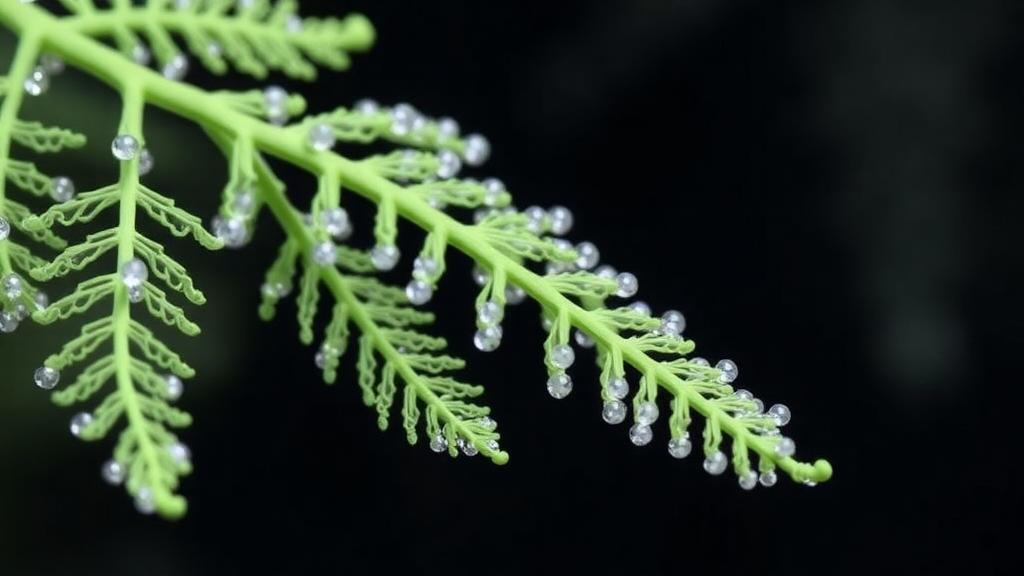
Silver nanoparticles grown with the help of a little-known fern from the hills of northern Pakistan have shown a striking range of biological effects in a new study, from scavenging free radicals to killing stored-grain beetles and inhibiting bacteria. Researchers at Abdul Wali Khan University Mardan used methanolic and ethanolic extracts of Adiantum incisum, an evergreen fern collected in Malakand district, Khyber Pakhtunkhwa, to reduce silver nitrate into nanoparticles in a green-chemistry process that avoids the toxic chemicals and harsh conditions of conventional synthesis. The work, published in Discover Nano, pairs optimized synthesis conditions with an unusually broad battery of biological assays, and the authors report that the nanoparticles consistently outperformed the crude plant extracts that produced them.
The synthesis itself was visually unmistakable. When the plant extract was stirred into a one-millimolar silver nitrate solution, the mixture shifted from pale green to reddish brown as surface plasmon vibrations activated in the forming particles, with a distinct color change appearing after about twenty minutes of stirring and complete reduction after twenty-four hours. Ultraviolet-visible spectroscopy confirmed the transformation, showing the characteristic absorption peak between 400 and 500 nanometers. The researchers tested several extract-to-silver-solution ratios, from 1:1 up to 1:5, and found that the 1:5 ratio changed color fastest and produced the highest absorbance peak, making it the preferred formulation for both the methanolic and ethanolic versions of the nanoparticles.
Because reaction conditions strongly influence nanoparticle formation, the team systematically optimized pH, temperature, and salt concentration. The nanoparticles proved most stable under slightly basic conditions, with optimal synthesis between pH 9 and 10; stability diminished when the pH dropped to 6, while higher pH values produced higher absorption with narrower peaks. Temperature requirements differed between the two extracts. Methanolic-extract nanoparticles formed best at roughly 50 to 65 degrees Celsius, with absorbance falling above 65 degrees, likely because proteins and other biomolecules in the extract denature and compromise particle stability. Ethanolic-extract nanoparticles, by contrast, peaked at just 35 degrees Celsius, with absorbance declining steadily as temperatures rose toward 95 degrees. Salt also mattered: adding small amounts of a one-millimolar sodium chloride solution, with the maximum absorbance at 0.2 milliliters, supported particle formation, while increasing salt concentrations caused a consistent decline in absorbance, reaching the lowest value at 1 milliliter.
Characterization confirmed that genuine, crystalline silver had formed. Fourier-transform infrared spectroscopy identified the functional groups involved in capping and reducing the particles, including an amine N-H stretch at 3364 per centimeter, alkyl C-H stretching at 2922, aromatic C=C stretching at 1610 suggesting phenolic compounds, and a carbonyl C=O band at 1559. X-ray diffraction revealed sharp peaks at 31.95, 36.01, and 76.63 degrees corresponding to the (111), (200), and (220) crystal planes, matching the face-centered cubic structure of silver and the JCPDS reference file 040783. Scanning electron microscopy showed predominantly spherical particles that appeared monodispersed with relatively smooth surfaces at higher magnifications, though some aggregation was visible at lower magnifications, a common feature of biosynthesized nanoparticles. Energy-dispersive X-ray spectroscopy detected a strong silver signal at 3 kiloelectronvolts in both preparations, alongside modest peaks for carbon, oxygen, silicon, and chlorine attributed to the organic capping layer and sample substrate rather than impurities in the silver core.
On the biological front, antioxidant activity was measured with the DPPH radical scavenging assay at concentrations of 50, 100, and 500 micrograms per milliliter. The ethanolic nanoparticles were the standout, inhibiting 85.2 percent of DPPH radicals at 500 micrograms per milliliter, exceeding even the ascorbic acid positive control, which reached 78.9 percent at the same concentration. Methanolic nanoparticles achieved 64.96 percent inhibition, while the crude ethanolic and methanolic extracts managed 35.5 and 62.2 percent, respectively. The authors attribute the radical-scavenging capacity to phytochemical capping on the nanoparticle surface, which can donate electrons or hydrogen to neutralize radicals in combination with the reactive nanoparticle surface.
Methanolic nanoparticles killed 56.7 percent of beetles at 1000 micrograms per milliliter, and ethanolic nanoparticles achieved 53.4 percent mortality at the same concentration, with the ethanolic result statistically significant. The researchers note that silver nanoparticles can harm insects by penetrating cell membranes, and that mortality has been linked to surface expansion of the insect integument caused by dehydration.
Phytotoxicity was assessed with the Lemna minor duckweed bioassay over seven days at 28 degrees Celsius. Ethanolic nanoparticles inhibited frond growth by 51.11 percent at 1000 micrograms per milliliter, and methanolic nanoparticles by 45.5 percent, both statistically significant, while the crude ethanolic and methanolic extracts inhibited growth by 36.66 and 35.5 percent. Atrazine, the reference herbicide, produced 90 percent inhibition. The authors suggest that silver nanoparticle formation can alter plant biomass and disrupt photosynthesis and chlorophyll formation, hinting at possible herbicidal applications, though this remains an observation in a laboratory duckweed model rather than a field result.
In animal experiments, the team evaluated anti-inflammatory and analgesic effects in albino mice obtained from the Veterinary Research Institute in Peshawar, with six groups of three mice per experiment. In the carrageenan-induced paw edema model, methanolic nanoparticles inhibited 79.2 percent of inflammation at 300 milligrams per kilogram, and ethanolic nanoparticles 75 percent at the same dose, compared with 87.5 percent for the aspirin standard. The corresponding crude extracts inhibited 66.75 and 70.8 percent. In the acetic acid-induced writhing test, ethanolic nanoparticles reduced writhing by 65.2 percent and methanolic nanoparticles by 61.11 percent at 500 micrograms per milliliter, against 83.3 percent for the paracetamol standard. These are early-stage animal findings with very small group sizes, so they indicate potential rather than established therapeutic value.
Antimicrobial results rounded out the evaluation. Using the disc diffusion method, ethanolic nanoparticles produced inhibition zones of 22 millimeters against Shigella dysenteriae and 20 millimeters against Pseudomonas aeruginosa at 100 micrograms per milliliter, while methanolic nanoparticles produced 22 and 18 millimeters against the same organisms. The streptomycin control reached 24 and 22 millimeters. Against Aspergillus niger in the agar well diffusion assay, methanolic nanoparticles produced a 14-millimeter inhibition zone and ethanolic nanoparticles 12 millimeters at 100 micrograms per milliliter, while neither crude extract showed antifungal activity; the clotrimazole control reached 20 millimeters. The authors propose that these antimicrobial effects arise from multiple mechanisms, including the release of silver ions, disruption of microbial cell walls and membranes, increased membrane permeability, inactivation of proteins and enzymes, and generation of reactive oxygen species.
The study has acknowledged limitations. The authors note that particle size and surface charge were not characterized, and that the antimicrobial assays were qualitative disc diffusion tests without quantitative measures such as minimum inhibitory, bactericidal, or fungicidal concentrations. Statistical comparisons were made by one-way analysis of variance with post hoc testing, and all experiments were run in triplicate, but several reported p values, such as 0.619 and 0.626 for the top antioxidant results, suggest some comparisons did not reach conventional significance. Even so, the breadth of the evaluation is unusual for a single green-synthesis study, and the consistent pattern of nanoparticles outperforming their parent extracts supports the idea that nanoscale size and high surface reactivity, combined with phytochemical capping, enhance biological activity. The authors suggest that biosynthesized silver nanoparticles from A. incisum hold potential for agricultural and pharmaceutical applications, while cautioning that future work must evaluate cytotoxicity, stability, and in vivo performance before any practical use in biomedical or agricultural systems can be considered.
Subject of Research: Green synthesis of silver nanoparticles using Adiantum incisum fern extracts and their characterization and biological activity evaluation
Article Title: Synthesis and biological assessment of silver nanoparticles using Adiantum incisum extracts
Article References: Shuaib, M. A., Murad, W., Khan, A., Asad, S., Begum, H. A., Alqahtani, O., Alshamrani, M. A., & Al Kazman, B. S. M. (2026). Synthesis and biological assessment of silver nanoparticles using Adiantum incisum extracts. Discover Nano, 21(1), Article 547. https://doi.org/10.1186/s11671-026-05055-x
Image Credits: AI Generated
DOI: 10.1186/s11671-026-05055-x
Keywords: silver nanoparticles, green synthesis, Adiantum incisum, nanotechnology, antioxidant, antibacterial, antifungal, insecticidal, phytotoxicity, anti-inflammatory, DPPH assay, phytochemicals
News Source: Denise Maddox. (October 29, 2026). Fern-made silver nanoparticles show antioxidant and antimicrobial power in lab tests. Scienmag.



