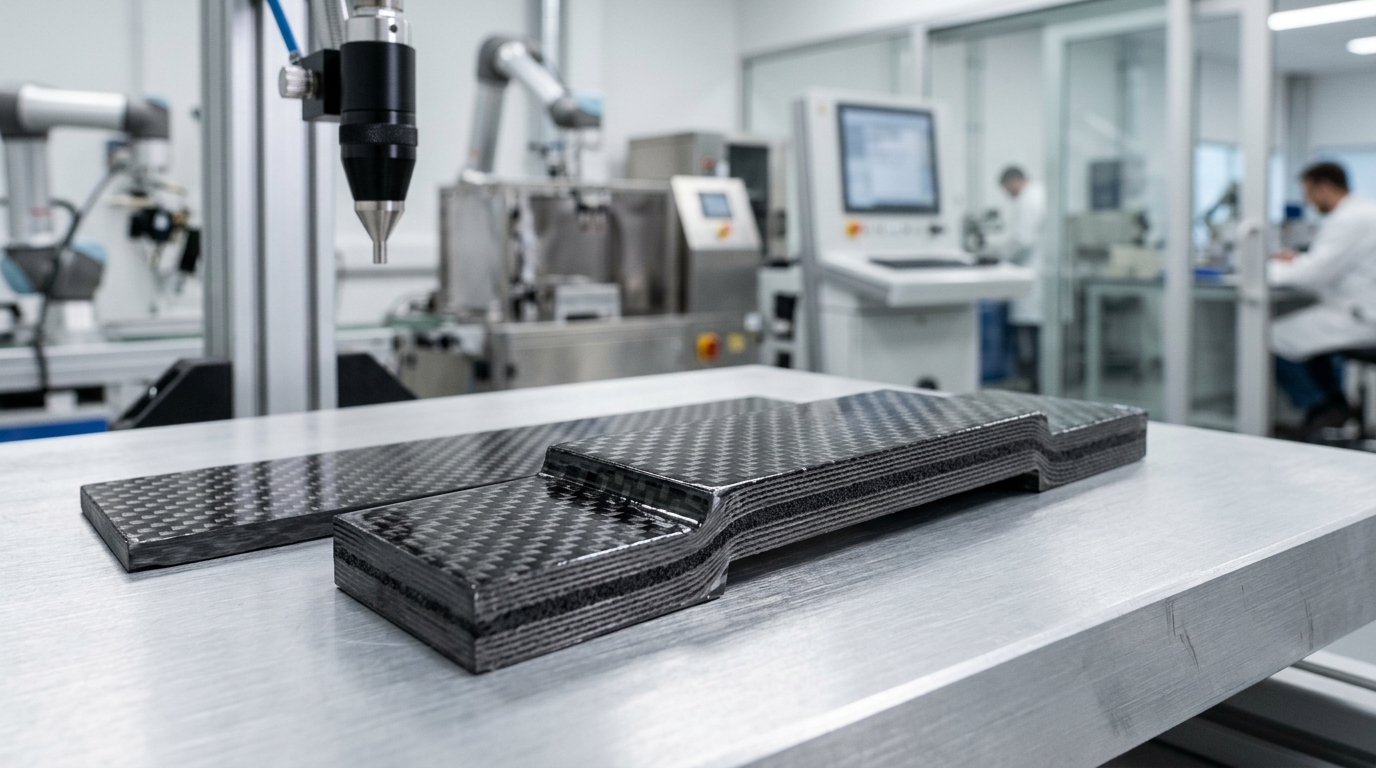
Carbon fiber-reinforced polymer (CFRP) laminates are prized for their stiffness and strength, but their layered construction leaves a familiar weak point: the interlaminar region between plies, where delamination-related failure can begin. A study published in the Journal of Materials Science on 4 November 2026 reports a systematic attempt to strengthen that zone by spraying commercially available multiwalled carbon nanotubes into CFRP interlaminar regions, and then measuring how the nanotubes’ length and degree of oxidation shape the resulting mechanical response. The work, led by Mingjun Shi and colleagues with co-author Weisong Zhang, used a consistent spray-deposition route across all comparisons, so that differences in performance could be examined under directly comparable processing conditions rather than under changes in how the tubes were deposited.
The researchers built two focused comparison series. One varied nanotube length while keeping oxidation states broadly comparable; the other varied surface oxidation while keeping geometrical characteristics roughly matched. All tubes were introduced with the same spray-deposition route, and the modified laminates were then subjected to both in-plane and out-of-plane quasi-static tests covering interlaminar-related strength and stiffness across different loading modes. This design allowed the team to examine effects that are often entangled in studies where nanotube type and processing method change together.
The headline result is that the mechanical response was neither monotonic nor uniform across loading modes. Among the examined grades, an intermediate condition labeled CNT3, with a mean length of 13.46 micrometers and a surface oxygen content of approximately 5.20 atomic percent, delivered the most balanced overall reinforcement. Relative to the unmodified laminate, it raised interlaminar shear strength by 13.7 percent and flexural strength by 8.0 percent. Those gains, measured under quasi-static loading, indicate that an intermediate condition in nanotube geometry and surface chemistry provided the most balanced overall reinforcement among the examined grades across the tested loading modes.
The extremes of the length series told a more cautionary story. Short nanotubes formed relatively discontinuous interlaminar domains, and the authors associate this limited reinforcement continuity with limited reinforcement. At the other end, the longest nanotubes produced a denser but more heterogeneous interlaminar morphology, with greater local accumulation of tube-rich material. That morphology was associated with reduced shear-related performance, yet the same condition showed higher compressive strength. In other words, a single nanotube grade was associated with different responses across loading modes, depending on how the tubes arranged themselves between the plies and which load path was engaged.
The oxidation-state series revealed a parallel trade-off. Increasing surface functionality on the nanotubes was beneficial only up to the point where oxidation-induced structural disorder and tube-wall degradation remained limited. Beyond that, the oxidation-induced structural disorder and tube-wall degradation appear to come at the cost of the nanotube's own structural integrity, reducing the reinforcement it was meant to provide. The authors frame this as a balance among three factors: interlaminar connectivity, CNT–matrix compatibility, and CNT structural integrity.
These findings matter because interlaminar-related failure is a key damage mode in laminated composites, and nanotube interlayers are one of several strategies being explored to address it. By showing that the response was loading-mode-dependent, the study cautions against judging a nanotube modification by a single test. A grade associated with higher compressive strength was simultaneously associated with reduced shear-related performance, so materials designers optimizing for one property need to check the others under the same processing conditions.
The study’s scope is worth noting. The results come from quasi-static tests on the examined CNT grades under the specific spray-deposition route used, and the authors describe the responses as non-monotonic within both comparison series rather than as a general law. The abstract does not report fatigue, impact, or environmental aging performance, and the mechanisms are described as associated with the observed interlaminar morphologies and mechanical measurements rather than demonstrated through direct imaging of failure processes.
What the work does establish is a practical design consideration: when tailoring CFRP interlaminar regions with sprayed nanotube interlayers, the choice of tube length and oxidation level should be treated as a coupled optimization problem.
Subject of Research: Effects of carbon nanotube length and oxidation state on the interlaminar mechanical performance of spray-modified CFRP laminates.
Article Title: Tailoring interlaminar-related mechanical responses of CFRP laminates using spray-deposited CNT interlayers: role of CNT length and oxidation state
Article References: Shi, M., Yuan, R., Huang, R., Jiang, Y., Zheng, D., Song, H., Wang, J., Wang, Y., & Zhang, W. (2026). Tailoring interlaminar-related mechanical responses of CFRP laminates using spray-deposited CNT interlayers: role of CNT length and oxidation state. Journal of Materials Science. https://doi.org/10.1007/s10853-026-13857-8
Image Credits: AI Generated
DOI: 10.1007/s10853-026-13857-8
Keywords: carbon nanotubes, CFRP laminates, interlaminar shear strength, flexural strength, spray deposition, oxidation state, composites, nanocomposites, quasi-static testing, delamination, surface functionality, Journal of Materials Science
News Source: Denise Maddox. (November 5, 2026). Spray-Deposited CNT Interlayers Tune CFRP Strength, but Only Up to a Point. Scienmag.