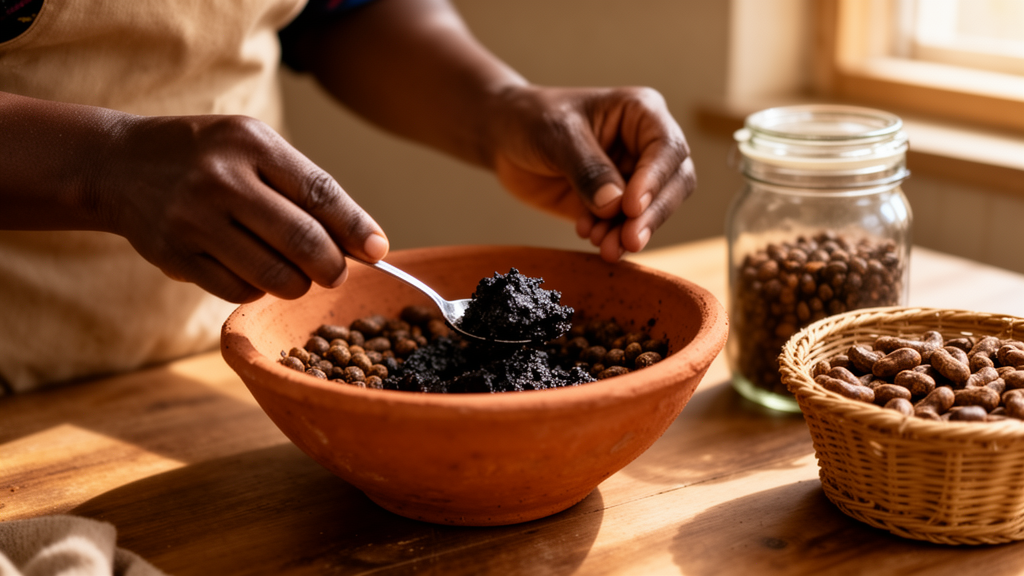
Scientists have isolated strains of Bacillus subtilis from iru, a pungent fermented condiment made from African locust bean seeds in Nigeria, and shown that selected strains can raise the levels of two essential B vitamins in the finished product. In a study published in the journal Biotechnology for Food Future, researchers report that lab-scale fermentations carried out with vitamin-overproducing strains increased riboflavin, or vitamin B2, by 38 percent and folate, or vitamin B9, by 35 percent compared with fermentations using the corresponding wild-type strains. According to the authors’ calculations, ten grams of iru fermented with these strains could supply about a quarter of an adult’s recommended daily riboflavin intake and all of the recommended daily folate intake for adults.
The work began with a survey of traditional production sites. The team purchased twenty fresh iru samples of good visual and odour quality from cottage producers in Oyo State and Ekiti State in Nigeria, transporting them to the laboratory on ice within two hours. Nutrient agar counts from the samples ranged from 6.14 to 7.46 Log10 CFU per gram. To capture only spore-forming bacteria, the researchers heat-treated the samples in a boiling water bath for ten minutes, which inactivates vegetative cells, before plating serial dilutions on nutrient agar and incubating them aerobically at 37 degrees Celsius for 24 hours. From this process they picked 86 morphologically distinct colonies for further study.
Phenotypic identification of the isolates revealed a diverse Bacillus community: 34 strains were classified as B. subtilis, 17 as Bacillus pumilus, 15 as Bacillus megaterium, 16 as Bacillus badius, 3 as Bacillus polymyxa and 1 as Bacillus cereus. B. subtilis accounted for roughly 36 percent of the collection, consistent with earlier findings that it dominates spontaneous iru fermentation, where it contributes extracellular proteinases and glutamic acid that shape the condiment’s characteristic flavour. All 86 isolates produced protease, and 46 showed amylolytic activity, traits that matter technologically because proteases break down proteins to develop flavour and texture while amylases degrade starch and release fermentable sugars.
Safety screening formed a central part of the characterisation. The isolates were tested for haemolysis on Columbia agar with 10 percent sheep blood, for gelatinase production on gelatin-supplemented nutrient agar, and for biogenic amine formation on Niven agar supplemented with precursor amino acids including L-lysine, L-histidine, L-ornithine, L-phenylalanine, L-arginine and tyrosine. Only one isolate showed beta-haemolysis, 11 showed alpha-haemolysis and 74 showed gamma-haemolysis, meaning no haemolytic activity. None of the isolates tested positive for gelatinase, and only two produced biogenic amines; one of those made four amines, histamine, tryptamine, cadaverine and tyramine, while the other made only tryptamine, and both also displayed haemolytic activity. On the basis of the absence of haemolysis, gelatinase and biogenic amine production, 72 isolates were carried forward to vitamin screening.
The vitamin screen used chemically defined media lacking the vitamin of interest. For folate, isolates were inoculated into folate-free Folic Acid Casei Medium, and for riboflavin into a chemically defined riboflavin-free medium, with quantification by VitaFast kit and by UHPLC with diode array detection respectively. Only 9 of the 72 selected isolates grew in the folate-free medium, indicating folate production, with concentrations ranging from 0.30 plus or minus 0.17 milligrams per litre for isolate I152 to 1.94 plus or minus 0.24 milligrams per litre for isolate I164. For riboflavin, 31 isolates grew in the riboflavin-free medium, with yields between 0.0062 plus or minus 0.002 milligrams per litre for isolate I75 and 0.0385 plus or minus 0.004 milligrams per litre for isolate I163. The nine folate producers and the top nine riboflavin producers were selected for improvement.
To push vitamin synthesis higher, the researchers exposed the selected wild-type strains to rising concentrations of toxic vitamin analogues, a classical food-grade selection strategy that does not involve genetic modification. Cultures were successively transferred through media containing 50, 100 and 200 milligrams per litre of roseoflavin, a riboflavin analogue, or methotrexate, a folate analogue, and surviving colonies were collected and quantified. All nine riboflavin-selected strains grew at the highest roseoflavin concentration, but only isolates I11, I163 and I164 showed slight improvements, and I11 and I163 were chosen as working strains. Under methotrexate pressure, six of the nine folate producers survived at the highest concentration, with isolate I166 increasing its folate output from 1.665 plus or minus 0.205 to 3.715 plus or minus 0.318 milligrams per litre and isolate I156 rising from 1.835 to 2.985 milligrams per litre; I166 and I156 became the folate working strains. Overall, the selection yielded a 1.5-fold increase in riboflavin and a 2.2-fold increase in folate production in defined media.
The team then turned to the food matrix itself. Cooked, dehulled African locust bean cotyledons were inoculated with the two overproducing strains and their wild types at 105 CFU per gram and incubated at 37 degrees Celsius for 48 hours, with uninoculated beans as a control and all experiments run in biological triplicate. The initial pH of the boiled cotyledons was 5.36, rising to between 6.9 and 7.5 after 24 hours and between 8.2 and 8.9 after 48 hours, reflecting the alkaline character of Bacillus fermentation, in which ammonia is a final metabolic product. Bacterial counts in controlled fermentations ranged from 6.19 to 7.92 log CFU per gram at 24 hours and reached 8.86 to 9.94 log CFU per gram by 48 hours. Sequencing of the gyrA gene confirmed that the improved isolates I163O and I166O were 100 percent identical to B. subtilis.
The vitamin results in iru were the study’s headline outcome. Riboflavin concentration in iru fermented with the overproducing strain I163O rose from 0.028 plus or minus 0.00135 to 0.033 plus or minus 0.001874 milligrams per gram at 24 hours, and from 0.036 plus or minus 0.00176 to 0.050 plus or minus 0.00013 milligrams per gram at 48 hours, a 38 percent increase over the wild type. Folate in iru fermented with the overproducing strain I166M increased 1.4-fold, from 0.019 to 0.025 milligrams per gram at 24 hours and from 0.035 plus or minus 0.0008 to 0.047 plus or minus 0.0006 milligrams per gram at 48 hours, a 35 percent gain. Compared with spontaneously fermented iru, the controlled fermentations doubled riboflavin levels and raised folate 2.8-fold. The authors estimate that ten grams of the enriched iru would supply 25 percent of the recommended daily intake of riboflavin, 100 percent of the folate recommendation for adults and 50 percent of the folate recommendation during pregnancy.
The authors note that the organoleptic properties of the enriched iru, assessed informally by a panel of experienced traditional food processors, matched typical iru in taste, aroma and texture, with the strong ammonia smell and the soft, sticky, dark brown or black appearance characteristic of the traditional product. They also point out that B. subtilis of the B. subtilis clade holds Generally Recognized as Safe status from the U.S. Food and Drug Administration and Qualified Presumption of Safety status from the European Food Safety Authority, and that none of the selected starter strains showed beta-haemolytic activity, gelatinase production or biogenic amine formation. Because B. subtilis is common in other West and Central African fermented foods, the authors suggest the approach could extend to products such as ugba, owoh and okpehe.
Several limitations remain open. The precise genetic alterations behind the enhanced vitamin output have not been identified, and the authors state that whole-genome sequencing of the overproducing strains is planned to locate mutations in biosynthetic or regulatory genes, including the FMN riboswitch that controls riboflavin biosynthesis in B. subtilis. The stability of the overproducing phenotype over multiple generations was not explicitly tested in this study, although the authors note that similar roseoflavin-induced traits in lactic acid bacteria have remained stable in previous work, and they commit to evaluating stability during prolonged fermentation and storage. The authors also acknowledge that the modest riboflavin increase highlights the need to select more efficient strains, and they caution that riboflavin’s antimicrobial, photosensitised activity may impose a self-inhibitory limit on accumulation in producer cells. As a lab-scale study using spontaneous mutants rather than engineered organisms, the findings establish a proof of concept for vitamin biofortification of traditional fermented foods while preserving their sensory and cultural value.
Subject of Research: Isolation and characterisation of riboflavin- and folate-producing Bacillus subtilis strains from Nigerian iru fermentation for vitamin biofortification
Article Title: Polyphasic characterisation of Bacillus subtilis strains for iru fermentation and vitamin bioenrichment
Article References: Awotundun, T. A., Greppi, A., Pugin, B., Plüss, S., Odunfa, S. A., Russo, P., Bokulich, N. A., & Olanbiwoninu, A. (2026). Polyphasic characterisation of Bacillus subtilis strains for iru fermentation and vitamin bioenrichment. Biotechnology for Food Future, 1(1), Article 1. https://doi.org/10.1186/s44496-025-00003-1
Image Credits: AI Generated
DOI: 10.1186/s44496-025-00003-1
Keywords: Bacillus subtilis, iru, fermentation, riboflavin, folate, vitamin biofortification, African locust bean, food safety, starter cultures, Nigeria, roseoflavin, methotrexate
News Source: Daisy Hatcher. (October 28, 2026). Spore-forming bacteria from Nigerian iru boost folate and riboflavin in fermented food. Scienmag.