The white-fleshed Blanca Cristalina cultivar stood out for its aromatic complexity and distinctive vegetable notes, while the yellow Amarilla Plátano delivered the highest juiciness score of the study and shared the top crunchiness scores with Blanca Cristalina. The work, published in Frontiers in Sustainable Food Systems, also proposes a preliminary sensory wheel intended to give researchers and industry a standardized vocabulary for describing the fruit.
Prickly pear, Opuntia ficus-indica, is a defining crop of arid and semi-arid Mexico, which is the species’ center of origin and the world’s leading producer. According to national agricultural statistics cited in the study, the 2024 agricultural cycle covered 44,464 hectares across 16 states and produced 409,596 tons of fruit, generating a commercial value exceeding 1,698 million Mexican pesos, roughly 93.97 million US dollars at the exchange rate used by the authors. Zacatecas ranks as the third-largest producing state, with about 76,000 tons valued at approximately 449.6 million pesos. The crop’s tolerance of water scarcity has made it a strategic resource in regions where few fruit trees thrive, and the authors note growing international interest in its nutritional profile, including vitamin C, dietary fiber, carotenoids, polyphenolic compounds and betalains.
Despite this economic and nutritional significance, the researchers argue that quality assessment of prickly pear has leaned heavily on physicochemical measurements such as acidity, pH and colorimetry, while sensory evaluation has remained coarse, typically limited to broad judgments of aroma, flavor, color and texture. Sensory perception, they contend, is a multidimensional phenomenon that such coarse descriptors cannot capture. Unlike products that have validated lexicons and sensory wheels, prickly pear lacks a standardized descriptive language, a gap the new study set out to begin closing with a strictly descriptive and exploratory approach.
The plant material came from a single commercial orchard in the locality of San Ramón, Zacatecas, managed agroecologically since 2020 under a technical support program of the agriculture ministry SADER. The orchard, planted at roughly 476 plants per hectare, has no formal irrigation system and relies on rainfall supplemented by tanker watering of about 50 liters per plant twice monthly from March to June. Synthetic inputs were replaced with bocashi, a solid-state fermented organic amendment applied at 3 kilograms per plant from February to April, and lime sulfur sprayed at 7 liters per hectare in the same window to prevent cochineal scale infestations. Three cultivars were studied: Blanca Cristalina (code M253), Roja Pelón (M647) and Amarilla Plátano (M874), all among the main prickly pears marketed in Mexico.
Sampling was tightly controlled to standardize ripeness. Fruit was collected from a single commercial harvest lot on August 8, 2025, drawn from produce destined for daily local market sale, with selection restricted to large, clean, spineless fruits free of physical defects. Baseline measurements documented average fruit weights of about 166 to 172 grams across the three cultivars, uniformly low titratable acidity near 0.06 percent expressed as citric acid, and cultivar-specific pH and color values consistent with visual maturity. The fruit was stored at 4 degrees Celsius for 16 hours before the sensory session on August 9, 2025.
The panel itself was built through a three-stage process. Sixty candidates entered structured screening and training covering color recognition, basic taste and odor identification, intensity discrimination, descriptive ability, texture discrimination and product-specific training, with predefined minimum performance thresholds such as correctly identifying at least 80 percent of samples in taste and odor tests. Thirty-five assessors passed and completed an intensive 160-hour training program focused on Opuntia varieties. The authors acknowledge that formal quantitative assessments of panel performance, such as assessor effects and repeatability across duplicates as outlined in the ISO 11132:2021 standard, were not exhaustively recorded, so the resulting lexicon is presented as an exploratory first approximation rather than a fully validated instrument.
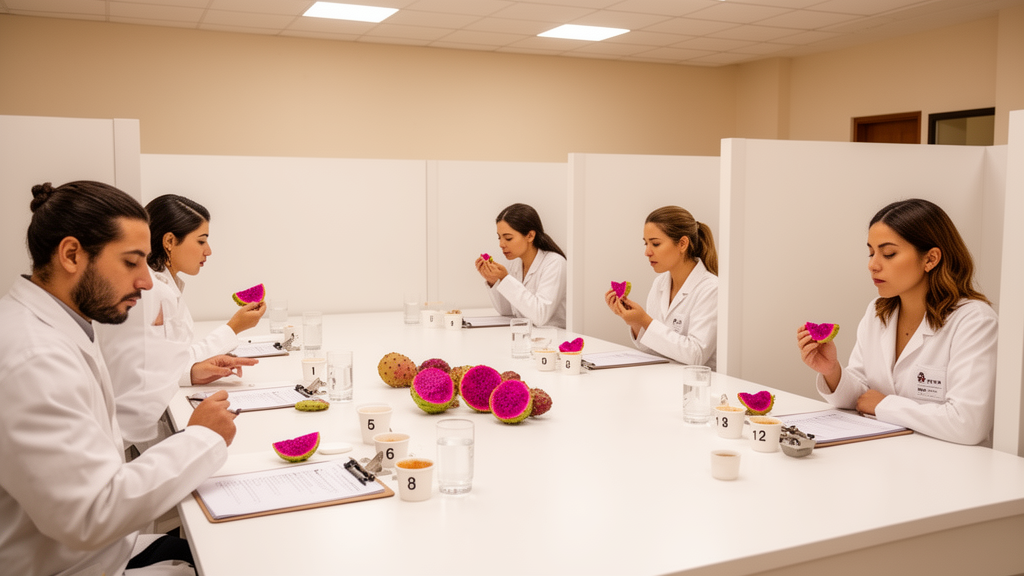
Evaluation took place at the INIFAP sensory analysis laboratory in Zacatecas, in ISO-standard tasting booths operated under ISO 22000:2018 food safety protocols. Each assessor tasted all three cultivars, presented monadically in randomized order to minimize carry-over effects, with each cultivar evaluated twice in the same session. Samples were coded and blinded: the administrator did not know which code corresponded to which cultivar, and assessors were not told the identities behind the codes, although the authors note this falls short of a true double-blind procedure because samples were prepared by one of the authors. Visual information was masked with blindfolds during olfactory, gustatory and textural evaluation, and panelists cleansed their palates with water and unsalted crackers between samples. Using the Spectrum Descriptive Analysis method on a 150-point universal intensity scale, the panel scored 41 attributes spanning aroma, flavor, appearance and texture.
Statistically, the data were analyzed with repeated measures analysis of variance treating cultivar as a within-subjects factor, followed by Bonferroni post-hoc comparisons and a Benjamini-Hochberg correction to control the false discovery rate across the 41 attributes. Eighteen discriminant attributes survived these tests and fed a principal component analysis whose first two components explained 55.88 percent of total variance, leaving the authors careful to describe the resulting sensory map as exploratory. The results split the cultivars into distinct identity profiles. In aroma, Blanca Cristalina scored 72.00 for green notes and 70.29 for nopal notes, more than three times the intensity perceived in the two pigmented cultivars, and it also led on citrus and fermentation notes. In flavor, it recorded the highest overall intensity at 89.43, with nopal notes at 61.43 and green notes at 57.71, and was judged significantly fruitier at 66.29. Amarilla Plátano, by contrast, reached the highest sweetness score of 100.00 and floral notes of 70.86, and dominated texture with a juiciness mean of 106.00, the only attribute in the study to exceed 100, alongside high crunchiness. Roja Pelón was distinguished mainly by larger perceived seed size and showed a fainter, intermediate profile overall.
From these data the team constructed a hierarchical sunburst diagram representing a preliminary sensory wheel, in which the arc length of each attribute is proportional to its mean intensity across all three cultivars and attributes are stratified into high, medium and low intensity tiers. This visualization separates transversal traits that define the shared identity of the fruit, chiefly juiciness, sweet flavor, crunchiness and freshness, from low-intensity varietal markers such as green, nopal and fermentation notes, which carry little global weight but high discriminative power. The authors stress that the stratification reflects intensity magnitude, not sensory relevance, and that consolidating a universal wheel will require validation across a much broader spectrum of genotypes.
The study’s limitations are explicitly framed. It examined three cultivars from a single production context and a single harvest, without independent biological replications across seasons, without a comparative conventional management control, and therefore without any claim about the isolated effects of the bio-inputs. No consumer panel, hedonic ratings or purchase-intention measures were included, so the intensity scores describe intrinsic sensory characteristics rather than acceptance or market value. The authors position the work as a foundational baseline: the documented organoleptic diversity of Zacatecan prickly pear under agroecological management could underpin future consumer research, cultivar differentiation and specialty market positioning, but profitability and price premiums remain untested questions for subsequent agricultural economics studies.
Subject of Research: Descriptive sensory characterization of three agroecologically grown prickly pear cultivars from Zacatecas, Mexico, using a trained panel and multivariate statistics to build a preliminary sensory wheel.
Article Title: Organoleptic diversity and sensory wheel of prickly pear (Opuntia ficus-indica) produced under agroecological management in the Mexican semi-desert
Article References: López-Santiago, M. A., Sánchez-Toledano, B. I., García-Vázquez, R., Figueroa-González, J. J., & Maciel-Torres, S. P. (2026). Organoleptic diversity and sensory wheel of prickly pear (Opuntia ficus-indica) produced under agroecological management in the Mexican semi-desert. Frontiers in Sustainable Food Systems, 10, Article 1989109. https://doi.org/10.3389/fsufs.2026.1989109
Image Credits: AI Generated
DOI: 10.3389/fsufs.2026.1989109
Keywords: prickly pear, Opuntia ficus-indica, sensory evaluation, trained panel, sensory wheel, agroecology, Zacatecas, semi-arid agriculture, cultivar differentiation, principal component analysis, food quality, Mexico
News Source: Alan Morgan. (October 28, 2026). Trained Panel Maps Distinct Sensory Profiles of Agroecological Prickly Pear in Zacatecas. Scienmag.