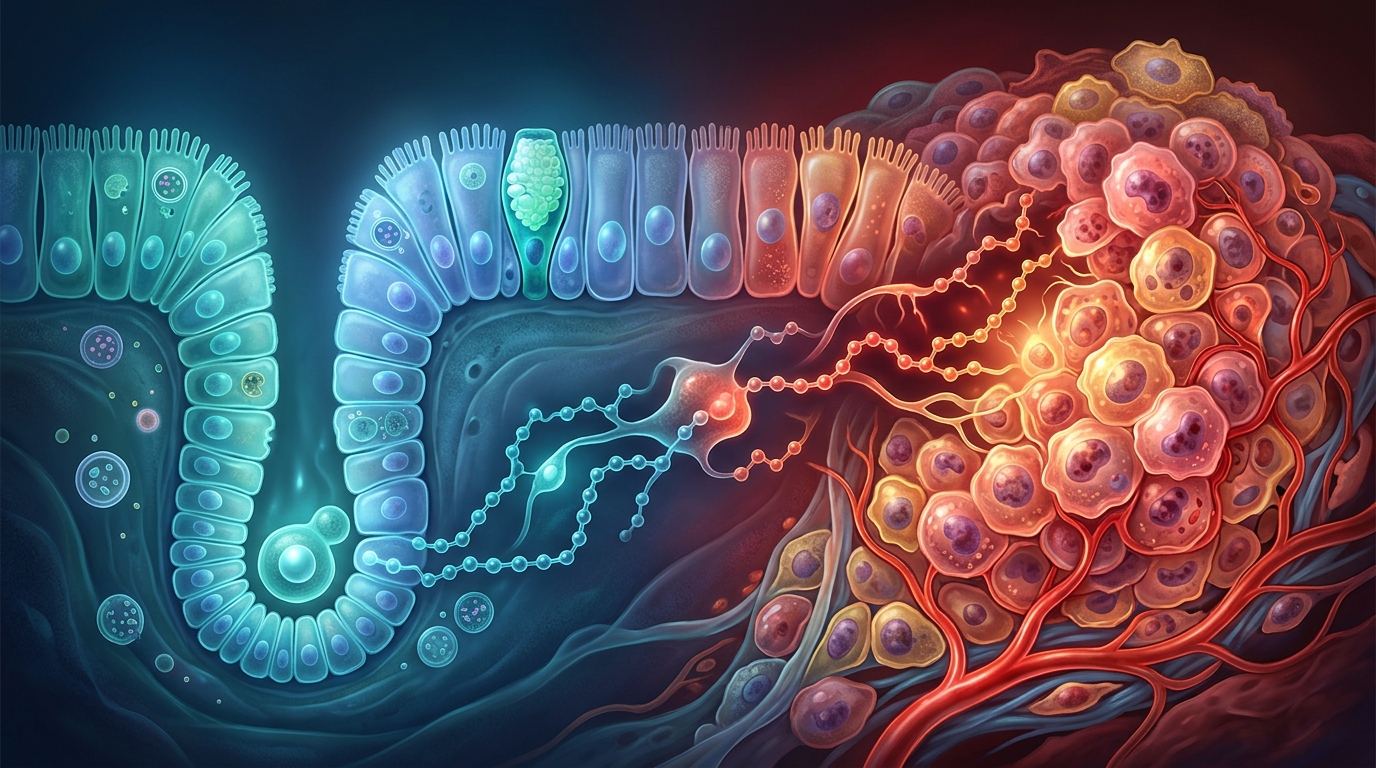
Spermidine, a naturally occurring polyamine, sits at the center of a new mini review examining colorectal cancer, a disease that remains a leading cause of cancer-related mortality and whose incidence is rising, particularly among young people. Published open access in the journal Amino Acids, the review argues that understanding this small molecule may be key to developing novel therapeutic strategies for the disease.
Colorectal cancer development is driven by genetic and epigenetic alterations in key oncogenic pathways, and it is accompanied by a profound reprogramming of polyamine metabolism. Within this reprogramming, spermidine is regarded as a pro-tumorigenic metabolite. It is produced downstream of the MYC–ornithine decarboxylase (ODC) axis, and the review describes how it sustains colorectal cancer growth by fueling hypusination of eIF5A, a modification that in turn supports MYC translation. This establishes a feed-forward MYC–ODC–polyamine–eIF5A circuit that promotes tumorigenesis.
That circuit may also point to new treatment opportunities. According to the review, recent studies show that combined inhibition of polyamine biosynthesis and eIF5A hypusination synergistically impairs MYC translation and suppresses colorectal cancer growth in preclinical models. The authors note that this dual approach outperforms single-agent strategies such as blocking ODC with difluoromethylornithine (DFMO), highlighting the translational potential of targeting the axis at two points simultaneously.
Yet the story is not one-sided. The review gathers multiple lines of evidence indicating that excessive spermidine, or altered flux through the polyamine pathway, can be cytotoxic. Several reports demonstrate that high-dose spermidine triggers apoptosis, the process of programmed cell death. In other words, the same molecule that can feed tumor growth can, at high concentrations, kill cells.
Experimental models add a further twist: spermidine and epithelial eIF5A hypusination appear able to protect against colitis and colitis-associated cancer by supporting the translation of detoxifying enzymes. This protective function complicates any simple classification of the polyamine as purely harmful in the gut.
Taken together, the literature points to a dual role for spermidine in colorectal cancer, simultaneously a fuel for tumor growth and, under certain conditions, a cytotoxic or protective agent. The authors state that the aim of the review is to dissect the functions of spermidine in the disease, to summarize and critically discuss the potential benefits of this polyamine, and to evaluate how it might be rationally exploited as a therapeutic agent in cancer. The findings discussed are drawn from preclinical models and experimental studies, and the review frames dual targeting of the MYC–ODC–polyamine–eIF5A axis as a promising direction for future translational work.
Subject of Research: The dual role of the polyamine spermidine in colorectal cancer growth and therapy
Article Title: Spermidine in Colorectal cancer: friend or foe?
Article References: Coni, S., Bordone, R., Campea, L., Ohno, S., Canettieri, G., & Agostinelli, E. (2026). Spermidine in Colorectal cancer: friend or foe?. Amino Acids, 58(1), Article 47. https://doi.org/10.1007/s00726-026-03554-w
Image Credits: AI Generated
DOI: 10.1007/s00726-026-03554-w
Keywords: spermidine, colorectal cancer, polyamine metabolism, MYC, eIF5A hypusination, ornithine decarboxylase, DFMO, preclinical models, cancer therapy, Amino Acids, Colorectal, cancer
News Source: Nathaniel Bowman. (November 3, 2026). Spermidine Shows a Double-Edged Role in Colorectal Cancer Growth. Scienmag.