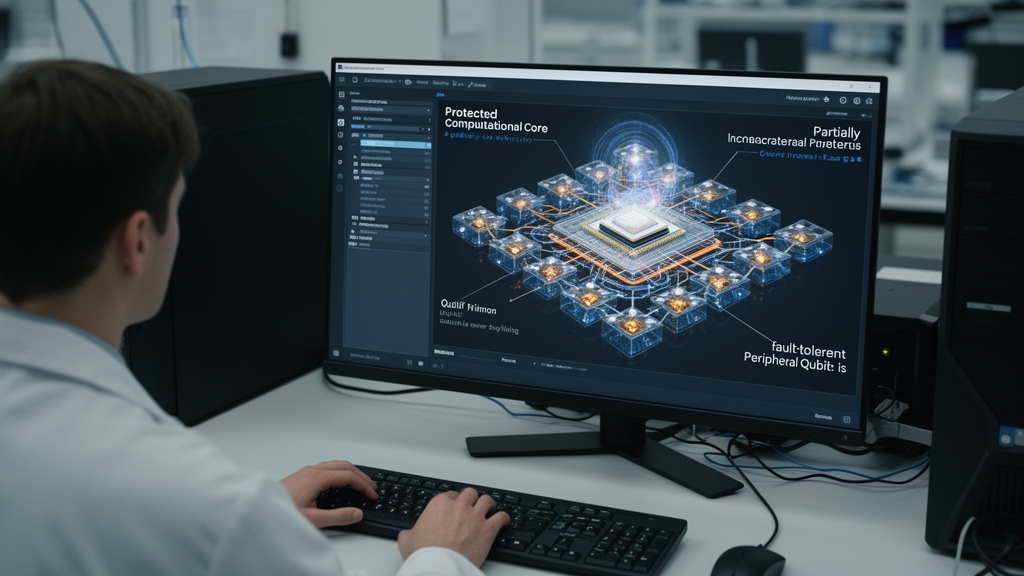
University of Central Florida researchers are developing software tools to test whether partially fault-tolerant quantum computers could make demanding electron simulations more practical. The $400,000 Department of Energy grant supports a project led by Siyuan Niu, an assistant professor in UCF’s Department of Electrical and Computer Engineering, with co-investigators Di Wu and Eduardo Mucciolo. The work is intended to improve the translation of simulations into quantum operations, speed up error detection and correction, and estimate the total quantum and classical resources required. It is a research and software-development effort, not a demonstration that a useful quantum advantage has already been achieved.
The motivation is the gap between today’s error-prone quantum hardware and fully fault-tolerant systems that use quantum error correction to identify and repair errors before they corrupt a calculation. Current devices can accumulate errors during the long sequences of operations needed for advanced simulations. Fully protected designs can mitigate that problem, but they may require substantial additional hardware and run time. Niu’s team is examining whether an intermediate architecture can reduce those demands while retaining enough protection to support scientifically useful work.
The team will use the Fermi-Hubbard model, a standard model for studying interacting electrons, as a benchmark for simulating how electrons evolve in materials over time. The project will focus on the Space-Time Efficient Analog Rotation, or STAR, architecture, which applies full error correction to basic quantum operations but uses partially protected “analog” rotations for operations that are performed repeatedly in quantum simulations. Those rotations could avoid some of the qubit and time overhead associated with fully fault-tolerant designs, although they would retain residual error and might need to be repeated until they succeed.
To evaluate that trade-off, the researchers plan to build an open-source framework combining three components: a compiler that converts quantum simulations into executable operations, a fast GPU-based decoder that identifies errors in quantum error-correction data, and a resource estimator that calculates the qubits, runtime, classical computing power and operation types needed for a simulation. Error correction spreads information across multiple physical qubits and repeatedly checks for signs of errors. A classical decoder then uses those checks to locate and correct problems before they spoil the result, an approach designed to address the fragility of qubits and the accumulation of errors during extended calculations.
The framework’s modular design would allow researchers to substitute alternative compilation or decoding methods and compare their results. The team also plans to compare resource estimates for STAR with estimates for today’s noisy, unprotected devices and fully fault-tolerant architectures. Such comparisons could help identify which simulations may become realistic, which hardware improvements matter most and when scientifically useful quantum computing may become feasible. The broader objective is to determine whether, and under what conditions, advanced quantum machines can reach “quantum utility,” meaning that they can perform scientifically useful computations at a practical cost. Even successful completion of the project would provide a roadmap and assessment rather than a guaranteed demonstration of quantum advantage.
Subject of Research: Software tools for evaluating partially fault-tolerant quantum simulations of electron behavior in materials
Article Title: New software tools explore the potential of partially fault-tolerant quantum computing
Article References: New software tools explore the potential of partially fault-tolerant quantum computing. Original publication (Bibliographic details unavailable.)
Image Credits: AI Generated
DOI: Not provided
Keywords: partially fault-tolerant quantum computing, quantum error correction, STAR architecture, quantum simulation, Fermi-Hubbard model, quantum compiler, GPU-based decoder, resource estimation, electron materials simulations, software, tools, explore
News Source: Katie Riggs. (October 20, 2026). Software framework targets partially fault-tolerant quantum simulation. Scienmag.