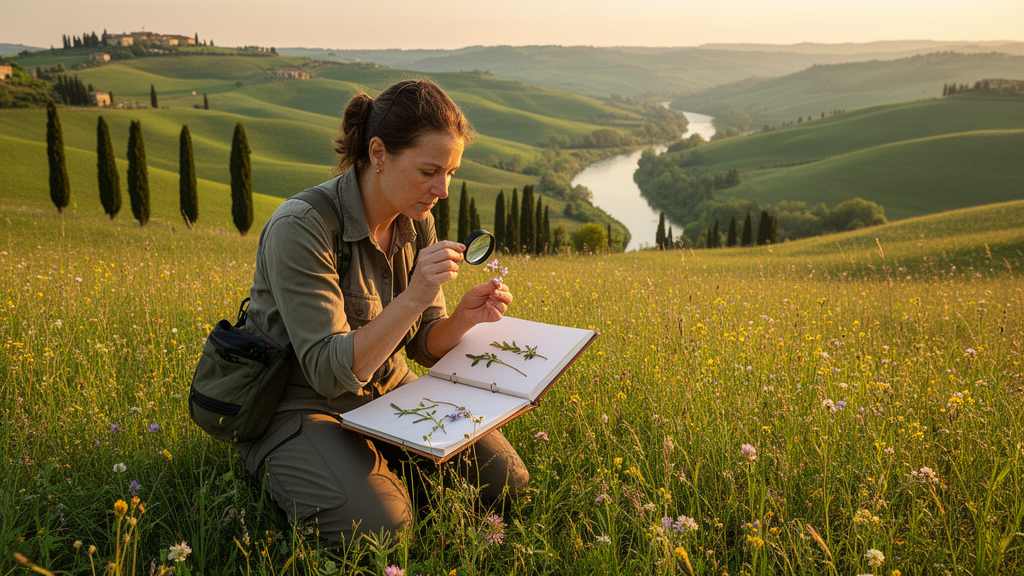
A floristic inventory based on field surveys from 2018 to 2024 identified 1,034 specific and subspecific vascular plant taxa in Tuscany’s lower Sieve Valley. Of these, 893 were recorded for the first time in the valley, 21 were new records or confirmations for the province of Florence, and two were new for Tuscany. The inventory also documented 109 established alien taxa.
The study filled a substantial gap in regional botanical knowledge. Although early floristic records for the lower Sieve Valley date to 1860, only 140 taxa had been reliably referred to the area between 1860 and 2010, including 70 reported before 1950. The new research combined a review of the limited literature with field investigations, herbarium specimens, approximately 3,000 photographs and about 5,000 field observations.
The surveyed area covers 101 km² of the Sieve River basin between Contea and Pontassieve, extending across parts of Pontassieve, Pelago, Rufina and Londa in the province of Florence. Elevations range from 90 to 992 metres above sea level, with distinct valley-floor, hilly and sub-mountainous sectors. The landscape includes urbanized and industrial areas, croplands, vineyards, olive groves, meadows, forests, rocky slopes, rivers, streams and artificial reservoirs. The valley also includes the Chianti Rufina subzone of Chianti Classico DOCG production.
Researchers used Species-Area Relationships developed for Tuscany to estimate expected richness before comparing the predictions with field results. The expected number of species and subspecies was 1,009, compared with 1,034 observed taxa. The correspondence between expected and observed established taxa was 99.3%, indicating that the valley’s floristic richness was close to the model estimate and comparable to other Tuscan areas. Expected alien richness was 89 taxa, whereas the inventory documented 109 established aliens, about 10% of the established flora and 22% above the prediction.
The alien total was proportionally higher than predicted but lower than in nearby areas such as the Cerbaie Hills and the municipality of Empoli. The authors proposed that Populus × canadensis nothosubsp. canadensis should be considered a naturalized alien in Tuscany because it is widespread along the terminal stretch of the Sieve River and competes with native Populus nigra subsp. nigra. Aliens were most numerous in urban and riparian environments, while Arundo donax and Robinia pseudoacacia were among the most widespread along the regional road network.
Three families accounted for 30% of the recorded flora: Asteraceae with 131 taxa, Poaceae with 93 and Fabaceae with 88. The most prominent life forms were hemicryptophytes at 35.1%, therophytes at 30.1% and geophytes at 15.4%. Eurosiberian taxa represented 32.6% of the flora and transitional Eurosiberian-Mediterranean taxa 30.3%, followed by widely distributed taxa at 14.3% and Mediterranean taxa at 13.5%. The authors associated this pattern with the area’s temperate and continental climate, summer aridity and mixture of open habitats.
Twelve Italian endemics were recorded, including Bellevalia webbiana, a narrowly endemic species categorized as Endangered nationally. Newly discovered populations expanded the known range of B. webbiana, whose previously reported area of occupancy was 68 km² and described as gradually decreasing. Of 17 taxa of national conservation interest, 14 were categorized as Least Concern, two as Data Deficient, two as Near Threatened, one as Vulnerable and one as Endangered. Olive groves, fallow grasslands, riparian zones and artificial water basins supported several of the conservation-significant plants.
Among 72 historical records reviewed for the valley, 33 taxa were directly confirmed during fieldwork and 39 were not. The unconfirmed records were concentrated mainly around Monte Giovi. The study noted two possible explanations: older localities were sometimes described only approximately, making it difficult to determine whether plants occurred inside the defined basin, while agricultural abandonment and extensive reforestation may have reduced suitable habitat. The authors therefore treated habitat loss as a possible explanation rather than a demonstrated cause of every missing record.
Water bodies were identified as the most affected habitats because of hydromorphological alteration, water over-exploitation, pollution and alien-species invasion. The authors highlighted the conservation value and fragility of wetlands and artificial basins for rare hygrophytes. Ludwigia peploides subsp. montevidensis, a regulated alien macrophyte recently recorded in the area, was singled out because it can compete strongly with native aquatic communities. Overall, the survey provides a detailed baseline for the lower Sieve Valley, while the unconfirmed historical records and continuing pressures on aquatic habitats remain important limitations on the completeness of the inventory.
Subject of Research: Floristic inventory of vascular plants in Tuscany’s lower Sieve Valley
Article Title: The vascular flora of the lower Sieve Valley (Tuscany, central Italy)
Article References: Pinzani, L. (2025). The vascular flora of the lower Sieve Valley (Tuscany, central Italy). Italian Botanist, 19, 1-14. https://doi.org/10.3897/italianbotanist.19.144112
Image Credits: AI Generated
DOI: 10.3897/italianbotanist.19.144112
Keywords: floristic inventory, vascular flora, lower Sieve Valley, Tuscany, plant diversity, biodiversity, alien species, field survey, species-area relationships, conservation status, vascular, flora
News Source: Margaret Porter. (October 20, 2026). Floristic survey finds 1,034 vascular plant taxa in Tuscany’s lower Sieve Valley. Scienmag.