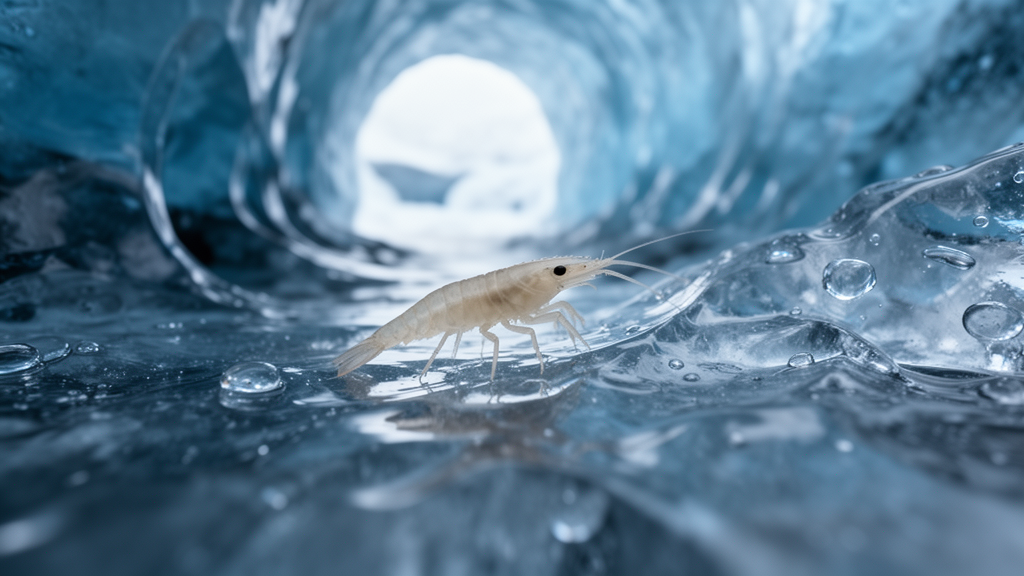
A field and laboratory study of Allegheny Cave Amphipods found that the crustacean Stygobromus allegheniensis was present and active during winter in Sam’s Point Ice Cave #1 in New York’s Minnewaska State Park Preserve. The investigators observed amphipods in liquid water beneath surface ice and collected 14 animals from an unfrozen pool. Laboratory tests found that specimens could survive complete ice encasement for up to four hours under the tested conditions, while specimens with access to a thin film of liquid water survived at least 27 hours in an ice-water mixture.
The study combined two cave visits with laboratory exposures of field-collected animals. Researchers surveyed Sam’s Point Ice Cave #1 on January 26 and February 2, 2025, recording ice, flowing water, air and water temperatures, and wall-rock temperatures. They used carrot-baited funnel traps to sample amphipods.
One trap was placed for three hours beneath the ice of a shallow pool and recovered a single specimen, which was returned to its natural setting. A second trap remained for 24 hours in an ice-free pool and collected 14 animals, which were transported alive to the laboratory. The cave contained sharply contrasting winter microhabitats.
Air in the upper galleries ranged from 2.0 to 3.2 °C, and pools there remained unfrozen. Lower galleries were colder, with air temperatures of 0.4 to 1.2 °C, wall-rock temperatures as low as −1.0 °C, and increasing ice accumulation along floors and walls. Yet liquid water at 1.7 to 3.3 °C continued to flow from fissures or seep through gravel in the colder sections.
A pool approximately 15 metres long and 2 metres deep remained free of surface ice and had a recorded water temperature of 6.6 °C. Amphipods were also detected where substantial surface ice was present. In a shallow pool, researchers drilled through an approximately 10-centimetre ice cover and found about 12 cm of liquid water beneath it.
The trap placed in this water collected one S. allegheniensis , indicating that at least some individuals remained active beneath frozen pool surfaces. The 14 animals recovered from the deeper, unfrozen pool ranged from 4.9 to 10.2 mm in body length. The researchers interpreted this broad size range as suggesting multiple age groups were present in the cave during winter, although they did not directly determine the animals’ ages or reproductive status.
For the freezing experiment, the 14 collected specimens were held for 24 hours at 2 °C and then exposed to −18 °C until 95% of the water had frozen, which took approximately 15 minutes. Three animals were fully encased in ice at −2 °C for three hours, two for four hours, and four for 4.5 hours. Two of the three animals in the three-hour group and one of the two in the four-hour group survived.
None of the four animals exposed for 4.5 hours survived complete encasement. These results did not support the hypothesis that collecting the animals in January and February conferred enough cold tolerance to survive an entire winter frozen solid. A different outcome occurred when five specimens retained a film of liquid water around parts of their bodies after freezing.
They were transferred to 0.5 °C, where the surrounding ice remained solid but the water film stayed liquid, and they were only partially encased. All five survived 27 hours in the ice-water mixture. Body parts outside the ice continued moving, and the animals resumed active movement immediately after thawing.
Specimens exposed to temperatures no higher than 2 °C for a total of 123 hours, including the 27-hour partially frozen period, remained alive and active. Some swam beneath sheets of ice while remaining in contact with the ice. Earlier experiments found a temperature preference near 14.4 °C and showed that October-collected specimens could walk on ice.
The current survey documented persistent liquid water in deep pools, beneath gravel, and in cracks in colder galleries. The authors therefore proposed that amphipods may retreat to these warmer, unfrozen microhabitats when upper pool layers freeze. The study did not directly track individual animals, however, so it did not establish the precise mechanism by which the cave population avoids prolonged encasement.
The results also weigh against a life cycle in which every adult dies during winter and cold-resistant eggs alone regenerate the population after the thaw. That possibility had been considered by analogy with the Antarctic fairy shrimp Branchinecta gaini , whose resting eggs can remain viable at −25 °C. For S. allegheniensis , however, fertilized eggs are retained by females in a brood pouch, or marsupium, complicating a directly comparable egg-based strategy.
The winter observations showed living amphipods of varied sizes in the cave, but they did not directly establish whether reproduction occurred during winter or that multiple reproductive cohorts were present throughout the year. Overall, the findings suggest that S. allegheniensis may combine behavioral use of liquid-water microhabitats with limited physiological tolerance of freezing. Its attraction to baited traps indicates activity and responsiveness to food cues under near-freezing conditions, rather than the deep inactivity associated with true hibernation.
The laboratory experiment involved only 14 field-collected animals and a limited set of exposure durations, so it does not establish how the entire cave population survives every natural winter condition. Nevertheless, the observations document winter activity in both ice-covered and unfrozen sections of the cave and show that access to liquid water was associated with substantially longer survival than complete solid-ice encasement in the tested animals.
Subject of Research: Winter survival and activity of Allegheny Cave Amphipods in New York ice caves
Article Title: Winter survival strategies of cave-adapted amphipods in the Ice Caves of Sam’s Point area of Minnewaska State Park Preserve, NY, USA
Article References: Espinasa, L., Espinasa, J., & Castañeda, O. (2025). Winter survival strategies of cave-adapted amphipods in the Ice Caves of Sam’s Point area of Minnewaska State Park Preserve, NY, USA. Subterranean Biology, 53, 103-117. https://doi.org/10.3897/subtbiol.53.157293
Image Credits: AI Generated
DOI: 10.3897/subtbiol.53.157293
Keywords: Allegheny Cave Amphipod, Stygobromus allegheniensis, ice caves, winter survival, freeze tolerance, liquid-water refuges, cave amphipods, Sam’s Point, Shawangunk Ridge, New York, Winter, survival
News Source: Drew Townsend. (October 20, 2026). Field and laboratory study finds Allegheny cave amphipods active in New York ice caves but not tolerant of prolonged solid-ice encasement. Scienmag.