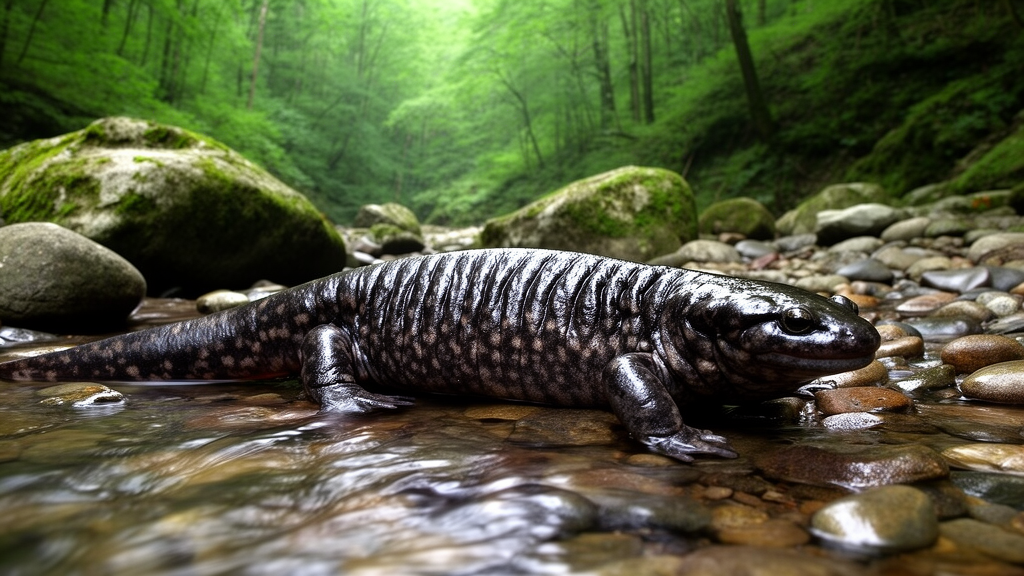
An integrative taxonomic study has identified two wild-caught giant salamanders from western Anhui as a previously undescribed species, Andrias yaoluopingensis. The formal description combines external morphology with mitochondrial-genome phylogeny and a haplotype network, bringing the number of recognized species in the genus Andrias to six.
The specimens were collected from the Macao River in Yaoluoping National Nature Reserve, Yuexi County, Anqing City, Anhui Province, on 20 September 2017. The collection site is at 31.00°N, 116.08°E and 948 metres above sea level. The authors proposed the name A. yaoluopingensis for the type locality and suggested “Yaoluoping Giant Salamander” as its English common name. The holotype, adult male HSA25201, and paratype, adult female HSA25202, were deposited in the Anhui Normal University Museum.
Chinese giant salamanders were historically treated as one widespread species, but recent molecular and morphological studies have documented additional lineages and formally recognized species. Earlier work proposed several genetically distinct clusters, restored A. sligoi from the synonymy of A. davidianus, and described A. jiangxiensis in 2022 and A. cheni in 2023. The molecular data available for the Dabie Mountain region were described as poorly studied when the two Anhui specimens were examined in 2017.
The researchers made 25 external measurements on the two specimens using digital calipers and compared them with holotype data for A. sligoi, A. jiangxiensis and A. cheni. The holotype measured 650.69 mm in total length and 420.54 mm in snout-vent length; the female paratype measured 545.80 mm and 354.13 mm, respectively. The diagnosis includes a flat head and trunk, a head slightly longer than wide, few and irregularly distributed tubercles above the orbit, an eye diameter longer than the naris diameter, a discontinuous lateral neck fold, slight interdigital webbing and the finger-length sequence FIII > FII > FI > FIV. The dorsal surface is tan with darker trunk blotches, while the ventral surface is greyish-brown with darker patches.
For the molecular analysis, the team extracted genomic DNA from ethanol-preserved liver tissue and amplified two near-complete mitochondrial genomes measuring 14,751 and 14,271 base pairs. These sequences were combined with 30 mitochondrial genomes from other Chinese Andrias and one from the Japanese outgroup A. japonicus. Bayesian-inference and maximum-likelihood analyses produced identical tree topologies. The Anhui specimens formed a distinct, previously undescribed lineage, clade C, with a Bayesian posterior probability of 1.00 and 100% maximum-likelihood bootstrap support.
The analysis also identified 27 haplotypes across 393 sites, with haplotype diversity of 0.98. The haplotype network showed deep genetic separation between A. yaoluopingensis and the other Chinese giant salamanders. The new species was most closely related to A. sligoi, from which it differed in eye and naris proportions, finger-length sequence and the presence of slight interdigital webbing. Mean mitochondrial sequence divergence between the new species and A. sligoi was 1.31 in the table’s units of 0.01%.
Based on the phylogenetic results, the authors reported A. yaoluopingensis from the type locality in western Anhui, northern Guangxi and Hunan Province, although the newly described specimens themselves came only from the Anhui collection site. They estimated that clade C and A. sligoi diverged around the Pliocene or early Pleistocene, based on earlier work. The authors discussed the Twain-Hu Plain, which includes eastern and southern Hubei and eastern and northern Hunan, as a possible biogeographic setting. Dongting Lake lies in the middle of the plain, and the Yangtze River runs through the lake. Historical river capture and change, or possibly anthropogenic translocation, were proposed as possible explanations for the lineage’s present distribution, but the study did not establish which mechanism produced it.
The principal limitation was the absence of nuclear data. Mitochondrial introgression can occur in Andrias and could support a different taxonomic scenario. Nuclear data were also unavailable for important specimens, including the A. sligoi holotype and most populations, while a previous RAG2 analysis had revealed no obvious geographic patterns. Morphological comparisons were further constrained because pure A. davidianus and A. sligoi have not been genetically identified, and farm-bred animals can contain genetic material from translocated individuals or hybrids. The study therefore relied on a small series of specimens and available mitochondrial and morphological data.
Despite those constraints, the authors considered the agreement between the strongly supported mitochondrial topology and the morphological diagnosis sufficient for the formal description. They stated that wild populations in northeastern Hunan and eastern Hubei require further study, alongside additional field surveys, nuclear sampling and revision of the phylogenetic and biogeographic history of Chinese Andrias. The study also noted that Chinese giant salamander populations have declined due primarily to overexploitation, habitat loss and degradation, making species-level classification important for conservation and genetic management.
Subject of Research: Taxonomic description of a new Andrias giant salamander from Anhui, China
Article Title: A new species of the Giant Salamander genus Andrias ( Amphibia , Urodela , Cryptobranchidae ) from Yuexi, Anhui, China
Article References: Jiang, Z., Huang, R., Yang, J., Zhao, K., Zhang, Y., Zhang, T., Zhang, Y., Chu, J., Chen, J., & Huang, S. (2026). A new species of the Giant Salamander genus Andrias (Amphibia, Urodela, Cryptobranchidae) from Yuexi, Anhui, China. Zoosystematics and Evolution, 102(2), 649-658. https://doi.org/10.3897/zse.102.179377
Image Credits: AI Generated
Keywords: Andrias yaoluopingensis, giant salamander, new species, integrative taxonomy, Anhui, China, mitochondrial phylogeny, morphology, cryptic diversity, conservation, species, Giant
News Source: Margaret Porter. (October 20, 2026). Morphological and mitochondrial evidence supports new giant salamander species from Anhui. Scienmag.