Within the TRANSITION Project, KIT, HIU and partners will develop powerful sodium-ion battery prototypes for future application in electro-mobility and stationary energy storage
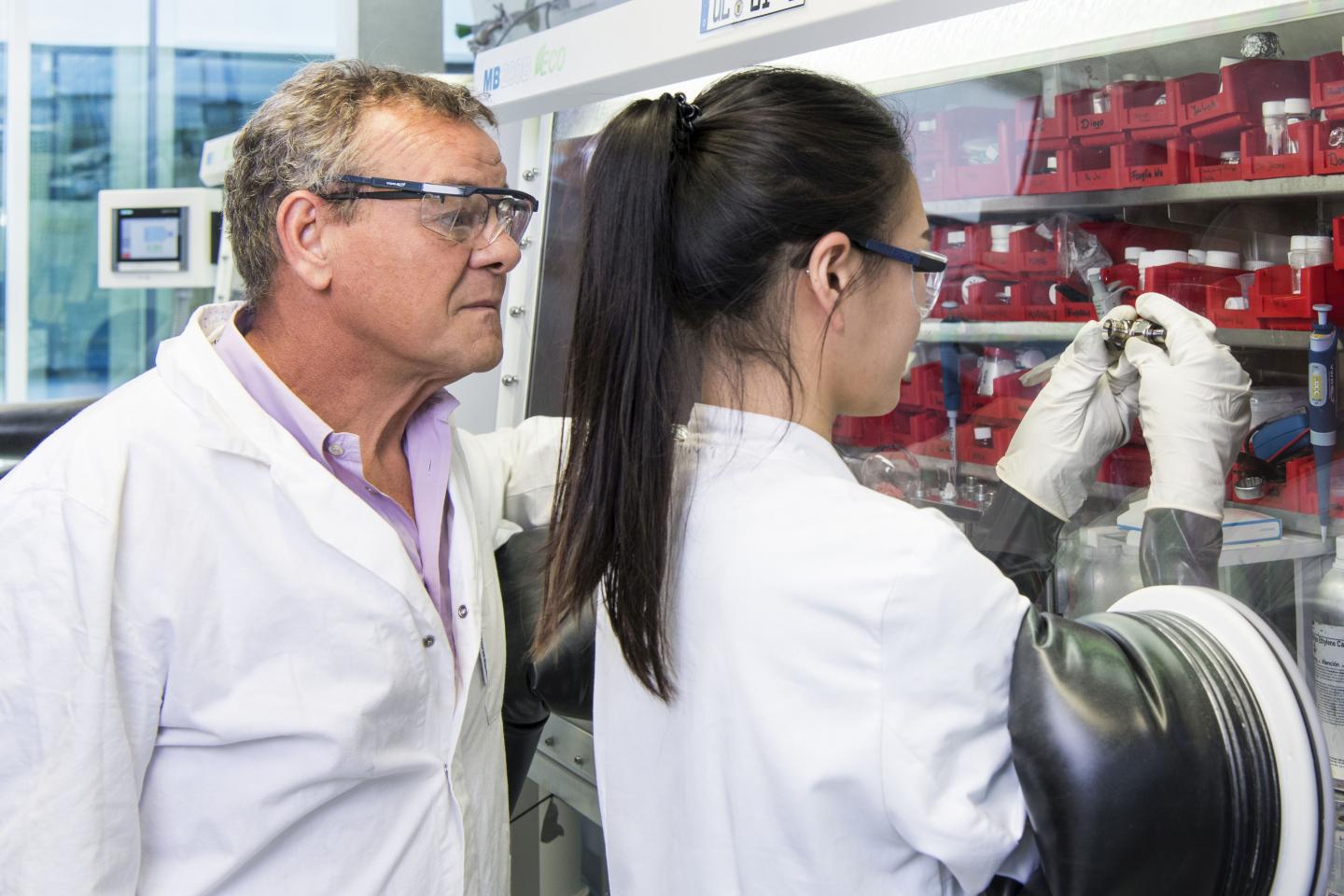
Credit: Photo: Amadeus Bramsiepe, KIT
The driving force of the TRANSITION project is to make a central contribution to a more sustainable energy storage strategy in Germany. The markets for electromobility and stationary energy storage will grow significantly in the course of the energy turnaround and require more energy efficient and powerful storage technologies. Presently,
lithium-ion batteries are one of the greatest successes for energy storage applications of the last century. LIBs are light, compact and offer outstanding energy and power density, dominating the market for portable electronics, hybrid and electric vehicles. “However, in view of the increasingly growing demand of lithium and raw materials employed in the lithium technology, such as cobalt, concerns has been raised about the future and long-term availability of the critical raw material and cost. In this scenario, sodium-ion batteries represent an alternative low cost and more environmentally friendly energy storage technology,says Professor Stefano Passerini, Director of HIU.
The TRANSITION project will focus on the development of powerful liquid and polymeric sodium-ion batteries employing layered transition metal oxides at the cathode side and biomass derived hard carbon at the anode side. “This is the first German consortium funded by the BMBF to work on the development of up-scaled sodium-ion batteries, covering a broad range of challenges from materials development to prototype cell fabrication, says Passerini. Within the project, his team will develop innovative biomass-derived hard carbon in combination with aqueous binders and aluminum as current collector.
The development of up-scaled sodium ion battery prototypes and the achievement of the desired goals represent a great challenge we can only meet in a network with the complementary competencies of the partners says Stefano Passerini. The team at the Friedrich-Schiller-University Jena (FSU) will coordinate the research activities toward the design of advanced liquid and polymeric electrolyte solutions, while the team at Center for Solar Energy and Hydrogen Research Baden-Württemberg (ZSW) will lead the cobalt free cathode development.
About the TRANSITION project
The three partners of the TRANSITION project will work together toward the development of powerful liquid and polymeric sodium-ion battery prototypes, this way strengthening international competitiveness and supporting Germanys leadership in the field of electrochemical energy storage.
The project funded under the Batteries 2020 Framework Program of the German Federal Ministry of Education and Research involves alongside the three scientific partners a comprehensive industrial advisory board. Within the scientific groups, the leading scientist Professor Stefano Passerini (HIU), Dr. Margret Wohlfahrt-Mehrens from the Center for Solar Energy and Hydrogen Research (ZSW) and Professor Philipp Adelhelm from the Friedrich-Schiller-University Jena (FSU).
###
About the Helmholtz Institute Ulm (HIU)
The HIU was established in January 2011 by Karlsruhe Institute of Technology (KIT), member of the Helmholtz Association, in cooperation with Ulm University. With the German Aerospace Center (DLR) and the Center for Solar Energy and Hydrogen Research Baden-Württemberg (ZSW), two other renowned institutions are involved in the HIU as associated partners. The international team of about 120 scientists at HIU works on the development of future energy storage systems for stationary and mobile use.
Find more on HIU at: http://www.
More about the KIT Energy Center: http://www.
Being “The Research University in the Helmholtz Association,” KIT creates and imparts knowledge for the society and the environment. It is the objective to make significant contributions to the global challenges in the fields of energy, mobility and information. For this, about 9,300 employees cooperate in a broad range of disciplines in natural sciences, engineering sciences, economics, and the humanities and social sciences. KIT prepares its 25,100 students for responsible tasks in society, industry, and science by offering research-based study programs. Innovation efforts at KIT build a bridge between important scientific findings and their application for the benefit of society, economic prosperity, and the preservation of our natural basis of life.
This press release is available on the internet at http://www.
Media Contact
Monika Landgraf
[email protected]
Original Source
https:/