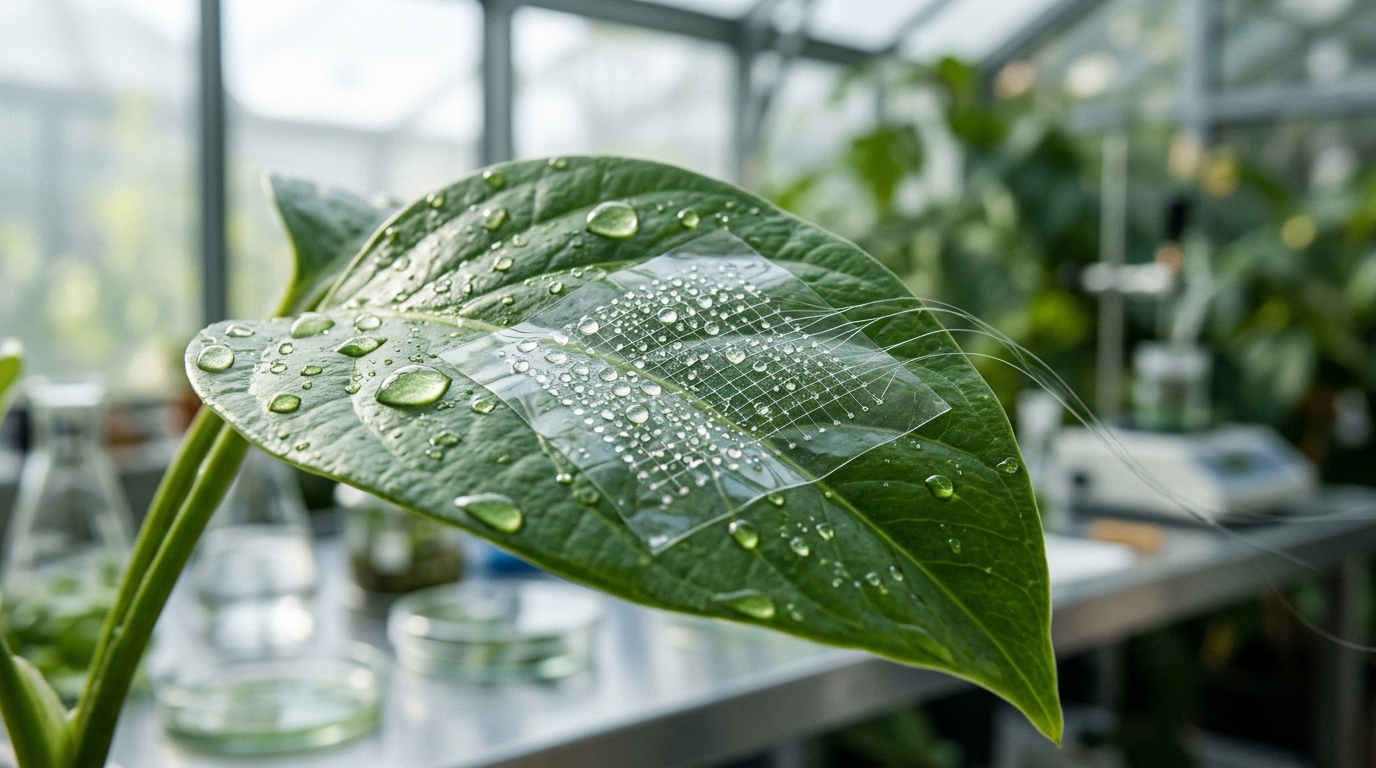
Plants may soon help power the gadgets of everyday life, not by burning their biomass but by letting water move through them. A review published in Environmental Chemistry Letters examines how plant-based materials can generate electricity through hydrovoltaic technologies, which produce power during the interaction of water and material interfaces as charge is transmitted in water flow, evaporation and humidity gradients. The authors, led by Shipu Jiao and Xiaohong Zhou, argue that these technologies are attracting growing interest as a power source for low-power devices and wearable electronics because they are sustainable and depend less on meteorological conditions than many other renewable options.
The review organises the field around four mechanisms. The first is the streaming potential and the electrokinetic effect, in which water moving through a charged channel drags ions along and separates charge. The second is evaporation-induced ion transport and charge separation, where water leaving a porous surface pulls ions upward and leaves an imbalance that can drive a current. The third is a moisture-gradient-driven diffusion potential, produced when humidity differs across a material and ions diffuse from one region to another. The fourth is synergistic enhancement by photothermal effects, in which absorbed light warms the material and strengthens the water-driven processes.
The materials themselves fall into three broad groups. Raw plant tissues, extracted biopolymers and natural or engineered plant-derived products all appear in the literature. This range matters because the review reports a clear performance split: plant tissues and natural plant-derived materials generally deliver currents from tens of microamps down to nanoamps, whereas engineered products reach currents of microamps to milliamps. In other words, processing a plant material can shift the current output by orders of magnitude, a point the authors highlight as central to the technology’s development.
Across the devices surveyed, the numbers are modest but real. Open-circuit voltages typically fall between 0.2 and 1.2 volts, enough to drive some low-power electronics directly or to be accumulated in series. Short-circuit currents range from microamps to nanoamps, and power density generally remains in the microW to nanoW per square centimetre range. Those figures place hydrovoltaic generators firmly in the energy-harvesting category rather than as replacements for batteries or solar panels, but they are meaningful for sensors and wearables that need only tiny, continuous supplies.
The applications the review identifies follow directly from that profile. Self-powered sensing and health monitoring can use a device that generates its own electricity from ambient moisture or water flow, removing the need for battery changes in implants or remote sensors. Wearable and portable electronics are a natural fit because fabrics and flexible substrates can host plant-derived films. Distributed energy harvesting and the internet of things represent the larger ambition: vast networks of low-power nodes that each sip microwatts from evaporation rather than drawing on the grid.
Why plants? The review’s framing suggests several practical reasons. Plant tissues are already porous, rich in charged biopolymers such as cellulose, and structured at the nanoscale in ways that favour ion transport and water adsorption. Extracted biopolymers allow researchers to build films with controlled pore structures, while engineered plant-derived products can be treated to boost surface charge or photothermal response. The review does not claim that any single material is optimal, but its taxonomy gives researchers a map of where the strongest currents have been obtained.
The authors are candid about the field’s weaknesses. Limitations include limited power output, insufficient long-term stability and difficulties in large-scale manufacturing. A device that works for hours in a laboratory may degrade as salts accumulate or as the water supply fluctuates, and producing hectares of uniformly performing material remains unproven. Standardised performance evaluation is also lacking, which makes comparisons between studies difficult and can inflate expectations.
The path forward, according to the review, lies in integration rather than any single breakthrough. Further advances are likely to rely on combining multiple power-generation mechanisms, optimising material and interfacial design, standardising how performance is measured and improving system-level integration so that generators, storage and electronics work as a coherent unit. The photothermal synergy already points in that direction, since light and water can reinforce each other in a single device.
For now, the review’s contribution is a consolidated picture of a young field. It gathers the mechanisms, the material classes and the application domains into one framework, and it sets out the performance envelope that current plant-based hydrovoltaic devices occupy. If the limitations can be addressed, the vision is of electricity drawn quietly from the water cycle, using materials that grow in fields and forests rather than mined in laboratories.
Subject of Research: A review of plant-based materials used in hydrovoltaic technologies that generate electricity from water flow, evaporation and humidity gradients.
Article Title: Plant-based materials to produce electricity by hydrovoltaic technologies: a review
Article References: Jiao, S., Zhang, P., Wang, Q., Yan, H., & Zhou, X. (2026). Plant-based materials to produce electricity by hydrovoltaic technologies: a review. Environmental Chemistry Letters. https://doi.org/10.1007/s10311-026-01934-y
Image Credits: AI Generated
DOI: 10.1007/s10311-026-01934-y
Keywords: hydrovoltaic, plant-based materials, evaporation-induced power, streaming potential, biopolymers, wearable electronics, self-powered sensors, internet of things, photothermal effects, power density, Environmental Chemistry Letters, Plant-based
News Source: Bethany Barker. (November 4, 2026). Plants turn water into electricity as hydrovoltaic devices reach 1.2 volts. Scienmag.