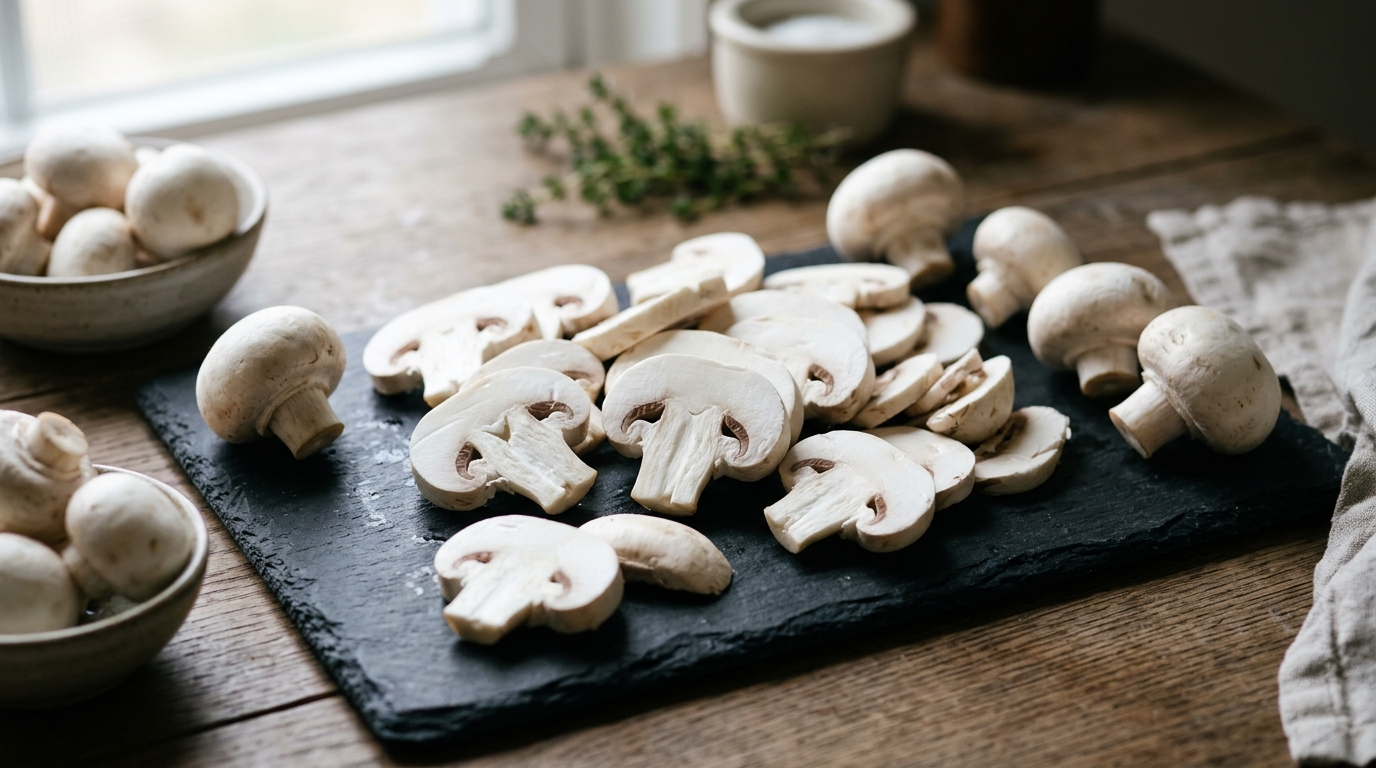
Fresh-cut button mushrooms begin losing their market appeal within hours of slicing, as browning, water loss and softening race ahead of any supply chain that can move them to a shopper’s basket. A new open-access study reports that a brief dip in a dilute solution of D-cysteine, a mirror-image form of the common amino acid cysteine, slows that decline measurably. Wenwen Jiang, Xinyan Zhang, Haonan Ren, Zhe Wang and Fansheng Cheng found that immersing sliced Agaricus bisporus caps in 0.5 grams per liter of D-cysteine for three minutes delayed browning, curbed weight loss, preserved more reducing sugars and soluble protein, and lowered malondialdehyde, a chemical fingerprint of membrane damage.
Button mushrooms of the W192 variety, grown by a Chinese biotechnology company, were pre-cooled at 4 degrees Celsius, sliced into pieces 2 millimeters thick, and randomly divided into three groups of 150 mushrooms each, with three replicates of 50 mushrooms per group. One group was dipped in distilled water as a control, one in the 0.5 gram per liter D-cysteine solution, and one in D-cysteine combined with 1 millimole per liter propargylglycine, an inhibitor that blocks biological hydrogen sulfide synthesis. After treatment, the slices were air-dried and stored at 4 degrees Celsius, with sampling on days 0, 1, 2, 4, 7 and 10.
The D-cysteine group had the highest L* value, a measure of whiteness, after treatment and kept the highest value among the three groups, while adding the inhibitor significantly decreased the L* value of the combination group. Weight loss followed a similar pattern: from day 7 onward the D-cysteine group showed significantly lower weight loss than the other groups, with the control group losing the most.
Nutritional indicators moved in the treatment’s favor as well. Reducing sugars declined in all groups over storage, as expected, but on day 2 the D-cysteine group held the highest content of the three. Soluble protein also fell overall, yet D-cysteine treatment markedly raised soluble protein levels relative to the control, while the inhibitor-treated combination induced a decrease. Malondialdehyde, the degradation product that signals phospholipid oxidation and membrane leakiness, rose with storage in every group but was significantly lower with D-cysteine, and the inhibitor again blunted the effect.
Superoxide production generally climbed with extended storage; after 10 days the control and inhibitor-combination groups reached 26.42 and 26.52 micromoles per minute per gram fresh weight respectively, while the D-cysteine group stayed lowest at 22.41. Hydrogen peroxide content fluctuated, but during the first four days the D-cysteine group showed the lowest levels. Phenylalanine ammonia-lyase, which feeds the phenolic substrates that polyphenol oxidase later oxidizes into brown pigments, showed variable patterns during storage, but during days 2 to 7 its activity in the D-cysteine group was higher than in the control group. Lipoxygenase, which accelerates peroxidation of membrane fatty acids, stayed consistently lower in the D-cysteine group than in the control group throughout storage.
The team then measured the activities of three enzymes named AbCBS, AbCSE and AbMST, the mushroom counterparts of the cystathionine beta-synthase, cystathionine gamma-lyase and mercaptopyruvate sulfurtransferase pathways that generate hydrogen sulfide in mammalian cells, with plants using at least seven routes including dedicated cysteine desulfhydrases. The authors conclude that the AbMST route is the predominant contributor in button mushrooms, with AbCBS and AbCSE providing a minor fraction, and they propose that D-cysteine may also be converted into L-cysteine by an unidentified mechanism, feeding those two pathways as well.
Transcriptome sequencing on day 4 of storage reinforced the physiological story at the gene level. Comparing the control and D-cysteine groups, the researchers identified 354 differentially expressed genes, 281 upregulated and 73 downregulated, with 2,173 genes shared across the two comparisons and 651 unique to the control-versus-D-cysteines contrast. Gene ontology enrichment flagged the oxidation-reduction process, cysteine metabolic and biosynthetic processes, sulfur amino acid metabolism, oxidoreductase and peroxidase activity, and sulfur compound transport. Kyoto Encyclopedia of Genes and Genomes pathway analysis highlighted sulfur metabolism along with the degradation of branched-chain amino acids and fatty acids, tryptophan metabolism and the yeast cell cycle.
The authors frame their conclusion carefully: D-cysteine maintains quality by regulating antioxidant enzyme activity, converting to endogenous hydrogen sulfide, and converting to L-cysteine, with the precise molecular mechanism at the protein and metabolic levels still to be worked out. They suggest metabolomic analysis, gene editing and protein interaction verification as the next steps to clarify the regulatory network.
Button mushrooms deteriorate markedly within 72 to 96 hours at ambient temperature, and conventional preservation tools, from cold storage and modified atmosphere packaging to chemical treatments and films, carry drawbacks including cost, instability, potential toxicity and damage to sensory and nutritional quality. Hydrogen sulfide itself is an effective senescence inhibitor in fruits, vegetables and cut flowers, but its pungent smell at elevated concentrations limits direct use, which is why prompting the produce to make its own supply is attractive.
Subject of Research: Postharvest preservation of fresh-cut button mushrooms using D-cysteine to stimulate endogenous hydrogen sulfide biosynthesis
Article Title: D-Cysteine preserves postharvest quality of fresh-cut button mushrooms by regulating antioxidant defense system and activating H2S biosynthesis
Article References: Jiang, W., Zhang, X., Ren, H., Wang, Z., & Cheng, F. (2026). D-Cysteine preserves postharvest quality of fresh-cut button mushrooms by regulating antioxidant defense system and activating H2S biosynthesis. Agricultural Products Processing and Storage, 2(1), Article 48. https://doi.org/10.1007/s44462-026-00081-5
Image Credits: AI Generated
DOI: 10.1007/s44462-026-00081-5
Keywords: D-cysteine, button mushrooms, postharvest quality, hydrogen sulfide, antioxidant enzymes, browning, fresh-cut produce, transcriptomics, food preservation, Agaricus bisporus, reactive oxygen species, sulfur metabolism
News Source: Alan Morgan. (November 4, 2026). D-Cysteine Keeps Fresh-Cut Button Mushrooms White and Fresh by Triggering Internal Hydrogen Sulfide. Scienmag.