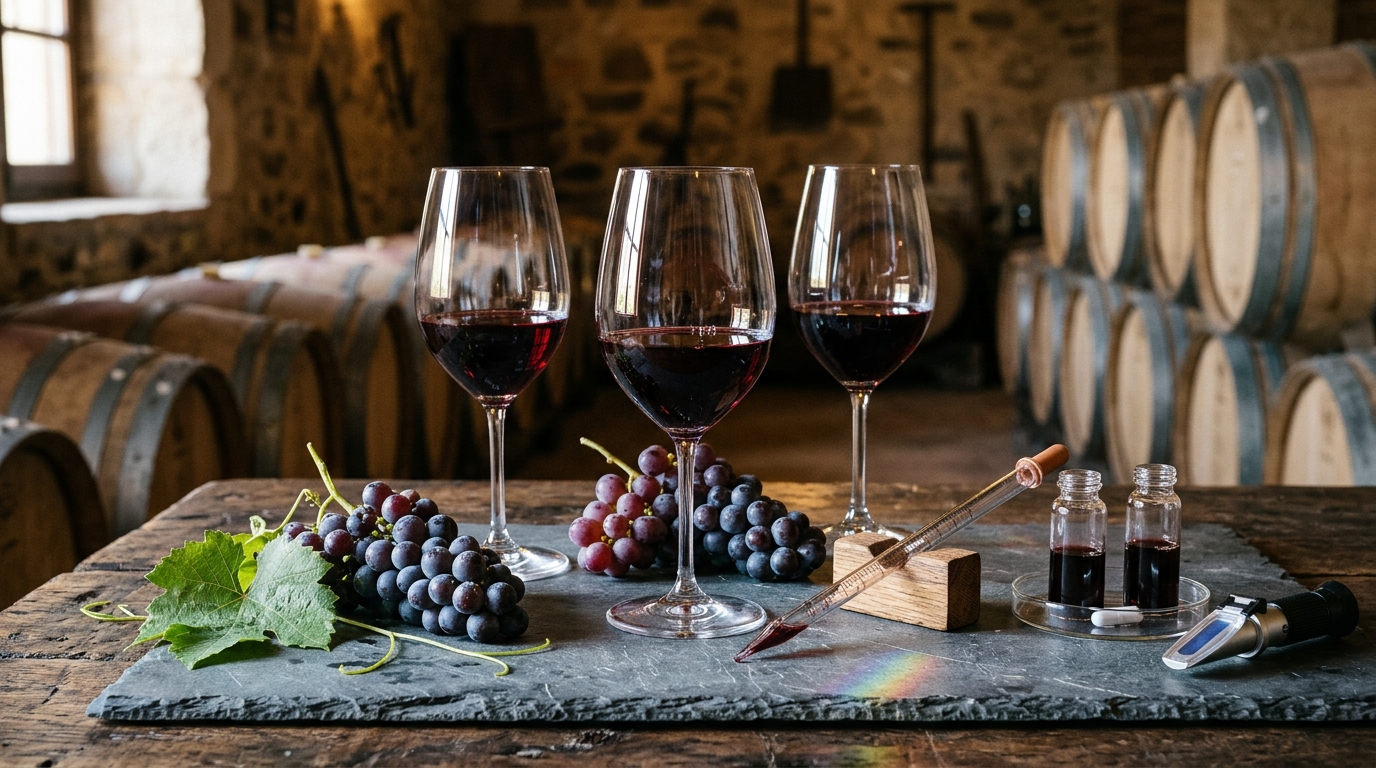
A team of analytical chemists at the University of Barcelona has shown that the phenolic compounds naturally present in Spanish red wines carry enough chemical information to identify where a wine comes from and which grape variety it was made from, with classification errors as low as 4.3 percent in the most favorable cases. The study, published in Frontiers in Natural Products, analyzed 150 commercial red wines from four major Protected Designations of Origin (PDOs) and several monovarietal styles, using high-performance liquid chromatography coupled with tandem mass spectrometry (HPLC-MS/MS) to quantify 22 phenolic compounds, and then applied chemometric models to translate those concentrations into wine identities.
The research addresses a persistent problem in food authentication: how to verify that a bottle labeled Rioja, Ribera del Duero, Somontano, or Montsant genuinely belongs to that designation, and that a wine sold as Tempranillo, Garnacha, or Syrah is what it claims to be. Rather than hunting for a single chemical signature unique to each category, the researchers built their strategy on the combined pattern of common phenolics, including hydroxycinnamic acids, catechins, flavonols, and benzoic acids. Individually, none of the 22 compounds serves as a definitive marker of any class, but subtle differences in their relative abundances, evaluated simultaneously, proved rich in discriminatory information.
The wine collection was deliberately broad. It included 39 Rioja wines, 27 from Ribera del Duero, 26 from Somontano, and 14 from Montsant, with the remainder drawn from other regions such as Penedès, Priorat, Navarra, and Campo de Borja. On the varietal side, the set contained 56 monovarietal Tempranillo wines, 20 Garnacha, and 9 Syrah, alongside other varieties and blends. Samples were filtered, stored cold, and injected in a fully randomized analytical sequence, with replicate measurements of the same wine never run back to back, to minimize the influence of uncontrolled instrumental drift. A pooled quality control sample, made by combining small aliquots of every filtered wine, was injected every 15 samples to monitor and correct for temporal variation in instrument response.
Before any supervised classification, the team explored the data with principal component analysis (PCA), an unsupervised technique that reveals natural structure without being told which class each sample belongs to. The picture was complex. For the four main PDOs, the first three principal components captured 25.08, 13.47, and 12.5 percent of the variance, and while wines from the same designation tended to occupy particular regions of the score plots, the clusters were diffuse and overlapped substantially. Somontano samples leaned toward the positive side of the first component, whereas Montsant, Ribera del Duero, and Rioja occupied very similar regions, with Rioja wines concentrated centrally and responsible for much of the overlap, particularly with Ribera del Duero.
The varietal PCA told a somewhat clearer story. Restricted to Tempranillo, Garnacha, and Syrah, the model captured more than half of the total variance with three components and revealed relatively compact regions of class predominance. Tempranillo samples separated along the first component, Syrah spread predominantly in the upper region of the second, and Garnacha occupied the central area. The loading plots linked these patterns to specific compound families: the positive side of the first component was strongly associated with flavanols such as catechin, epicatechin, and procyanidins, while the second contrasted benzoic acids against flavonols. Notably, Tempranillo appeared to be defined less by distinctive overexpressed markers than by comparatively lower concentrations of compounds characteristic of the other varieties, with ellagic acid as a partial exception.
For the supervised phase, the researchers split the injected wines into a calibration set of 70 percent (217 sample injections) and a completely held-out prediction set of 30 percent (94 injections), with all replicates of a given wine kept within the same subset to prevent information leakage. They compared three modeling strategies: binary PLS-DA, which asks whether a wine belongs to a target class or to everything else; multiclass PLS-DA, which assigns each wine to the most probable of several predefined classes, including a catch-all “others” category; and SIMCA, a one-class method that models only the target class and accepts or rejects samples based on their distance from that model. The number of latent variables was chosen by minimizing cross-validation error using a Venetian Blinds scheme, and model performance was judged on sensitivity, specificity, and overall classification error in the external prediction set.
The multiclass PLS-DA models delivered the best results for geographical origin, with prediction errors ranging from 6.4 percent for Ribera del Duero to 11.7 percent for Rioja, and sensitivity and specificity values generally above 0.85. Somontano emerged as the most differentiated PDO, consistent with its partial separation in the PCA, while Rioja and Ribera del Duero proved hardest to distinguish from each other, plausibly because wines from both designations are predominantly produced from the same grape, Tempranillo, and therefore share compositional characteristics. SIMCA performed consistently worse for PDO classification, with error rates between 18.1 and 21.3 percent, although the authors note that one-class modeling remains conceptually attractive for authentication because it does not depend on how well the non-target classes are represented. A variable importance analysis highlighted astilbin, caftaric acid, and hydroxytyrosol for Montsant; ellagic acid and epigallocatechin for Ribera del Duero; 4-hydroxybenzoic acid, astilbin, and epigallocatechin for Rioja; and catechin, epicatechin, and procyanidins for Somontano as the strongest contributors to geographical discrimination.
Grape variety discrimination was more variable. Multiclass PLS-DA classified Syrah with a prediction error of only 4.3 percent, but this figure was driven by excellent specificity (0.978) rather than sensitivity, which was limited to 0.600, likely reflecting the small number of Syrah wines available. Garnacha yielded prediction errors of 12.8 and 14.9 percent for binary and multiclass PLS-DA respectively, with balanced moderate sensitivity and specificity. Tempranillo, despite being the best-represented variety, was the most challenging, with prediction errors between 16.0 and 22.3 percent depending on the strategy. The authors attribute this to the difficulty of distinguishing pure monovarietal Tempranillo from blends in which the variety predominates, and to the absence of highly distinctive phenolic markers for Tempranillo in the measured panel. Caftaric and ferulic acids were the key discriminants for Garnacha, while astilbin, syringic acid, p-coumaric acid, epicatechin, vanillic acid, and procyanidin B2 contributed most for Syrah. SIMCA behaved erratically across varieties, performing competitively for Syrah at 7.4 percent error but failing badly for Garnacha, where specificity collapsed to 0.329 and the overall error approached 60 percent.
The authors are careful to frame the scope and limitations of their findings. The classification figures come from a single random calibration-prediction split, and because some classes, particularly Montsant, Garnacha, and Syrah, were thinly represented in the prediction subset, misclassifying even a few samples substantially shifts sensitivity and error estimates. The team suggests that enlarging the dataset would be the most effective route to more robust evaluation, and that resampling approaches such as bootstrap methods or repeated calibration and prediction splits could quantify the uncertainty of the current estimates. They also emphasize that the method quantifies compounds that are common to all wines rather than unique signatures, so authentication rests on multivariate compositional patterns rather than on any single telltale analyte. Concentration-based profiling has practical advantages, however: the resulting models can be applied to future samples received by a laboratory over time, and new wines can be added to the calibration set to improve representativeness and predictive performance.
Within those limits, the study demonstrates that a targeted panel of 22 phenolic compounds, measured by a routine HPLC-MS/MS workflow and interpreted with interpretable chemometric tools, is sufficient to support the classification and authentication of Spanish red wines by both geographical origin and varietal composition. The approach is presented as entirely general: with an appropriately representative sample set, the same strategy could be extended to other designations, grape varieties, or authentication problems, offering producers, distributors, and regulators a chemically grounded tool for verifying that what is on the label matches what is in the bottle.
Subject of Research: Authentication of Spanish red wines by phenolic profiling and chemometric classification of geographical origin and grape variety
Article Title: Wine identity through phenolics: authentication of Spanish red wines by geographical origin and grape variety
Article References: Calvo-Salvador, J., Sentellas, S., & Saurina, J. (2026). Wine identity through phenolics: authentication of Spanish red wines by geographical origin and grape variety. Frontiers in Natural Products, 5, Article 1991421. https://doi.org/10.3389/fntpr.2026.1991421
Image Credits: AI Generated
DOI: 10.3389/fntpr.2026.1991421
Keywords: wine authentication, phenolic compounds, HPLC-MS/MS, chemometrics, PLS-DA, SIMCA, Protected Designation of Origin, Spanish red wine, grape variety, Tempranillo, principal component analysis, food forensics
News Source: Drew Townsend. (November 4, 2026). Phenolic Fingerprints Trace Spanish Red Wines to Origin and Grape Variety. Scienmag.