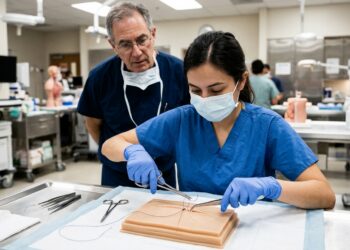
Supervisor assessment can have a positive impact on surgical skills acquisition regardless of its impact on total cognitive load, according to an experimental crossover study published in Global Surgical Education – Journal of the Association for Surgical Education.
Assessments of technical skills are a central component of competency-based medical education programs. Yet studies have shown that cognitive load can influence technical skills, and little has been known about how supervision shapes that load. The research team, led by Kirstine Bruun Viuf and colleagues, set out to determine whether assessment affects the performance of surgical skills and, if so, whether cognitive capacity mediates that effect.
The study used an experimental crossover design comparing supervisor assessment with no assessment. Surgical residents performed a suturing exercise on three consecutive days. Technical skill was scored with the Objective Structured Assessment of Technical Skills tool, and cognitive load was measured with the NASA Task Load Index. Supervisor assessment was delivered on Day 2 for one group and on Day 3 for the other, with the alternate condition serving as the no-assessment day for each group.
At baseline, the groups were evenly matched: no significant differences in OSATS or NASA-TLX scores were observed between them.
A significant difference in OSATS scores emerged on both Day 2 and Day 3, with the group assessed on Day 2 outperforming the group assessed on Day 3 on both days. On Day 2 the mean difference was −4.8 points, with a 95 percent confidence interval of −7.0 to −2.6; on Day 3 it was −3.5 points, with a 95 percent confidence interval of −5.3 to −1.7.
Within-group improvement from Day 2 to Day 3 was observed.
The groups showed no difference in NASA-TLX scores, and the researchers found no correlation between cognitive load and technical skills.
The authors conclude that assessment can have a positive impact on surgical skills acquisition, regardless of its impact on total cognitive load.
The mechanism behind the results was not identified, and the authors state that future studies are needed to establish how supervisors should incorporate this into their clinical assessment.
Subject of Research: How supervisor assessment affects surgical residents' technical skill performance and cognitive load during suturing training.
Article Title: Performance under pressure: how does assessment affect surgical skills?
Article References: Viuf, K. B., Gamborg, M. L., Cheung, J. J. H., Rölfing, J. D., Hesseldal, K. B., Sloth, S. B., & Jensen, R. D. (2026). Performance under pressure: how does assessment affect surgical skills?. Global Surgical Education – Journal of the Association for Surgical Education, 5(1), Article 211. https://doi.org/10.1007/s44186-026-00609-0
Image Credits: AI Generated
DOI: 10.1007/s44186-026-00609-0
Keywords: surgical education, assessment, cognitive load, surgical residents, suturing, OSATS, NASA-TLX, competency-based medical education, supervision, technical skills, crossover study, Performance
News Source: Courtney Benton. (November 5, 2026). Assessment can have positive impact on surgical skills acquisition, study suggests. Scienmag.