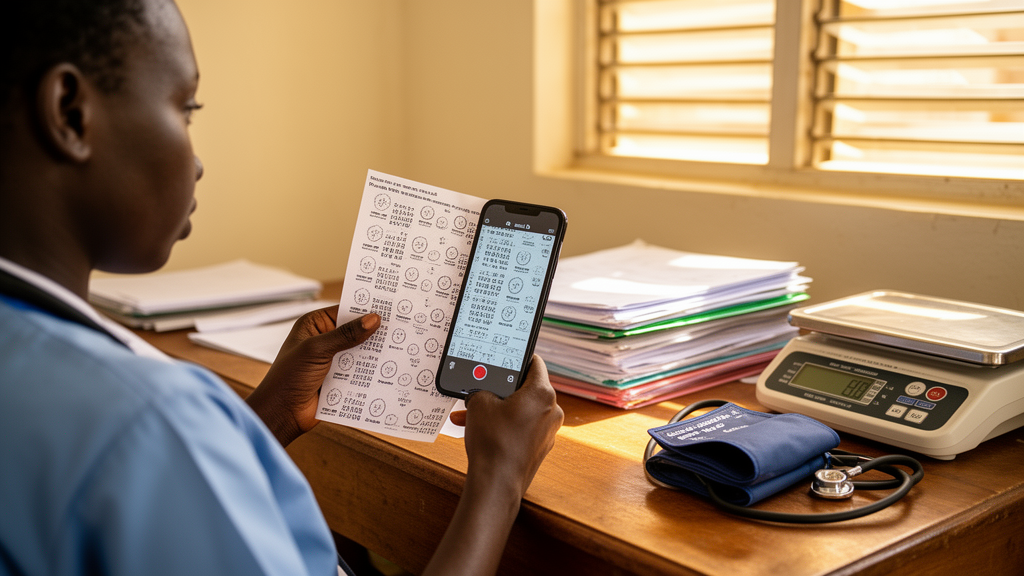
A hybrid paper-digital record system known as Smart Paper Technology (SPT) has been judged feasible and broadly acceptable by health workers piloting it in maternal and infant health services in The Gambia, according to a qualitative implementation study conducted between September and December 2024. The findings, drawn from two pilot facilities in the country’s Western Region, suggest that the approach could offer a practical route towards digitising health records in settings where fully electronic medical record systems remain out of reach.
Many low- and middle-income countries still depend on paper-based maternal and child health records that are frequently incomplete, fragmented and difficult to use for continuity of care and clinical decision-making. SPT is designed to bridge this gap: it retains the familiar paper forms that clinicians already use, but adds a digital layer in which completed documents are scanned and captured into an electronic system. The study team, guided by Rapid Assessment Procedures, evaluated the early implementation of the technology through 30 semi-structured interviews, four focus group discussions involving 30 participants, and non-participant observations across key service delivery areas. Participants included facility-level clinical, management and administrative staff, Ministry of Health personnel, and technical and implementing partners. The data were analysed thematically using NVivo 14.
Respondents identified several concrete advantages. Because SPT built on existing paper-based workflows, staff did not need to abandon routines they knew well, and the participatory introduction process reinforced this sense of continuity. Health workers also reported benefits in reporting, in retrieving patient information, and in linking maternal and infant records, a longstanding weakness of fragmented paper systems that can disrupt care across pregnancy, birth and infancy.
These gains, however, proved contingent on the surrounding implementation context. The study documented uneven training coverage among staff, periods of dual documentation in which paper and digital records had to be maintained in parallel, limited internet connectivity, scanning and data capture errors, storage constraints, and concerns about data governance. Rather than abandoning the system, staff responded with peer mentoring, remote troubleshooting and local workarounds, indicating a degree of organisational resilience that the authors note as important for early adoption.
Participants emphasised that successful scale-up would depend on sustained training, clear governance arrangements, adequate human and technical resources, and a phased transition towards government ownership. The researchers conclude that SPT offers a practical pathway towards digitisation in maternal and infant health services in low- and middle-income countries, but that its success hinges on strong organisational systems, workforce support and implementation processes responsive to the realities of routine service delivery. As a qualitative descriptive evaluation of two pilot facilities, the study captures early implementation experience rather than measuring clinical outcomes, and the authors frame their findings as evidence on feasibility and acceptability during the initial phase of deployment.
Subject of Research: Early implementation of Smart Paper Technology for maternal and newborn health records in The Gambia
Article Title: Smart Paper Technology for maternal and newborn health data in The Gambia: A qualitative study of early implementation
Article References: Nkereuwem, O., Prauseová, J., Ford, R., Jallow, A. O., Marena, M., Jarju, G., Fofana, S., Cham, M., Manjang, B., Kampmann, B., & Busza, J. (2026). Smart Paper Technology for maternal and newborn health data in The Gambia: A qualitative study of early implementation. PLOS Global Public Health, 6(10), e0006244. https://doi.org/10.1371/journal.pgph.0006244
Image Credits: AI Generated
DOI: 10.1371/journal.pgph.0006244
Keywords: Smart Paper Technology, The Gambia, maternal health, newborn health, health records, digitisation, implementation science, qualitative research, low- and middle-income countries, health information systems, Smart, Paper
News Source: Harold Sullivan. (October 23, 2026). Smart Paper System Shows Promise for Maternal Health Records in The Gambia. Scienmag.