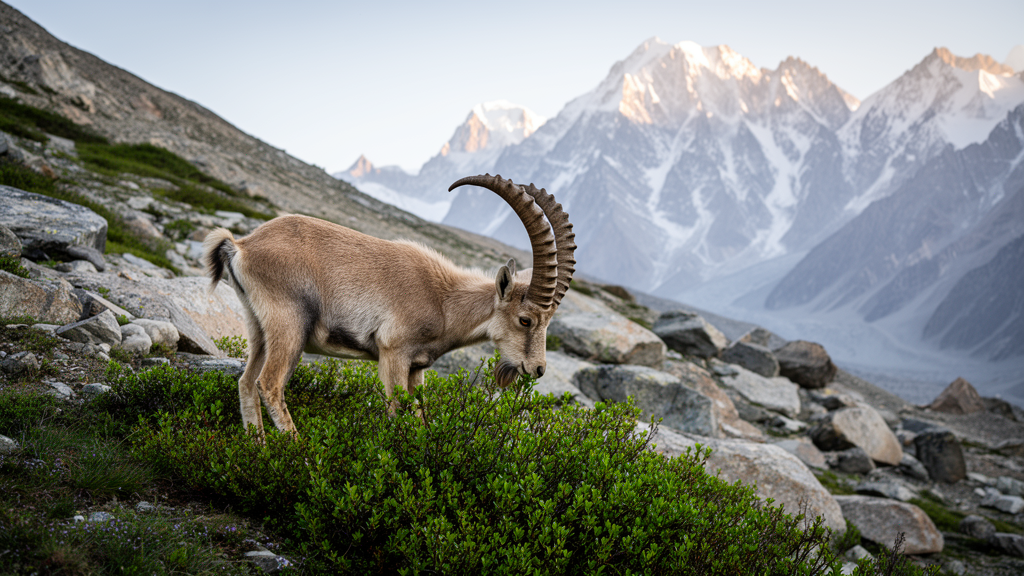
High in the Karakoram mountains of northern Pakistan, Himalayan ibex appear to make a quiet calculation every time they move across the landscape: where the forage is greenest is also where a snow leopard is most likely to be waiting. A new camera-trap study spanning the Hunza and Nagar districts set out to resolve whether these wild goats prioritize safety or food, and the answer is nuanced. Ibex favor rugged, low- to mid-elevation terrain near productive valley systems, but when snow leopards are present, they shift their use of space in ways consistent with an anti-predator strategy. The predators, in turn, appear to track their prey rather than simply follow their own preferred habitat features.
The research, framed around the well-known ecological concept of the landscape of fear, deployed 224 camera traps over 6,074 trap-nights, averaging 27 operational nights per site. Snow leopards were detected at 44 sites with 65 detections, giving a naive occupancy of 0.20, while ibex were detected at 40 sites with 73 detections and a naive occupancy of 0.18. Both species were photographed together at 10 sites. The cameras also recorded red fox, stone marten, weasel, blue sheep, Royle’s pika, golden marmot, and Himalayan snowcock, underscoring the ecological richness of these cold desert mountains.
Geographically, detections were not evenly distributed. Khunjerab National Park recorded the highest activity, with snow leopards detected at 20 sites and ibex at 22, including 4 sites where the two species co-occurred. In the Misgar Valley, snow leopards turned up at 14 sites and ibex at 12, again with 4 shared sites. In the Hunza-Nagar area, the figures were 10 and 6 sites respectively, with just 2 co-detections. These contrasts hint at how local conditions shape where predator and prey meet, but the study’s key insights came from statistical models rather than raw counts.
Using a multi-species occupancy modeling framework, the researchers estimated habitat associations while accounting for imperfect detection, a critical correction in surveys where animals are frequently present but unnoticed. For ibex, model selection based on the Akaike Information Criterion retained elevation in the occupancy component, and ruggedness, distance to roads, and elevation as detection predictors. Ibex site use increased with terrain ruggedness and declined with both elevation and distance to roads. In other words, these animals concentrate on steep valley side-slopes at low to mid elevations, avoiding the flat valley bottoms even when those lie nearby.
The ruggedness result stands out as the clearest behavioral signal. Steep, broken terrain is exactly where an ibex excels: agility and escape geometry matter more than raw speed when the threat is an ambush hunter built for cliffs. By clinging to precipitous slopes, ibex likely maximize their chances of detecting and evading a snow leopard. The authors interpret this as an anti-predator strategy consistent with the fear-landscape framework, in which prey species weigh nutritious forage against the probability of a deadly encounter and often sacrifice energy intake for safety.
The association with roads requires careful reading. Occupancy declined with increasing distance from roads, but the researchers caution that in the Karakoram, roads typically follow river valleys, precisely where water and the region’s scarce vegetation are concentrated. The pattern therefore most plausibly reflects a preference for productive valley habitats rather than any attraction to infrastructure itself. Elevation told a subtler story still: it appeared in both the occupancy and detection components of the model with opposite effects. Occupancy fell as elevation rose, while detection probability climbed, plausibly because open alpine meadows and scree slopes make ibex easier to see, whereas rugged, vegetated valley terrain offers cover that hides them from cameras as well as predators.
Snow leopards showed a strikingly different signature. The top single-species model retained the normalized difference vegetation index, or NDVI, as the occupancy predictor and ruggedness as the detection predictor. The NDVI relationship was a knife-edge threshold: below a value of 0.0, corresponding to barren rock and permanent snow, snow leopard occupancy was essentially zero, but as soon as NDVI turned slightly positive, occupancy probability jumped sharply toward 1.0. The authors read this as evidence that snow leopards roam nearly the entire landscape, excluding only the most inhospitable ground. Their elevated detection rates in rugged terrain fit the species’ natural history, since ridgelines, cliffs, and rocky outcrops serve as travel corridors, scent-marking sites, and vantage points that funnel movement.
The multi-species models revealed the interaction at the heart of the study. The best co-occupancy model retained distance to roads as the key covariate. Ibex occupancy showed a significant negative relationship with distance to roads, while the snow leopard trend was similar but non-significant. Crucially, the species interaction term was positive and significant, indicating that the two species co-occurred more often than expected under independence, particularly near roads. Yet the relationship flipped under conditional models: when snow leopards were present, ibex site-use probability rose with distance from roads, a potential spatial displacement away from predators. Conversely, snow leopard occupancy increased markedly with distance from roads when ibex were present, suggesting the cats track prey into more remote terrain rather than hunting only where conditions suit them best.
Taken together, the results sketch a dynamic rather than a static map of fear. Ibex balance forage access against safety, concentrating on rugged slopes near productive valleys, while snow leopards adjust their movements to prey distribution within terrain complex enough to support ambush hunting. Because valley areas near roads are also the greenest parts of this sparse landscape, they likely serve as the primary arena for predator-prey encounters, drawing snow leopards closer to human infrastructure than their habitat preferences alone would predict. From a conservation standpoint, the findings highlight the value of heterogeneous mountain terrain that provides both refuges for prey and hunting grounds for predators, and they suggest that expanding road networks in high mountains could disrupt these finely tuned interactions.
The authors are careful to note the limits of their evidence. The snapshot occupancy design captures spatial patterns but not short-term temporal avoidance or dynamic behavioral responses. NDVI as a vegetation proxy can be biased by snow cover, which alters spectral reflectance in alpine environments. The analysis assumes population closure during sampling, and violations of that assumption can distort detection and occupancy estimates. Model selection uncertainty also remains, particularly when competing models receive similar support and sample sizes are modest. Even with those caveats, the study demonstrates that in one of the world’s harshest mountain ecosystems, coexistence between a flagship predator and its primary prey is governed not by chance overlap but by habitat-mediated processes and behavioral feedback on both sides of the predator-prey equation.
Subject of Research: Predator-prey site use and co-occupancy of Himalayan ibex and snow leopard in the Karakoram, northern Pakistan
Article Title: Greenery or fear: Site use of Himalayan ibex in a predator-dominant landscape
Article References: Ali, H., Sutherland, C., Din, J. U., & Nawaz, M. A. (2026). Greenery or fear: Site use of Himalayan ibex in a predator-dominant landscape. iScience, 29(11), Article 117885. https://doi.org/10.1016/j.isci.2026.117885
Image Credits: AI Generated
DOI: 10.1016/j.isci.2026.117885
Keywords: Himalayan ibex, snow leopard, landscape of fear, occupancy modeling, camera traps, Karakoram, predation risk, habitat selection, Pakistan, wildlife conservation, multi-species occupancy, rugged terrain
News Source: Margaret Porter. (October 23, 2026). In the Karakoram, Himalayan Ibex Weigh Greenery Against the Fear of Snow Leopards. Scienmag.