


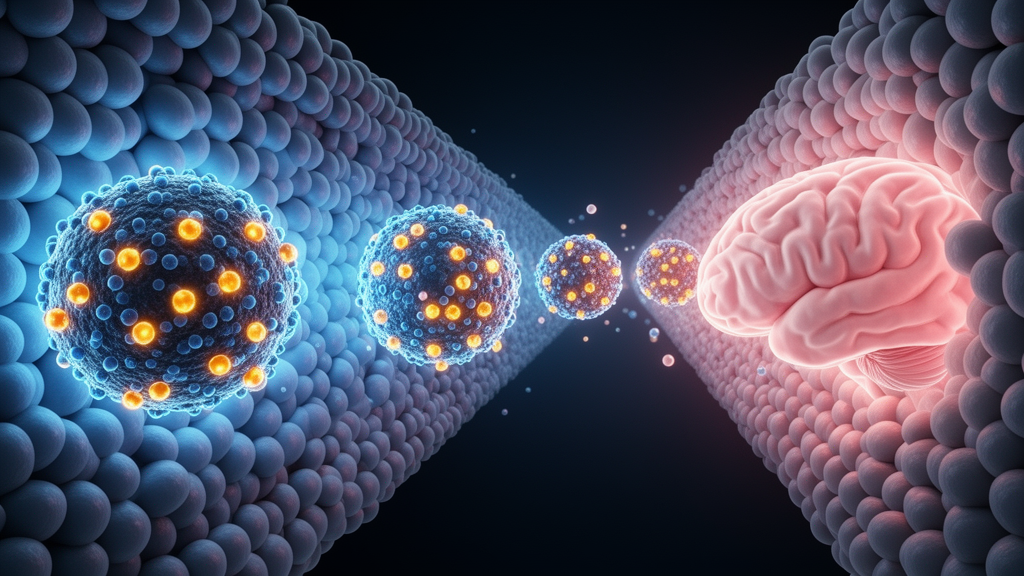
Glioblastoma remains one of the most lethal cancers in adults, and a newly published review in the Chinese Neurosurgical Journal examines why so many promising drugs never reach it. The WHO grade IV diffuse astrocytic tumor accounts for roughly 45 percent of malignant brain and central nervous system tumors and carries a median overall survival of only 14 to 15 months despite standard-of-care therapy. The review, authored by Sana Javaid, Wenqi Song, Sajid Ali and colleagues, argues that the central obstacle is not a lack of active drugs but a delivery problem: the tightly regulated blood–brain barrier and its heterogeneous counterpart inside tumors, the blood–brain tumor barrier, together severely limit how much therapy actually reaches malignant tissue.
The numbers cited in the review are stark. An estimated 98 percent of small-molecule drugs and nearly all biologics do not cross the intact blood–brain barrier at therapeutic levels. Even temozolomide, the first-line chemotherapeutic given after surgery and radiotherapy, is constrained by rapid chemoresistance and poor penetration across the barrier. Radiotherapy, meanwhile, unavoidably affects surrounding healthy brain and can cause clinically meaningful cognitive impairment in some patients. The barrier itself is a sophisticated structure: brain microvascular endothelial cells joined by continuous tight junctions, supported by pericytes, astrocytic end-feet, microglia and neurons, and equipped with efflux pumps such as P-glycoprotein and breast cancer resistance protein that actively expel many chemotherapeutics back into the bloodstream.
Complicating matters further, the barrier is not uniformly breached inside the tumor. In the enhancing tumor core, tumor-driven angiogenesis produces leaky, tortuous vessels with reduced tight junction integrity, but infiltrative margins may retain an almost intact barrier. This leaky-core-versus-protected-front pattern, the authors note, is a key reason why even barrier-permeant drugs fail to uniformly eradicate glioblastoma. Nanomaterial-based drug delivery systems are proposed as a way around these constraints, offering longer circulation half-life, improved solubility, better tumor deposition and, in some designs, the ability to convert external physical fields into local cytotoxic effects.
The review organizes brain-targeting strategies into passive and active approaches. Passive targeting relies on particle size, shape, surface charge and circulation time together with tumor vascular abnormalities; nanoparticles of roughly 10 to 100 nanometers with neutral or slightly negative surfaces and dense stealth coatings such as polyethylene glycol can evade rapid clearance and exploit the limited leakiness of the tumor barrier. But the authors stress that this enhanced permeability and retention effect is highly variable in brain tumors, so passive targeting alone is usually insufficient and is increasingly combined with active ligand-mediated targeting and physical-field strategies.
Active targeting functionalizes nanoparticles with ligands that recognize receptors overexpressed on barrier endothelium and tumor cells. Receptor-mediated transcytosis is the most widely exploited route: Angiopep-2-decorated polymeric nanoparticles targeting LRP1, transferrin-modified liposomes and apolipoprotein-mimetic gold nanoparticles all show improved barrier crossing and intratumoral delivery relative to untargeted carriers in preclinical models. Nutrient transporters offer a complementary route, since glioblastoma cells and barrier endothelium both abundantly express glucose transporters GLUT1 and GLUT3, and the amino acid transporter LAT1. Tumor-cell targets including EGFR and EGFRvIII, integrins, CD44 and IL-13Rα2 are exploited with antibodies, peptides and hyaluronic acid to sharpen delivery to invasive fronts and glioma stem-like cells.
A substantial portion of the review is devoted to stimuli-responsive or smart systems that release their payload only under specific conditions. Endogenous triggers exploit the tumor’s own biochemistry: acidic extracellular pH roughly 0.5 units below surrounding brain, elevated glutathione and reactive oxygen species, and dysregulated enzymes such as matrix metalloproteinases. Examples include mesoporous silica nanoparticles with hydrazone linkers that release cargo faster at pH 5 to 6, and disulfide-crosslinked micelles co-loaded with temozolomide and beta-lapachone that achieved nearly complete payload release under simulated tumor redox conditions, producing synergistic DNA damage and apoptosis in glioma models.
Exogenous triggers add external control. Thermosensitive carriers stay stable at body temperature but release drugs rapidly under mild hyperthermia at 40 to 45 degrees Celsius. Light-responsive systems use near-infrared activation of upconversion nanoparticles and gold nanorods for photodynamic and photothermal therapy, producing significant tumor regression in U87MG and other models when combined with chemotherapy. Magnetic iron oxide carriers can be guided by external magnets and heated under alternating magnetic fields, while ultrasound-sensitive echogenic liposomes and perfluorocarbon nanoemulsions undergo cavitation that releases drugs directly into tumor tissue and can transiently open the barrier. Low-intensity focused ultrasound with microbubbles has early clinical and preclinical data showing it can safely enhance intratumoral drug levels.
Biomimetic platforms form another frontier. Cell membrane-coated nanoparticles derived from tumor cells, macrophages, dendritic cells or red blood cells inherit immune evasion and homotypic recognition; a C6 glioma membrane-coated manganese dioxide-doxorubicin system showed pH-responsive release and significant tumor suppression, while dendritic cell membrane-cloaked rapamycin nanoparticles crossed the barrier, activated CD8-positive T cells and inhibited orthotopic glioma growth. Synthetic HDL nanodiscs loaded with the immune agonist CpG and docetaxel shrank tumors, and when combined with radiotherapy achieved long-term survival in 80 percent of treated mice that also resisted tumor re-challenge, suggesting immunological memory.
Clinical translation, though limited, is real. The iron oxide-based NanoTherm system holds a CE mark in Europe for intratumoral magnetic hyperthermia in recurrent glioblastoma combined with radiotherapy, with single-arm trials reporting median survival of around 13 to 23 months from first diagnosis. A first-in-human phase 0 trial of NU-0129, a gold-core spherical nucleic acid carrying siRNA against BCL2L12, proved that systemically administered RNAi nanodrugs can cross the human barrier, accumulate in tumor tissue and achieve target knockdown. Convection-enhanced nanoliposomal irinotecan, glutathione-PEGylated liposomal doxorubicin and the transferrin-targeted p53 liposome SGT-53 have all reached early-phase testing with manageable toxicity but modest efficacy so far.
The review is candid about why these advances have not yet transformed outcomes. Tumor heterogeneity means receptor-targeted carriers may address only selected subclones while antigen-negative cells drive recurrence; the immunosuppressive microenvironment blunts field-induced immune activation; ultrasmall particles clear efficiently but carry little drug, while larger ones accumulate in liver and spleen; and standard preclinical models overestimate nanoparticle penetration and efficacy. Many nanomedicines with robust preclinical results have failed to significantly extend survival in trials. The authors point toward artificial intelligence-guided formulation design, biomarker-matched modular platforms and image-guided monitoring of where nanoparticles accumulate as the most realistic paths forward, concluding that nanomedicine may become an important component of more precise glioblastoma therapy only if paired with better models, patient stratification and mechanism-driven clinical evaluation.
Subject of Research: Nanomedicine strategies for crossing the blood–brain barrier to treat glioblastoma
Article Title: BBB-aware stimuli-responsive and biomimetic nanomedicines for glioblastoma
Article References: Javaid, S., Song, W., Ali, S., Hou, W., Su, X., Wang, H., & Song, Y. (2026). BBB-aware stimuli-responsive and biomimetic nanomedicines for glioblastoma. Chinese Neurosurgical Journal, 12(1), Article 20. https://doi.org/10.1186/s41016-026-00438-6
Image Credits: AI Generated
DOI: 10.1186/s41016-026-00438-6
Keywords: glioblastoma, blood-brain barrier, nanomedicine, drug delivery, stimuli-responsive nanoparticles, biomimetic nanocarriers, magnetic hyperthermia, focused ultrasound, receptor-mediated transcytosis, clinical translation, blood-brain tumor barrier, photothermal therapy
News Source: Nathaniel Bowman. (October 29, 2026). Smart Nanoparticles Aim to Carry Brain Tumor Drugs Past the Blood–Brain Barrier. Scienmag.



